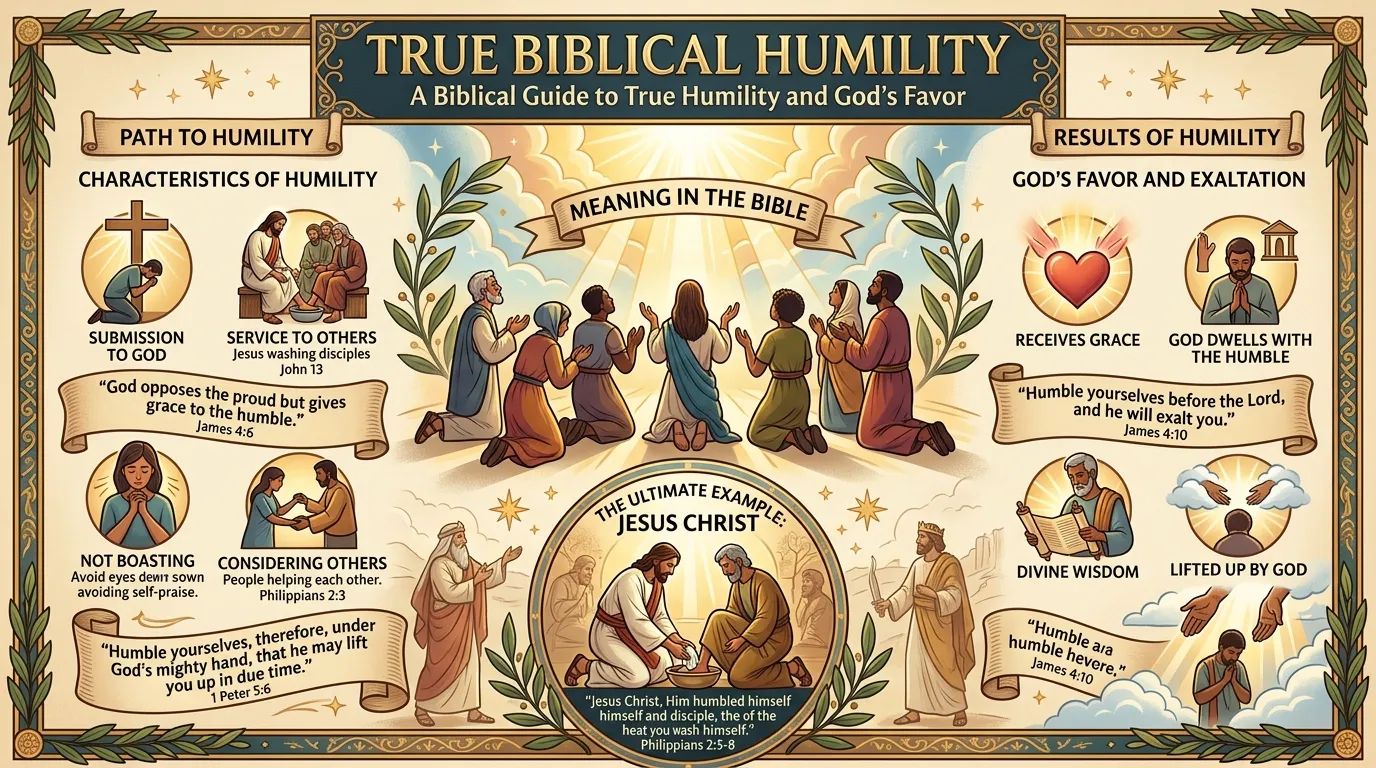
The Bible’s teaching on humility has a center, and the center is a person. Before we talk about Moses being “very meek,” or Mary’s lowliness, or the Proverbs about pride going before a fall, we need to look at Philippians 2 — the passage the early church sang, the pattern every other example follows. “Have this mind among yourselves, which is yours in Christ Jesus, who, though he was in the form of God, did not count equality with God a thing to be grasped, but emptied himself, by taking the form of a servant.”
This is the Christian definition of humility: not thinking less of yourself, but thinking of yourself less — because you are thinking of others more. It is not self-hatred. It is self-forgetfulness, modeled by the God who washed feet. Everything else the Bible says about humility is commentary on this.
The Descent: From Heaven to a Towel
Trace the descent in Philippians 2 and feel its steepness. He was in the form of God — the eternal Son, worshiped by angels, lacking nothing. He emptied Himself — not of deity, but of its privileges, its visible glory, its exemption from suffering. He took the form of a servant — the lowest social category in the ancient world. He was born in the likeness of men — fragile, hungry, tired. He humbled Himself by becoming obedient to the point of death — the servant now a victim. Even death on a cross — the most shameful death Rome had invented.
Each step down is voluntary. That is what makes it humility rather than humiliation. Humiliation is being brought low against your will. Humility is going low on purpose, for the sake of others. Jesus was not demoted. He descended. And the descent had a direction: it was always toward people — toward the manger, toward the lepers, toward the cross, toward us.
Then comes the turn: “Therefore God has highly exalted him.” The exaltation is God’s doing, not Christ’s grasping. This is the Bible’s unbreakable pattern: whoever humbles himself will be exalted, and whoever exalts himself will be humbled. The order cannot be reversed. Grasping never leads to glory. Only the descent does.
Moses: Meekness as Strength Under Control
The Old Testament’s great example is Moses, of whom Numbers says he “was very meek, more than all people who were on the face of the earth.” The statement is startling because Moses does not look meek. He confronts Pharaoh, smashes the tablets, orders executions after the golden calf. Meekness in Scripture is not softness. It is strength under control — power surrendered to God’s direction.
Moses’ meekness shows most clearly when his own position is threatened. When Miriam and Aaron challenge his authority, Moses does not defend himself; God does. When the people want to replace him, he falls on his face and intercedes for them. When God offers to destroy Israel and start over with Moses’ descendants, Moses refuses — pleading for the very people who have made his life miserable. That is meekness: the refusal to use power for self-protection, the willingness to spend it for others.
The Hebrew word for meekness, anavah, is related to the word for “afflicted” and “poor.” The meek are those who know their need. Moses knew his: he began his ministry protesting his inadequacy — “Who am I?” — and he ended it with the same awareness. Forty years of miracles did not cure him of dependence. That is why he could lead without domineering. He never forgot who was actually in charge.
Mary’s Lowliness and the Great Reversal
Mary’s Magnificat is the Bible’s great song of humility’s reward: “He has brought down the mighty from their thrones and exalted those of humble estate.” Mary knew she was lowly — she says so herself — and she knew exactly what God does with lowliness. He does not merely comfort it. He chooses it as His instrument.
The pattern runs through the whole Bible. God chooses Abel over Cain, Jacob over Esau, Joseph the dreamer over his older brothers, David the youngest over seven strapping siblings, Gideon the least in his family, the shepherds over the priests. The Bible is almost monotonous on this point: God resists the proud and gives grace to the humble. It is not that He dislikes the qualified. It is that qualification so easily becomes self-reliance, and self-reliance is the one thing grace cannot work with.
This is why humility is not optional equipment for the Christian life. It is the necessary condition for receiving anything from God. Pride is the only disease that makes you sicker while convincing you that you are well. Humility is the admission that opens the door to every other grace.
Pride: The Opposite That Explains
Humility is best understood against its opposite, and the Bible’s portraits of pride are unsparing. Isaiah gives us the archetype in the taunt against the king of Babylon — words the church has long read as describing Satan’s fall: “You said in your heart, ‘I will ascend to heaven… I will make myself like the Most High.'” Five “I wills,” each one a grasping. Pride is the attempt to ascend; humility is the willingness to descend. They are movements in opposite directions, and they end in opposite places: “But you are brought down to Sheol.”
The historical examples march through Scripture like warnings. Uzziah, blessed and successful, grows proud and enters the temple to burn incense — a priest’s task — and leaves a leper. Nebuchadnezzar surveys Babylon and says, “Is not this great Babylon, which I have built?” — and spends seven years eating grass like an ox until he learns that “the Most High rules the kingdom of men.” Herod accepts the crowd’s cry, “The voice of a god, and not of a man!” — and is struck down, “because he did not give God the glory.”
The pattern never varies: pride rises, God resists, the fall comes. “God opposes the proud but gives grace to the humble” is not a proverb among proverbs. It is the operating system of the universe. Every story of pride in Scripture is the same story, and every story of humility is the same story in reverse. The Bible repeats them because we keep forgetting which direction leads to life.
What Humility Is Not
Three counterfeits need to be named, because they do great damage. First, humility is not self-hatred. The Christian who constantly denigrates herself — “I’m worthless, I’m nothing” — is not being humble. She is being inaccurate. She is worth the blood of Christ. True humility agrees with God about who you are: a sinner saved by grace, an image-bearer marred but being restored, deeply loved and deeply flawed. Self-hatred is pride wearing a mask — it keeps the focus on self, just negatively.
Second, humility is not the refusal of responsibility. Moses tried this at the burning bush — “Please send someone else” — and God was not pleased. False humility dodges callings; true humility accepts them while depending on God to fulfill them. The humble person says “I can’t, but He can through me,” and then gets to work.
Third, humility is not weakness in the face of evil. Jesus, the humblest person who ever lived, cleansed the temple with a whip and called Herod a fox. Meekness is not niceness. It is power under God’s control — which means it can be fierce when God requires fierceness. The servant who washed feet also pronounced woes on Pharisees. Humility without courage is not humility. It is cowardice.
Practicing the Descent
Paul introduces Philippians 2 with a command: “Have this mind among yourselves.” Humility is not admired from a distance. It is practiced — in the specific, unglamorous decisions of ordinary days. What does the practice look like?
It looks like listening more than speaking, and when you speak, asking whether the words serve the other person or yourself. It looks like receiving correction without defensiveness — the humble person can be told hard truths because their identity is not at stake. It looks like doing hidden work: the tasks no one notices, the service no one applauds. It looks like refusing to grasp — for credit, for position, for the last word — and trusting God with the exaltation, in His time.
Above all, it looks like the towel. On the night before the cross, Jesus “rose from supper… and began to wash the disciples’ feet.” The Creator washing the creature’s dirt. Peter protested, and Jesus insisted. Then He said, “If I then, your Lord and Teacher, have washed your feet, you also ought to wash one another’s feet.” The command has never been rescinded. Somewhere today there is a foot — a need, a mess, a person beneath your dignity — waiting for someone humble enough to kneel.
The virtue itself, in its philosophical and religious dimensions, is explored in the study of humility across traditions — but its Christian meaning will always be measured by the distance from heaven’s throne to the foot-washing basin.










