Imagine opening the Bible and seeing ages that seem almost impossible today. Adam lived 930 years. Methuselah lived 969 years. Noah lived 950 years. These numbers can make us stop and ask, “Why did people in the Bible live so long? What does it mean?”
The ages of biblical patriarchs meaning in the Bible is not only about very long lives. These ages are part of the story of creation, sin, family, judgment, faith, and God’s plan for humanity.
Genesis gives careful details about the lives of early people. Their ages help us follow family lines from Adam to Noah and later generations. The numbers also show a major change in human life before and after the Flood.
For Christians, these passages invite us to think about the value of life and the faithfulness of God. They remind us that God works through generations. One person may begin something that another person continues many years later.
The Bible does not give one simple symbolic meaning for every number. So, we should be careful not to turn every age into a hidden code. The best place to begin is with what Scripture actually says.
Let us look at the biblical meaning, language, spiritual lessons, and possible interpretations of these remarkable ages.
Biblical Meaning of the Ages of Biblical Patriarchs
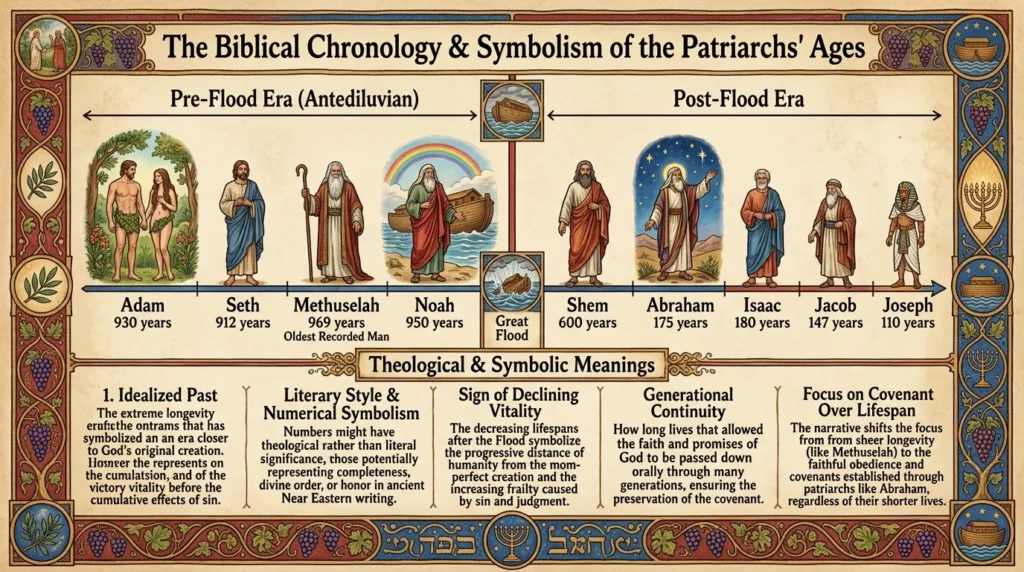
The biblical meaning of the ages of the patriarchs begins in the book of Genesis. Genesis 5 gives a genealogy from Adam through Noah. Along with each person’s name, the text often tells us how old he was when he became the father of the next generation and how long he lived.
These numbers help establish a clear family line.
The Ages Listed in Genesis
Here are the ages recorded for several early patriarchs:
| Biblical Patriarch | Age at Death | Main Scripture |
|---|---|---|
| Adam | 930 years | Genesis 5:5 |
| Seth | 912 years | Genesis 5:8 |
| Enosh | 905 years | Genesis 5:11 |
| Kenan | 910 years | Genesis 5:14 |
| Mahalalel | 895 years | Genesis 5:17 |
| Jared | 962 years | Genesis 5:20 |
| Enoch | 365 years | Genesis 5:23 |
| Methuselah | 969 years | Genesis 5:27 |
| Lamech | 777 years | Genesis 5:31 |
| Noah | 950 years | Genesis 9:29 |
Methuselah is the oldest person whose age is directly stated in the Bible. He lived 969 years according to Genesis 5:27.
But Enoch is different. Genesis 5:24 says that Enoch “walked with God” and that God took him. His life is therefore presented in a special way.
This teaches an important spiritual truth: the Bible focuses not only on how long someone lived, but also on how that person walked with God.
Long Life and God’s Blessing
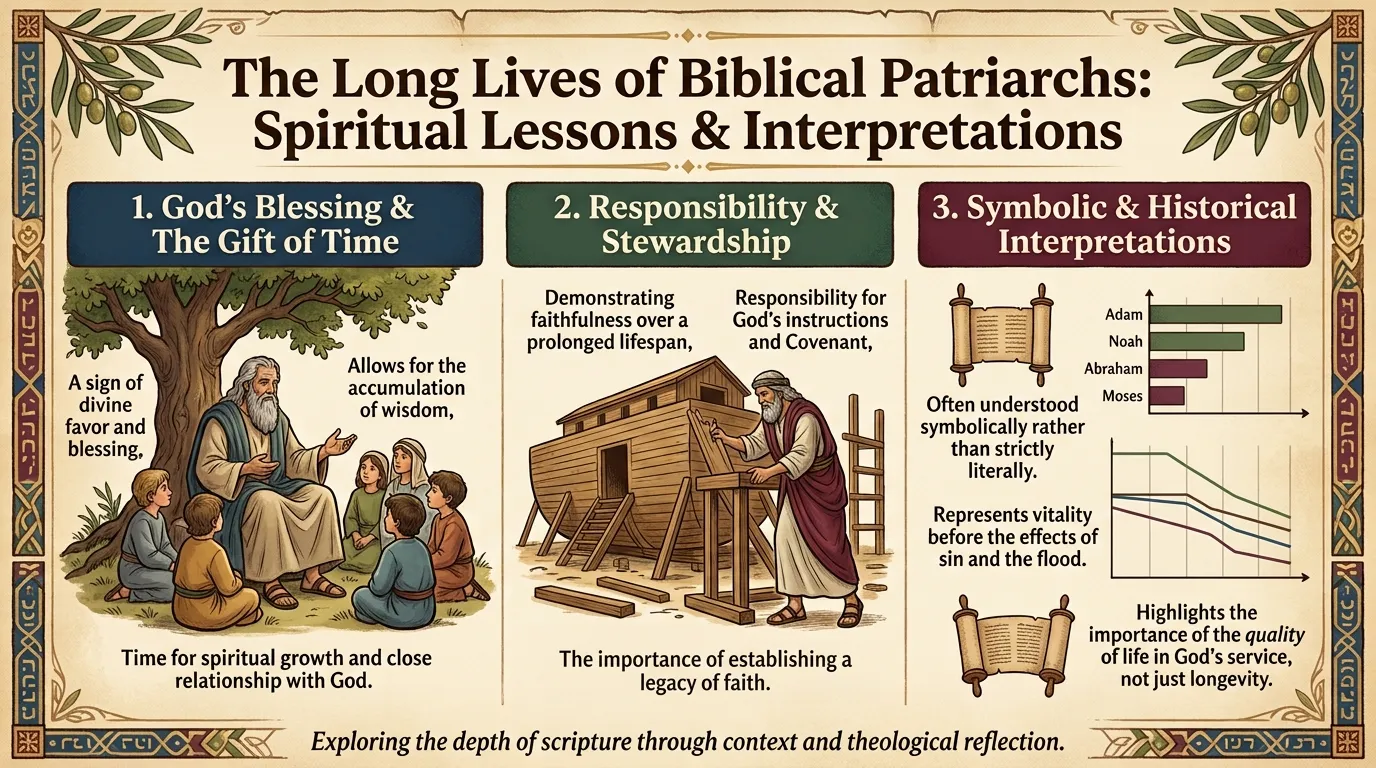
In the early chapters of Genesis, very long life appears repeatedly. Some readers understand this as showing God’s blessing and the strength of human life in the early world.
Genesis 1:28 records God’s blessing on humanity and His command to be fruitful and multiply. Life is presented as a gift from God.
However, the Bible does not say that every person who lived a long life was more righteous than someone who lived a shorter life. Long life should not automatically be viewed as proof of greater faith.
The story of Enoch makes the point especially clear. His most important description is not his age. It is that he walked with God.
The Ages Also Show the Passing of Generations
Genesis 5 repeatedly moves from one generation to another. Adam had Seth. Seth had Enosh. Enosh had Kenan. The family line continues until Noah.
The ages help readers see the long movement of history.
This can remind Christians that God’s work often takes place across generations. Faith is not always about seeing the whole story at once.
A parent may pray for a child. A grandparent may teach Scripture to a grandchild. A believer may plant seeds of faith that another generation will later grow.
The genealogies remind us that God sees the whole story.
A Change After the Flood
The Bible later shows a gradual reduction in the recorded ages of the patriarchs.
Noah lived 950 years according to Genesis 9:29. His son Shem lived 600 years, according to Genesis 11:10–11. Later generations lived shorter lives.
Abraham lived 175 years (Genesis 25:7). Isaac lived 180 years (Genesis 35:28). Jacob lived 147 years (Genesis 47:28). Joseph lived 110 years (Genesis 50:26).
By the time we reach Psalm 90, Moses writes:
“The days of our years are threescore years and ten; and if by reason of strength they be fourscore years.”
Psalm 90:10 gives 70 or 80 years as a general picture of human life in that setting.
The Bible therefore presents a striking contrast between the extraordinary ages in Genesis 5 and the much shorter lifespan familiar later in Scripture.
Genesis 6:3 and the 120 Years
Genesis 6:3 says that God declares, “his days shall be an hundred and twenty years.”
Some Christians understand this as a limit placed on human lifespan. Others understand it as referring to the time remaining before the Flood.
The passage is not explained in a way that settles every question for modern readers. Therefore, it is wise not to claim more than Scripture says.
The larger message is clear: human life is limited, God is sovereign, and people are accountable to Him.
Ages of Biblical Patriarchs Hebrew Meaning
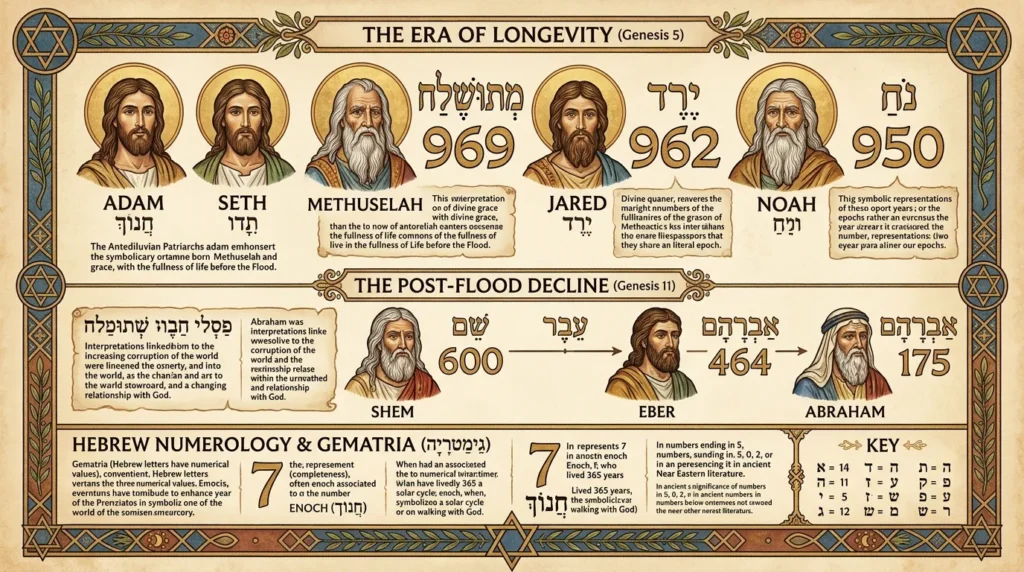
There is no single Hebrew word that means “the ages of biblical patriarchs.” This phrase is a modern English description of the ages recorded in the genealogies.
The main Hebrew word used for year is שָׁנָה, commonly transliterated as shanah. Its plural form is שָׁנִים (shanim).
Genesis uses this language when giving the ages of people.
For example, Genesis 5 repeatedly describes how many years a person lived. The wording connects a person’s age with the passing of years and generations.
The word shanah is connected with the ordinary biblical concept of a year or the cycle of time. It does not itself carry a secret meaning such as immortality or supernatural power.
The Hebrew Bible also uses terms related to fathers and ancestors. The Hebrew word אָב (av) means father, while אָבוֹת (avot) means fathers or ancestors. The English term “patriarch” comes from a later way of describing important fathers or ancestors in biblical history.
This distinction matters for Bible study.
There is no special Hebrew word saying that the great age of a patriarch has a hidden spiritual code. The safest interpretation comes from reading the ages in their context.
The Hebrew wording shows that Genesis is intentionally recording the passing of years. These numbers are part of the genealogy and history presented by the biblical writer.
Spiritual Significance and Symbolism
What is the spiritual meaning of the ages of biblical patriarchs?
One important lesson is the value of life.
The early genealogies show generation after generation receiving life, having children, growing old, and eventually dying. Even people who lived hundreds of years did not escape death, with Enoch being the notable exception described as being taken by God.
This can remind us that earthly life is temporary.
God Works Through Generations
The patriarchs also teach us about generational faith.
God’s promises did not depend on only one person’s lifetime. His story moved from Adam to Seth, from Seth to later generations, and eventually to Noah and beyond.
Your life may also be one part of a much larger story.
You may not see every result of your prayers. You may not know how your kindness will affect another person. But Scripture shows that God can work through generations.
Enoch Shows That Walking With God Matters
Enoch is perhaps the strongest spiritual example in this genealogy.
Genesis 5:24 says:
“And Enoch walked with God: and he was not; for God took him.”
Enoch lived 365 years, much less than Methuselah’s 969 years. Yet Scripture gives Enoch a special place because of his relationship with God.
This gives us a powerful lesson:
A long life is not the highest measure of a meaningful life. Walking with God is.
The Numbers Also Point to Human Mortality
The ages may seem enormous to us, but every life eventually reached an end except for the special case of Enoch.
This connects with James 4:14, which compares human life to a vapor that appears briefly and then disappears.
The lesson is not meant to make us afraid. Instead, it can help us live with wisdom, gratitude, and purpose.
Biblical Interpretations in Dreams or Real Life
Sometimes people notice the ages of biblical patriarchs in a dream, Bible study, sermon, conversation, or personal experience and wonder whether the number has a special message.
Christian dream interpretation should begin with caution. The Bible does not teach that every number seen in a dream has a fixed spiritual meaning.
For example, seeing 969 does not automatically mean that Methuselah’s age is a personal prophecy. Seeing 930 does not necessarily mean that Adam’s age is a message from God.
Context matters.
If a biblical age keeps appearing in your thoughts, you can use it as an opportunity for prayer and reflection. Ask questions such as:
- What does this passage teach me about God?
- Am I thinking about the purpose of my life?
- Do I need to trust God’s timing?
- Is God calling me to grow in faith?
- What can I learn from the life of the person connected to this number?
Dreams may reflect memories, emotions, fears, hopes, and things we have recently read or heard. Therefore, Scripture should remain the foundation of Christian discernment, rather than numbers alone.
Practical Lessons and Faith Insights
The ages of the biblical patriarchs can teach simple lessons for daily life.
Value your life. Every year is a gift.
Trust God’s timing. God’s work can continue beyond one generation.
Focus on faithfulness. Enoch’s example shows that walking with God matters more than impressive numbers.
Read Scripture in context. Do not create meanings that the Bible does not give.
Pray for wisdom. When something deeply touches your heart, bring it to God instead of rushing to a conclusion.
Bible Verses About the Ages and Lives of the Patriarchs
Several passages are especially helpful when studying this topic.
Genesis 5:5
Genesis records that Adam lived 930 years and then died.
This begins the repeated pattern of long life followed by death in the genealogy.
Genesis 5:24
“And Enoch walked with God: and he was not; for God took him.”
This verse shifts attention from age to relationship with God.
Genesis 5:27
Methuselah is recorded as living 969 years, making him the oldest person whose age is directly stated in Scripture.
Genesis 9:29
Noah lived 950 years.
His life connects the world before the Flood with the generations that followed.
Psalm 90:10
Psalm 90 gives a much shorter general picture of human life, describing seventy years, or eighty with strength.
Together, these passages encourage us to think about life, mortality, wisdom, and God’s presence.
What Do the Patriarchs’ Ages Mean for Christians Today?
The Bible does not tell us to chase a long life simply because the early patriarchs lived for centuries.
Instead, their stories can lead us to deeper questions.
How am I using the time God has given me?
Am I walking with God?
Am I building faith that can bless another generation?
Do I trust God’s plan even when I cannot see the whole story?
These are more important questions than trying to discover a secret meaning in every number.
The ages of the patriarchs show us a God who works through time, families, generations, promises, and human history.
They also remind us that our days are precious.
Frequently Asked Questions
Why did the biblical patriarchs live so long?
Genesis records extremely long lifespans for many people before the Flood. The Bible does not give a complete scientific explanation for these ages. Christians understand these passages in different ways, but the text clearly presents the ages as part of the early biblical history.
Who was the oldest person in the Bible?
Methuselah is the oldest person whose age is directly recorded. Genesis 5:27 says he lived 969 years.
What does Enoch’s age mean in the Bible?
Enoch lived 365 years, but his most important description is that he walked with God. His story shows that spiritual faithfulness is more important than simply having a long life.
Does the number 969 have a special biblical meaning?
The Bible does not give a symbolic meaning for the number 969. It is recorded as Methuselah’s age. It is better to understand the number in its biblical context than to assign it a hidden meaning.
What is the spiritual meaning of the patriarchs’ long lives?
They can remind Christians of God’s sovereignty, the value of life, generational faith, human mortality, and the importance of walking with God. These are biblical lessons rather than fixed meanings assigned to every age.
Does the Bible say humans should live for 120 years?
Genesis 6:3 mentions 120 years, but Christians interpret this verse in different ways. Some understand it as a lifespan limit, while others understand it as referring to the period before the Flood. The passage should be read carefully in its wider context.
Conclusion
The ages of biblical patriarchs meaning in the Bible is ultimately about more than numbers. Genesis records these long lives to show the movement of generations and the unfolding story of God’s work.
Their ages remind us that life is a gift, time is precious, and God’s purposes can reach across generations. Enoch reminds us that walking with God matters more than the number of years we live.
If a biblical age catches your attention, take it as an invitation to open Scripture, pray, and seek God’s wisdom. Your life may be shorter than the patriarchs’ lives, but it can still be full of faith, purpose, love, and hope in God.