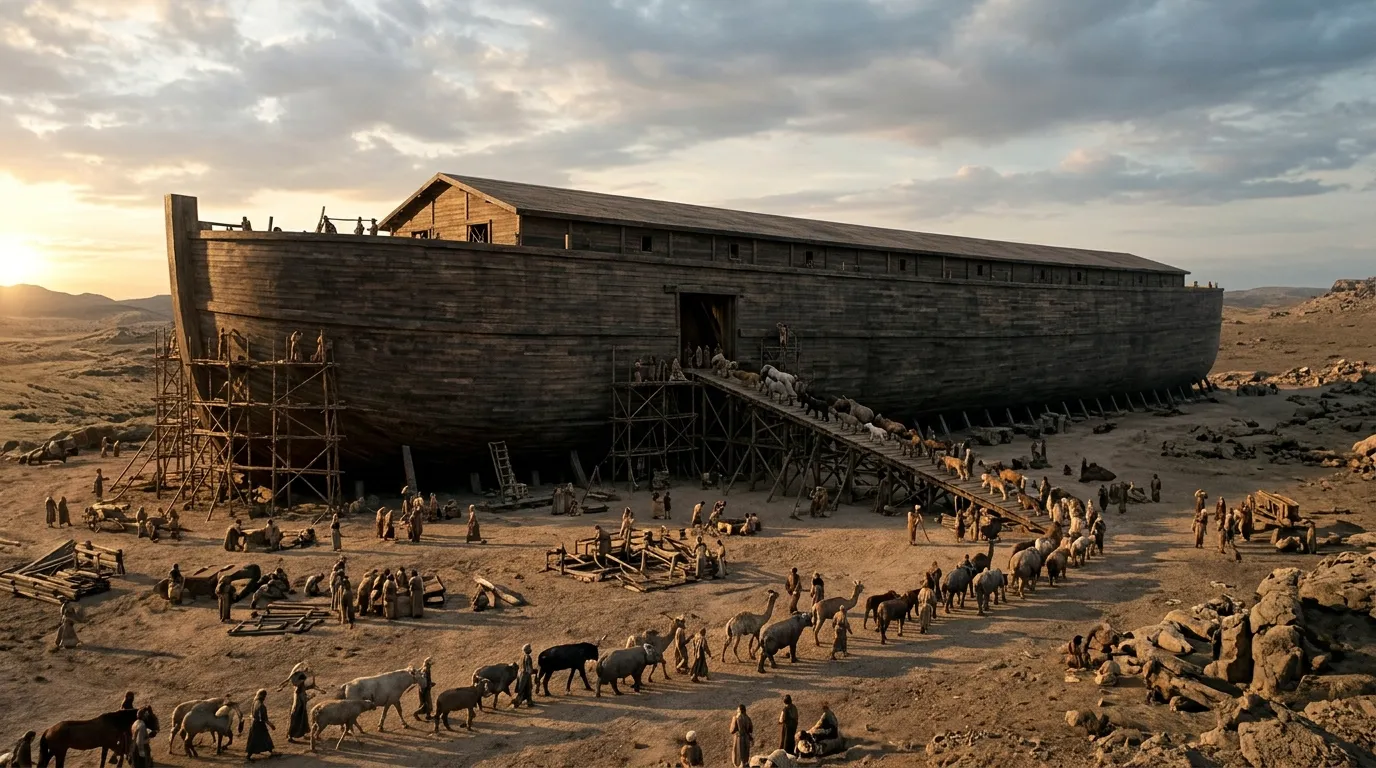
Most stories in Genesis give few measurements. Noah’s ark is the exception. Genesis 6:15 records its dimensions with the precision of a shipbuilder’s blueprint: three hundred cubits long, fifty cubits wide, and thirty cubits high. The passage goes on to specify three decks, a roof, a door in the side, and a covering of pitch inside and out. No other object in the early chapters of Genesis is described with such care. The numbers are there for a reason. They tell us that the ark was not a mythical box or a symbolic image. It was a vessel, designed by God, built by Noah, and sized for a purpose.
The first thing to understand about the measurements is the cubit. A cubit was the length of a man’s forearm, from the elbow to the tip of the middle finger — roughly eighteen inches, or about forty-five centimetres. Using that standard, the ark was approximately 450 feet long, 75 feet wide, and 45 feet high. That is longer than a football field, wider than a city bus is long, and as tall as a four-storey building. For a wooden vessel built in the ancient world, it was enormous — larger than any wooden ship known to have been built until the nineteenth century.
The Shape: A Barge, Not a Boat
The proportions of the ark are as revealing as its size. The ratio of length to width is six to one, which is the ratio that modern naval architects recognise as ideal for stability. A vessel with those proportions does not need to be steered or propelled. It rides out the waves. The ark had no sail, no rudder, no oar, and no keel. It did not need them, because it was not meant to go anywhere. It was meant to float, to survive, and to wait. Its shape was that of a barge or a chest — the Hebrew word for ark, tevah, is the same word used for the basket in which baby Moses was placed on the Nile. Both were containers that carried life through water by God’s protection rather than by human navigation.
The height of thirty cubits, divided into three decks, gives the ark a volume that is difficult to grasp without calculation. Its total capacity was roughly 1.4 million cubic feet, equivalent to about 570 standard railroad boxcars or roughly 450 semi-trailers. Even allowing for the space taken up by the structure itself, the ark had room for tens of thousands of animals, along with food for a year and living quarters for eight people. The dimensions are not decorative. They are the reason the story is physically plausible: the vessel God specified was large enough for the cargo He assigned to it.
The three decks also deserve attention. The ark was not a single open hold. It had three levels, which would have allowed Noah to separate animals by kind, size, or temperament, and to store food separately from living quarters. The roof, with an opening for light and air along the top, provided ventilation. The single door in the side meant that there was one way in and one way out — a detail that later readers have seen as a picture of salvation, with one door through which all must enter.
The Cubit Question and the Size Debate
Readers sometimes wonder whether the cubit used for the ark was the standard eighteen-inch cubit or a longer royal cubit of about twenty to twenty-one inches. If the longer measure was used, the ark would have been over 500 feet long, larger still. The Bible does not specify which cubit Noah used, and the difference does not change the meaning of the passage. Either way, the ark was a vessel of staggering size for its time, built by a man who had no shipyard, no crew, and no precedent.
That last point is worth pausing over. Noah was not a shipbuilder. He was a man described as righteous and blameless among the people of his time, who walked faithfully with God. When God gave him the dimensions, He was asking a farmer — or whatever Noah’s trade was — to build the largest wooden vessel in history, in a place where there was no sea, in preparation for a flood that no one had ever seen. The size of the ark is therefore a measure of Noah’s faith as much as of God’s engineering. Obedience on that scale required believing that the One who gave the measurements knew what He was doing.
The dimensions also answer the sceptic’s question about whether the ark could have worked. Modern naval engineers who have studied the proportions have concluded that a vessel of this shape and size would have been remarkably stable in rough seas, capable of withstanding waves far larger than any recorded. The ark’s design has been tested in wave tanks and in computer simulations, and the results consistently show that it would have ridden out a catastrophic flood without capsizing. The Bible’s ship, designed thousands of years before naval architecture existed as a science, turns out to be seaworthy.
Pitch, Gopher Wood, and the Details of Construction
Genesis specifies that the ark was made of gopher wood and covered with pitch inside and out. Gopher wood is not a species that modern readers can identify with certainty. It may be a transliteration of a Hebrew word for a resinous wood, possibly cypress or cedar. Whatever it was, it was a wood suited to the task, strong and resistant to water. The pitch — a tar-like substance — sealed the joints and made the vessel watertight. The Hebrew word for pitch is the same root as the word for atonement, the covering of sin. Later readers have noted the parallel: just as the pitch covered the ark and kept the waters of judgment out, so the atonement covers the believer and keeps judgment from falling on them. The ark was sealed by a covering, and salvation is still a matter of being covered.
The construction also took time. The Bible does not say exactly how long Noah spent building, but the period between God’s warning and the flood was 120 years, and the building was a major part of that period. For decades, Noah built a ship on dry land while his neighbours watched and mocked. Peter would later call him a preacher of righteousness, which suggests that the building itself was a sermon. Every plank, every coat of pitch, every cubit of length was a testimony that judgment was coming and that God had provided a way of escape. The size of the ark was part of the message: it was big enough for anyone who would enter, and its open door was an invitation that the world declined.
The Ark and the Tabernacle: Measured Dwellings
The ark is the first of several structures in the Bible that God measured. The tabernacle, the temple, and the New Jerusalem are all given exact dimensions, and in each case the measurements declare that God’s dwelling place is designed by God, not by human imagination. The ark belongs in that company. It was a floating sanctuary, a place where God preserved life through judgment, and its measurements were part of its holiness.
The parallels are instructive. The tabernacle was measured in cubits, just as the ark was. The temple was measured in cubits. The New Jerusalem is measured in stadia, but the principle is the same: God’s house is built to His specifications. The ark’s dimensions thus place it in a long line of God-measured dwellings, each of which foreshadows the final dwelling place where God will live with His people forever. The ark was the first of those dwellings, and it carried the promise of the last.
What the Dimensions Declare About God
The size of Noah’s ark ultimately says more about God than about carpentry. A God who gives exact dimensions is a God who cares about details. A God who specifies three decks, a roof, and a door is a God who plans thoroughly. A God who builds a vessel large enough for every kind of creature is a God whose mercy is wider than human expectation. The ark was not a minimal rescue. It was a generous one, sized to save far more than Noah’s family alone.
The ark’s dimensions also point forward. The tabernacle, the temple, and the New Jerusalem are all given exact measurements in Scripture, and in each case the measurements declare that God’s dwelling place is designed by God, not by human imagination. The ark belongs in that company. It was the first of God’s measured dwellings, a floating sanctuary in which life was preserved through judgment. The door in its side, the pitch that sealed it, and the dimensions that stabilised it all point to a God who saves by design, not by accident. For a survey of how the ark’s size has been studied and debated, the cubit article explains how this ancient measure worked and why the ark’s proportions matter.










