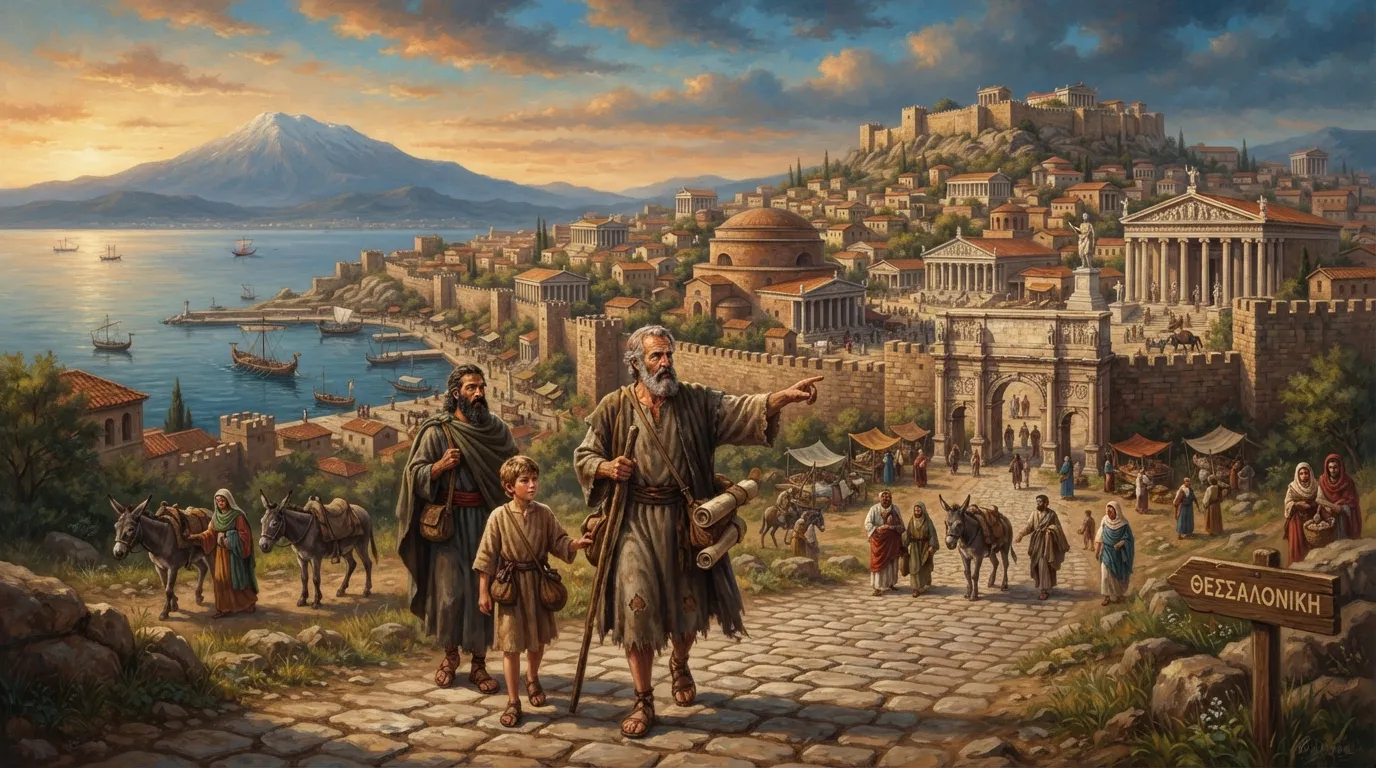
Thessalonica was the largest city Paul had yet entered in Europe — a bustling port on the Via Egnatia, the great Roman road that stitched the empire together. When Paul, Silas, and Timothy arrived there from Philippi, they were carrying fresh wounds from a beating and a prison cell, and they were about to plant one of the most beloved churches in the New Testament. The journey to Thessalonica, told in Acts 17:1–10, is a story of strategy, suffering, opposition, and surprising fruitfulness. It shows how the gospel advances through cities: not by accident, but by deliberate engagement with the Scriptures, the marketplace, and the synagogue — and not without cost.
The Road from Philippi
Paul’s team traveled from Philippi through Amphipolis and Apollonia to Thessalonica, a journey of roughly a hundred miles along the Via Egnatia. Luke compresses the travel into a single sentence, but the reality behind it matters: Paul arrived in Thessalonica limping. In Philippi, he and Silas had been stripped, beaten with rods, and thrown into prison with their feet in stocks (Acts 16:22–24). The earthquake, the jailer’s conversion, and their release had followed, but the bruises would still have been fresh. Paul later reminded the Thessalonians that “we had previously suffered and been treated outrageously in Philippi” (1 Thessalonians 2:2). He did not arrive as a triumphant conqueror. He arrived as a wounded man with a gospel he could not keep quiet.
The team’s route was strategic. Thessalonica was the capital of Macedonia, a free city with a large population, a busy harbor, and a significant Jewish community with a synagogue. Paul’s pattern was to go to the synagogue first — not because the gospel was only for Jews, but because the synagogue was where the Scriptures were known, where God-fearing Gentiles gathered, and where the case for Jesus as Messiah could be argued from the text his hearers already trusted.
Three Sabbaths of Reasoning
“As was his custom, Paul went into the synagogue, and on three Sabbath days he reasoned with them from the Scriptures, explaining and proving that the Messiah had to suffer and rise from the dead” (Acts 17:2–3). The verbs matter: reasoning, explaining, proving. Paul did not simply announce. He argued. He opened the Scriptures — the Law, the Prophets, the Psalms — and showed that the Messiah’s suffering was not an embarrassment to be explained away but a fulfillment to be embraced. Isaiah 53, Psalm 22, Psalm 16, and the whole pattern of the rejected and vindicated righteous one pointed to a suffering, dying, rising Messiah. “This Jesus I am proclaiming to you is the Messiah,” Paul said.
Three Sabbaths suggests about three weeks of sustained synagogue teaching, though Paul’s stay in Thessalonica may have been longer — Philippians 4:16 records that the Philippians sent him aid more than once while he was there, and 1 Thessalonians 2:9 describes him working night and day to support himself. Paul was not a hit-and-run preacher. He stayed, worked, taught, and built relationships. The church in Thessalonica was born from patient, text-driven, self-supporting labor.
Who Believed — and Who Did Not
The response was mixed, as it always is. “Some of the Jews were persuaded and joined Paul and Silas, as did a large number of God-fearing Greeks and quite a few prominent women” (Acts 17:4). The phrase “God-fearing Greeks” refers to Gentiles who had attached themselves to the synagogue without fully converting to Judaism. They were spiritually hungry and theologically prepared. The prominent women — a detail Luke includes repeatedly — suggest that the gospel reached the city’s upper social strata as well as its working people.
But other Jews were jealous. They rounded up “some bad characters from the marketplace,” formed a mob, and started a riot. They attacked the house of Jason, where Paul and Silas were staying, and dragged Jason and other believers before the city officials. The charge was political: “These men who have caused trouble all over the world have now come here… They are all defying Caesar’s decrees, saying that there is another king, one called Jesus” (Acts 17:6–7). The charge was a distortion — Jesus is indeed King, but His kingdom does not compete with Caesar’s in the way the mob implied — and it was effective. The city was thrown into turmoil. Jason was forced to post bond, and that night the believers sent Paul and Silas away to Berea.
The Letter That Followed
Paul’s concern for the young church did not end at his departure. He sent Timothy back to check on them, and when Timothy returned with good news, Paul wrote 1 Thessalonians — one of the earliest letters in the New Testament, and one of the warmest. “We were delighted to share with you not only the gospel of God but our lives as well” (1 Thessalonians 2:8). The letter is full of affection, commendation, and pastoral instruction: stand firm, live holy lives, love one another, work diligently, encourage the disheartened, and hold on to hope.
Thessalonica also became the church that received the New Testament’s most concentrated teaching on the return of Christ. When believers grieved for members who had died, Paul wrote the great comfort of 1 Thessalonians 4:13–18: the dead in Christ will rise, the living will be caught up, and “we will be with the Lord forever.” The Thessalonians’ questions about the end times were answered not with charts but with comfort: the future is a person, and the person is the Lord.
Why the Journey Still Matters
The journey to Thessalonica teaches several enduring lessons. First, wounded people can still be useful. Paul’s beating in Philippi did not disqualify him from Thessalonica; it prepared him to speak about a suffering Messiah with the authority of a suffering man. Second, the gospel advances through reasoning, not manipulation. Paul argued from Scripture and let the truth do its work. Third, opposition is not a sign of failure. The riot in Thessalonica did not mean Paul had failed; it meant the gospel had landed. Fourth, the measure of a ministry is not the size of the crowd but the health of the church left behind. Paul stayed only weeks, but the church he left became a model — “you became a model to all the believers in Macedonia and Achaia” (1 Thessalonians 1:7).
Finally, Thessalonica reminds us that the gospel’s greatest fruit often grows in the shortest stays. Paul was there only a few weeks. The church lasted for generations. The seed he planted in three Sabbaths of reasoning became a letter, a legacy, and a light to the whole region. Faithfulness is measured not by the length of the stay but by the truth of the seed.
Berea: The Noble-Minded Neighbors
When Paul and Silas fled Thessalonica by night, they went to Berea, a smaller city about fifty miles away. Luke’s description of the Bereans has become famous: they “received the message with great eagerness and examined the Scriptures every day to see if what Paul said was true” (Acts 17:11). The Bereans are the model of healthy skepticism — open-minded but not gullible, eager but not uncritical. They did not accept Paul’s teaching because Paul was impressive. They checked it against Scripture.
The contrast with Thessalonica is instructive. In Thessalonica, the opposition came from people who refused to examine the evidence. In Berea, the response came from people who examined it daily. The same gospel, the same preacher, different reception — and the difference was the posture of the hearers. The Bereans show that questioning is not the enemy of faith. Unquestioning prejudice is.
The Berean example also speaks to modern believers. We live in an age of loud voices, viral claims, and confident teachers. The Berean response is still the right one: receive the message with eagerness, and examine the Scriptures daily to see if it is true. The church does not need less discernment. It needs more — discernment shaped by Scripture, practiced daily, and held with humility.
Paul’s Tentmaking: Work as Witness
Paul supported himself in Thessalonica by working “night and day,” likely at his trade of tentmaking. He refused to be a financial burden on the young church, and he modeled diligence. His tentmaking was not a distraction from ministry. It was part of it. The Thessalonians saw a preacher who worked with his hands, who did not exploit them, and who lived what he taught. In a culture that often separates sacred work from secular work, Paul’s example is a corrective: all honest work is sacred, and the way we work is part of our witness. The gospel is adorned by diligence.
For the city’s long history beyond the New Testament period, see the Wikipedia article on Thessalonica.










