“Hallowed be your name.” Those four words open the Lord’s Prayer, and they contain a lifetime of theology. When Jesus taught His disciples to pray that God’s name would be treated as holy, He was pointing to something deeper than a label. In the Bible, a name is not a tag. It is a revelation. The names of God in Scripture disclose who He is, what He does, and how He relates to His people. To know the name of God is, in a real sense, to know God.
The Bible uses many names for God — not because God has an identity crisis, but because no single name can contain Him. Each name is a window. Together they form a portrait. This article walks through the major names of God in Scripture, what each one reveals, and why the name of God still matters for prayer, worship, and daily trust.
Why Names Mattered in the Ancient World
In the world of the Bible, a name carried weight. To know someone’s name was to have access to them. To speak in someone’s name was to act with their authority. To profane a name was to dishonor the person. The third commandment — “You shall not misuse the name of the LORD your God” — is not primarily about a vocabulary rule. It is about treating God’s revealed character with the reverence it deserves. God’s name is the public form of His identity, and how we handle it reveals what we think of Him.
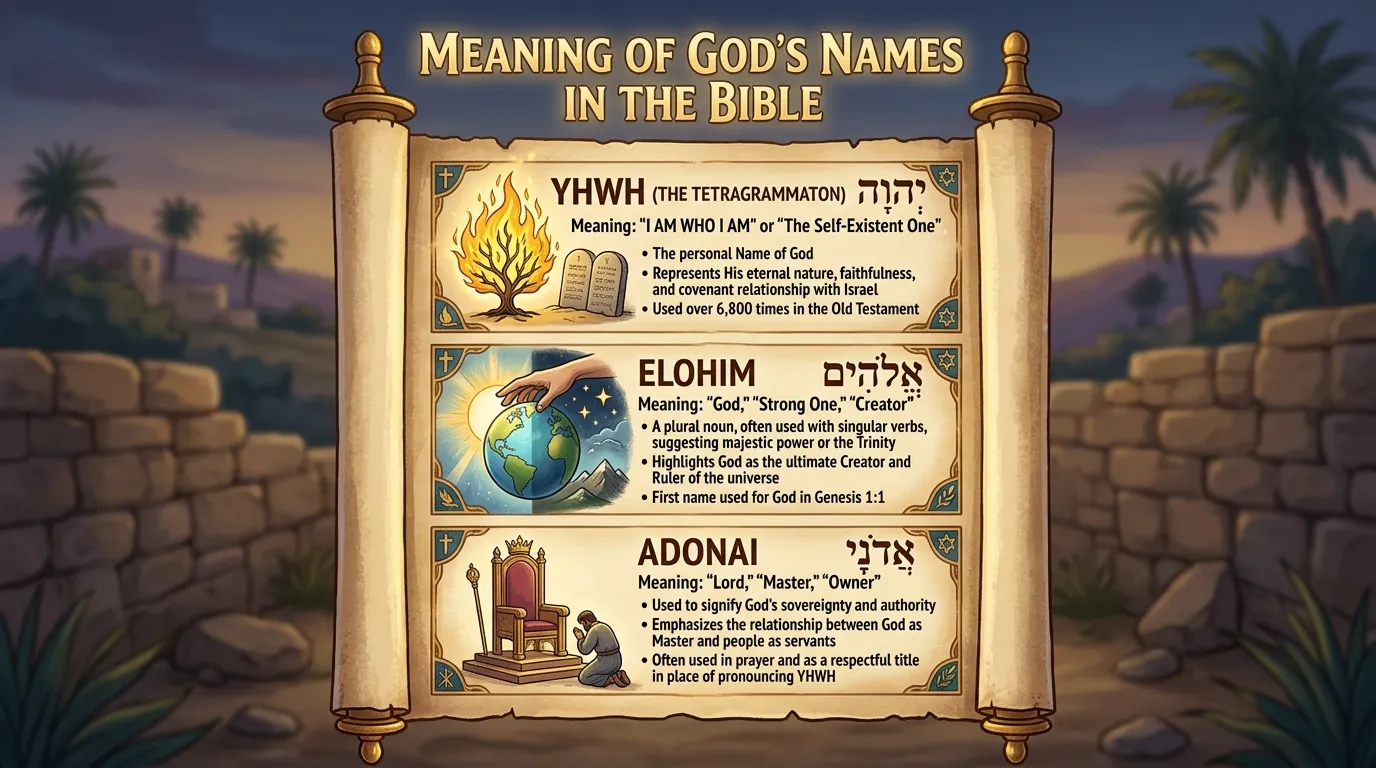
When God revealed Himself to Moses at the burning bush, Moses asked for His name. God answered, “I AM WHO I AM” (Exodus 3:14). The Hebrew is YHWH, usually rendered LORD in English Bibles. The name speaks of self-existence, faithfulness, and presence: God is, God is who He is, and God will be present with His people. It is the covenant name, the name by which God bound Himself to Israel and, through Israel, to the world.
The Names That Reveal God’s Character
Some names describe who God is in Himself. El is the ancient Semitic word for God, conveying might and transcendence. Elohim, used in Genesis 1:1, is grammatically plural with a singular verb — a form that has fascinated theologians for centuries and that Christians read as consistent with the Trinity. El Shaddai, God Almighty, speaks of all-sufficiency; it is the name by which God revealed Himself to Abraham, Isaac, and Jacob. El Elyon, God Most High, declares supremacy over all other powers. El Olam, the Everlasting God, anchors trust in a God who does not age, tire, or expire.
Other names describe what God does for His people. YHWH Jireh, “the LORD will provide,” was Abraham’s name for the place where God provided the ram (Genesis 22:14). YHWH Rapha, “the LORD who heals,” was revealed at Marah (Exodus 15:26). YHWH Nissi, “the LORD is my banner,” was Moses’s declaration after the defeat of Amalek (Exodus 17:15). YHWH Shalom, “the LORD is peace,” was Gideon’s altar (Judges 6:24). YHWH Raah, “the LORD is my shepherd,” is the confession of Psalm 23. Each compound name was born in a crisis. God’s names were not invented in a classroom. They were discovered in deserts, battles, illnesses, and impossibilities.
The Name Above Every Name
The New Testament gathers all these names into a single person: Jesus. The angel told Joseph, “You are to give him the name Jesus, because he will save his people from their sins” (Matthew 1:21). The name Jesus — Yeshua in Hebrew — means “the LORD saves.” It is the covenant name YHWH joined to the verb “to save.” In Jesus, the God who revealed Himself as provider, healer, banner, peace, and shepherd became a man and fulfilled every name in His own body.
After the resurrection, Paul declares that God “gave him the name that is above every name, that at the name of Jesus every knee should bow” (Philippians 2:9–10). The early church baptized in His name, prayed in His name, healed in His name, and died for His name. To call on the name of Jesus is to call on the whole character of God — His holiness, His mercy, His power, and His nearness — concentrated in the person of the Son.
Hallowed Be Your Name: What It Means to Honor the Name
When Jesus taught us to pray “Hallowed be your name,” He was teaching us to ask that God’s character be recognized, honored, and displayed — in the world, in the church, and in our own lives. Hallowing the name is not a ritual. It is a life. It means speaking of God truthfully, representing Him faithfully, and refusing to attach His name to what He has not authorized. It means that our use of God’s name in worship, witness, and everyday speech should match the weight of who He is.
It also means trusting the name. The Psalms are full of this trust: “The name of the LORD is a fortified tower; the righteous run to it and are safe” (Proverbs 18:10). “Our help is in the name of the LORD, the Maker of heaven and earth” (Psalm 124:8). To trust the name is to trust the person behind it. When the psalmist says, “I will praise your name,” he is not praising syllables. He is praising the God the syllables reveal.
Praying the Names
One practical way to deepen prayer is to pray through the names. When you are afraid, pray to YHWH Shalom, the God who is peace. When you are in need, pray to YHWH Jireh, the God who provides. When you are lost, pray to YHWH Raah, the Shepherd. When you are sick, pray to YHWH Rapha. When you feel small before a great task, pray to El Shaddai, the Almighty. The names are not magic formulas. They are reminders — each one a door into a different room of God’s character, and every room is open to the believer.
Above all, pray in the name of Jesus. That name carries every other name with it, because Jesus is the full revelation of God. “In the past God spoke to our ancestors through the prophets… but in these last days he has spoken to us by his Son” (Hebrews 1:1–2). The Son is the name made flesh, the character made visible, the God of Abraham, Isaac, and Jacob standing among us with nail marks in His hands.
The Name in Worship: The Psalms
Nowhere is the name of God celebrated more richly than in the Psalms. The psalmists praise the name, trust the name, call on the name, and sing of the name’s glory. “O LORD, our Lord, how majestic is your name in all the earth!” (Psalm 8:1). “Sing the praises of the LORD, enthroned in Zion; proclaim among the nations what he has done” (Psalm 9:11). “Some trust in chariots and some in horses, but we trust in the name of the LORD our God” (Psalm 20:7). The Psalms treat God’s name as a refuge, a banner, and a song.
The Psalms also show that calling on the name is the pattern of prayer in crisis. “In my distress I called to the LORD; I cried to my God for help” (Psalm 18:6). “The LORD is near to all who call on him, to all who call on him in truth” (Psalm 145:18). The name is not a formula to be manipulated. It is a person to be trusted. The psalmists did not chant syllables. They cried to a God they knew, by the name He had revealed.
For believers today, the Psalms offer a vocabulary for worship. When words fail, the Psalms give words. When feelings are flat, the Psalms carry the praise. Praying the Psalms — speaking God’s name back to Him in the words He inspired — is one of the oldest and most reliable forms of worship. The name that was hallowed in the Psalms is still holy, still majestic, and still worthy of praise.
The Name and the Mission
God’s name is not only for worship. It is for mission. The psalmist prayed, “Declare his glory among the nations, his marvelous deeds among all peoples” (Psalm 96:3). The Great Commission is given in the name of the Father, the Son, and the Holy Spirit. To bear God’s name is to carry it into the world — to speak it, to live it, to embody it. The church is the community that bears the name, and the world will judge the name by the people who carry it. That is a sobering responsibility and a glorious privilege. When we live worthy of the name, the nations see what God is like.
For a broad survey of how these names have been catalogued and understood, the Wikipedia article on the names of God in Christianity is a useful reference.










