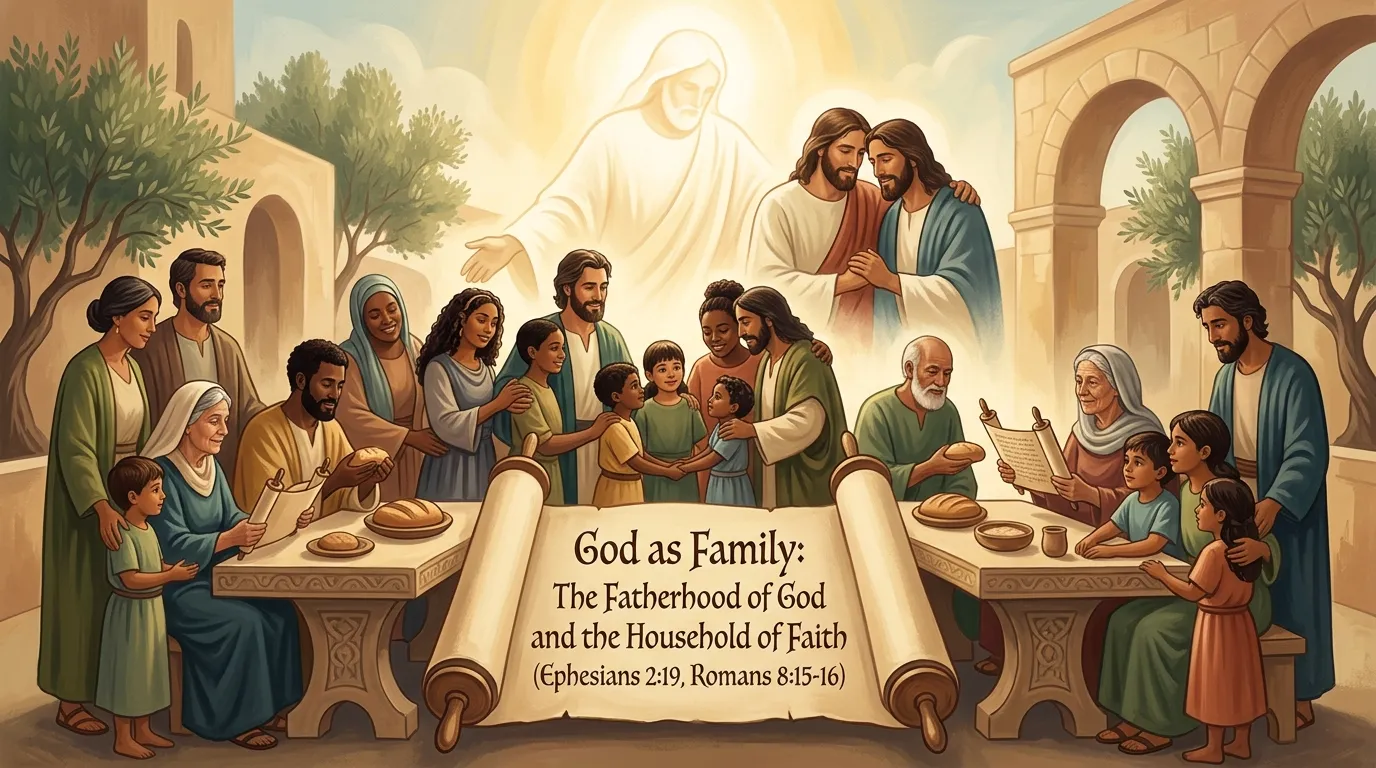
“Our Father in heaven.” The first two words of the Lord’s Prayer contain one of the most revolutionary claims in all of Scripture. The God who spoke galaxies into being, who delivered Israel from Egypt, who thunders from Sinai and whispers in the still small voice — that God invites His people to call Him Father. And the New Testament does not stop there. It describes believers as children of God, brothers and sisters of Christ, and members of a household that stretches across every nation, tribe, and tongue. God is not only a King to be obeyed or a Judge to be feared. He is a Father who has made a family.
The image of God as a family is not a sentimental metaphor layered onto a distant deity. It is the Bible’s own way of describing the deepest reality of salvation. To be saved is to be adopted. To be adopted is to be given a Father, a Brother, a Spirit, and a family. Everything else in the Christian life — obedience, holiness, mission, suffering — flows from that identity.
Israel: The First Family of God
The family language begins early. God called Israel His son: “Israel is my firstborn son” (Exodus 4:22). The covenant at Sinai was a family-making act. God did not merely give Israel laws; He gave them a name, a home, a table, and a Father. The prophets returned to this image again and again. Hosea pictured God as a father teaching Ephraim to walk, taking the child in His arms, healing him, leading him with cords of human kindness (Hosea 11:1–4). Isaiah pictured God as a father whose compassion for His children exceeds even a mother’s (Isaiah 49:15). Jeremiah pictured God weeping over His rebellious children and promising to bring them home.
Yet Israel’s story also shows the pain of a broken family. The children rebelled. The Father disciplined. The prophets warned that sonship without obedience was a hollow claim. The family image never meant that God indulged His children. A good father disciplines, and the discipline of Israel — exile, loss, chastening — was the discipline of a Father who refused to abandon His family.
Jesus: The Son Who Makes Us Children
The family image reaches its fullness in Jesus. He is the eternal Son of the Father, the beloved Son in whom the Father is well pleased (Matthew 3:17). But His sonship is not exclusive. It is inclusive. He came so that others could share it. John writes, “To all who did receive him, to those who believed in his name, he gave the right to become children of God” (John 1:12). Paul writes that God sent His Son “to redeem those under the law, that we might receive adoption to sonship” (Galatians 4:5).
Adoption in the Roman world was a powerful legal act. An adopted child received a new name, a new family, a new inheritance, and a new father — and the adoption could not be reversed. The old debts were canceled. The old family had no further claim. Paul borrows this whole legal world to describe salvation. When you trust Christ, you are not merely forgiven. You are adopted. Your debts are canceled, your name is changed, and your inheritance is secured. And the proof of adoption is the Spirit: “The Spirit you received brought about your adoption to sonship. And by him we cry, ‘Abba, Father'” (Romans 8:15). Abba is the intimate Aramaic word for father — the word Jesus Himself used in Gethsemane. The Spirit puts the Son’s own cry in our mouths.
Brothers, Sisters, and a Household
If God is our Father, then other believers are our brothers and sisters — not metaphorically, but truly. Jesus redefined family around Himself: “Whoever does God’s will is my brother and sister and mother” (Mark 3:35). The early church took this seriously. They shared meals, shared possessions, shared suffering, and called one another brother and sister hundreds of times in the New Testament letters. Paul calls Timothy his son in the faith, Philemon his brother, and the Roman believers his siblings in Christ. The church was not a club or an institution. It was a household.
Peter calls the church “God’s household” (1 Peter 4:17), and Paul calls believers “members of his household” (Ephesians 2:19). The household image carries obligations: households care for their members, correct them, feed them, shelter them, and carry their burdens. The New Testament’s “one another” commands — love one another, bear one another’s burdens, forgive one another, encourage one another — are household rules. They make no sense in a crowd of strangers. They make perfect sense in a family.
The Father’s Discipline and the Family Table
Two features of family life deserve special attention: discipline and the table. Hebrews 12 teaches that God disciplines His children because He loves them. “The Lord disciplines the one he loves, and he chastens everyone he accepts as his son.” Discipline is not rejection. It is proof of belonging. A father who never corrects his children does not love them; he has abandoned them. The hardships of the Christian life — conviction of sin, correction through Scripture, the painful consequences of foolish choices — are not signs that God has disowned us. They are signs that He is raising us.
The table is the other feature. Families eat together, and God’s family eats together too. The Lord’s Supper is a family meal, where children of the Father sit at the table of the Son and remember His death. The ancient church understood this: the Supper was not a private ritual but a household gathering. And the Supper points forward to the marriage supper of the Lamb, the great family feast at the end of history, when the whole household — every tribe, tongue, and nation — will sit down together and the Father will wipe every tear from their eyes.
What It Means to Live as God’s Family
First, it means security. Your place in the family does not depend on your performance. Adoption is a legal act, not a mood. You may grieve the Father, but you cannot un-adopt yourself. Second, it means identity. You are not defined by your failures, your family of origin, your wealth, or your reputation. You are defined by your Father. Third, it means responsibility. Children resemble their Father. Jesus said, “Be perfect, therefore, as your heavenly Father is perfect” (Matthew 5:48), and John wrote that everyone who has the hope of seeing Christ “purifies himself, just as he is pure” (1 John 3:3). Fourth, it means belonging. You are never alone. The church is not an optional extra. It is your family, given by your Father, and you need it as much as it needs you.
Finally, the family image gives us the Bible’s most beautiful picture of the future. “Now we are children of God, and what we will be has not yet been made known. But we know that when Christ appears, we shall be like him, for we shall see him as he is” (1 John 3:2). The family is not yet fully gathered. The table is not yet fully set. But the Father is waiting, the Son has prepared the way, and the Spirit is already teaching us to cry, “Abba.” One day the whole household will be home.
The Prodigal Son: The Family Story
No passage captures the family heart of God better than the parable of the prodigal son in Luke 15. A younger son demands his inheritance, squanders it in a distant country, and returns home rehearsing a speech: “Father, I have sinned against heaven and against you. I am no longer worthy to be called your son.” He expects rejection, or at best a servant’s place. What he gets is a father running to meet him, embracing him, clothing him, and throwing a feast. “For this son of mine was dead and is alive again; he was lost and is found” (Luke 15:24).
The parable is often read as a story about the son. It is really a story about the father. The father’s love is not conditioned on the son’s performance. It is not earned by the rehearsed speech. It is not withheld until the son proves himself. The father runs before the son finishes his confession. That is the heart of adoption: the Father’s love precedes our repentance, and His welcome is wider than our worthiness.
The parable also includes the older brother, who stayed home and resented the celebration. He represents the danger of a family member who lives in the house but misses the heart of the Father. He kept the rules but lost the relationship. The family of God has room for both sons — the runaway and the resentful — and the Father pursues both. The story ends with the father outside, pleading with the older son to come in. The invitation is still open.
For the theological background of this image, the Wikipedia article on God the Father traces how the doctrine developed.










