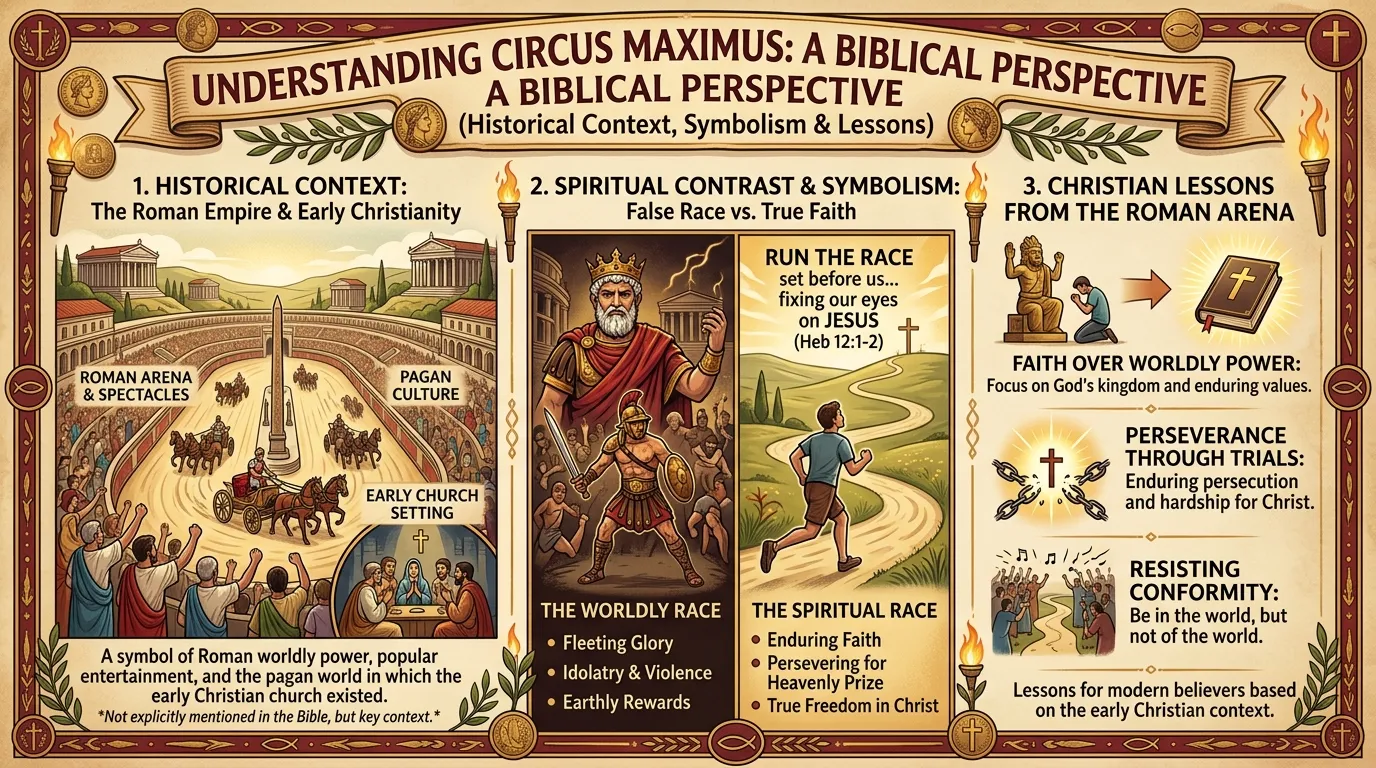
The Circus Maximus was not a circus. It was a racetrack — the largest stadium in the ancient world, a venue that could hold a quarter of a million spectators, built for chariot racing in the heart of Rome. On race days, the city stopped. Shops closed. The emperor attended. The crowds roared for their factions — the Blues, the Greens, the Reds, the Whites — with a passion that modern sports fans would recognize instantly. The Circus Maximus is not mentioned by name in the Bible. But it is part of the world the Bible was written in — the Roman world of spectacle, crowd, and glory that formed the backdrop of the New Testament. Understanding the Circus helps us understand what the apostles were up against, and what the Bible means when it talks about the world, the flesh, and the race set before us.
The arena: what the Circus Maximus was
The Circus Maximus — Latin for “greatest circus” — was a massive chariot-racing stadium in a valley between the Palatine and Aventine Hills in Rome. Its history stretches back to the early Roman kingdom, but its great stone form was built under Julius Caesar and expanded by later emperors, especially Trajan. At its peak, it was about 621 meters long and 118 meters wide, with tiered seating for an estimated 150,000 to 250,000 spectators — the largest venue for public entertainment ever built. It was the center of Roman popular culture for a thousand years.
The races were the main event. Four-horse chariots (quadrigae), driven by professional charioteers, raced seven laps around a central barrier called the spina, decorated with obelisks, statues, and the famous egg-and-dolphin lap counters. The turns were dangerous, the crashes spectacular, and the charioteers were superstars — some earned fortunes that dwarfed the salaries of senators. The factions that owned the teams — the Blues, Greens, Reds, and Whites — had fanatical followings. Riots over race results were not unknown. The Circus was Rome’s Super Bowl, its World Cup, and its gladiatorial games rolled into one — except that the athletes were horses and drivers, and the stakes were civic pride.
The Circus was also a place of imperial display. The emperor’s box, the pulvinar, overlooked the track. Processions opened the games. The emperor’s presence was part of the show. To attend the Circus was to participate in Roman identity — to be part of the crowd, to cheer for your faction, to share in the glory of the empire.
The world the apostles lived in
When Paul arrived in Rome, the Circus Maximus was already ancient — more than five centuries old. When he wrote to the Romans, the Corinthians, and the Philippians, his readers knew the Circus and the games intimately. The imagery of the New Testament is full of athletic metaphors that would have resonated with people who watched the races: “Run in such a way as to get the prize” (1 Corinthians 9:24). “I have finished the race, I have kept the faith” (2 Timothy 4:7). “Let us run with perseverance the race marked out for us” (Hebrews 12:1). The writers of the New Testament did not invent the race metaphor. They borrowed it from the world their readers lived in — a world of stadiums, crowds, and prizes.
The Circus also illustrates the Roman world’s values: glory, spectacle, competition, and crowd approval. The charioteer’s glory was public and immediate — the roar of the crowd, the palm branch, the purse of gold. The Christian’s glory, by contrast, was hidden and future — “an eternal glory that far outweighs them all” (2 Corinthians 4:17). The contrast between the two kinds of glory is one of the New Testament’s central themes. The world offers a wreath that wilts. Christ offers a crown that lasts.
The danger of living for the crowd
The Circus Maximus is a picture of the crowd’s power. A quarter of a million people, shouting together, can make any opinion feel like truth. The New Testament warns repeatedly about the danger of crowd approval. The crowd that shouted “Hosanna!” on Palm Sunday shouted “Crucify him!” on Good Friday (Mark 11:9; 15:13). The crowd that admired Paul in Lystra stoned him a few verses later (Acts 14:11–19). The crowd is fickle, and living for its approval is a trap.
Jesus warned about this directly: “How can you believe since you accept glory from one another but do not seek the glory that comes from the only God?” (John 5:44). The Pharisees, He said, loved “the place of honor at banquets and the most important seats in the synagogues” and “to be greeted with respect in the marketplaces” (Matthew 23:6–7). They were playing to the crowd. The Circus Maximus is the crowd’s temple — the place where public opinion is worshiped. The Bible’s answer is to seek the approval of God, not the applause of the stands.
Entertainment, persecution, and the martyrs
The Roman games also had a darker side. The Circus Maximus and the Colosseum were venues for public executions, including the execution of Christians. The historian Tacitus records that Nero, after the Great Fire of Rome in AD 64, blamed the Christians and had them killed as public entertainment — covered in animal skins and torn by dogs, or crucified, or set on fire to light his gardens. The crowds watched. The games turned murder into spectacle.
This is the world in which the apostles lived and died. Peter was crucified in Rome. Paul was beheaded there. The church’s first generations worshiped in a city where their faith could get them killed for entertainment. The New Testament’s call to endurance — “be faithful, even to the point of death” (Revelation 2:10) — was not abstract. It was written to people who knew that the crowd could turn from cheers to jeers, and that faithfulness might cost them their lives.
The Circus also raises a question the Bible addresses directly: what should Christians do with entertainment? The Bible does not forbid entertainment. It warns against being mastered by it. “I will not be mastered by anything” (1 Corinthians 6:12). The games of Rome were not evil because they were entertaining. They were dangerous because they shaped values — glory, violence, crowd approval, the dehumanization of the victim — that were opposed to the gospel. Christians today face the same question with their own entertainments: not “is it fun?” but “what is it forming in me?”
The factions: ancient sports tribalism
The four factions of the Circus — the Blues, Greens, Reds, and Whites — were more than racing teams. They were social identities. Fans wore their faction’s colors, sang its songs, and defended its honor in the streets. The factions had political dimensions: the Blues and Greens, in particular, became associated with social classes and political positions, and their rivalry could turn violent. In Constantinople, centuries later, the rivalry between Blues and Greens exploded into the Nika Riot of AD 532, which burned half the city and nearly toppled the emperor Justinian. The Circus was not only entertainment. It was a school of tribalism — a place where people learned to define themselves by their team and to hate the other team. The New Testament’s vision of unity — “There is neither Jew nor Gentile, neither slave nor free, nor is there male and female, for you are all one in Christ Jesus” (Galatians 3:28) — is the opposite of factionalism. The church is not a faction. It is a family.
The Circus Maximus also hosted religious processions. The games opened with a pompa — a parade of the gods’ images, carried around the track before the races began. Religion and entertainment were inseparable in Rome. To attend the games was to participate in a religious festival. Christians who refused to attend, or who attended and refused to worship, marked themselves as outsiders. The separation was costly. It is a reminder that in every age, entertainment carries a worldview, and Christians must discern whether the worldview on display honors God or opposes Him.
The race set before us
The New Testament’s athletic imagery gives Christians a better race. The race of faith is not a competition against others but a perseverance toward a goal. The prize is not a wreath but a crown of righteousness (2 Timothy 4:8). The crowd is not the spectators in the stands but the “great cloud of witnesses” — the faithful who have gone before (Hebrews 12:1). The coach is not a faction owner but Jesus Himself, “the pioneer and perfecter of faith” (Hebrews 12:2).
The Circus Maximus is now a ruin — a grassy field where Romans jog and tourists picnic. The factions are gone. The charioteers are forgotten. The roar of the crowd has faded. The race of faith, by contrast, is still being run. The church that was persecuted in Rome’s arenas outlasted the empire that built them. The glory that the Circus offered was temporary. The glory that Christ offers is eternal.
For the stadium’s history, its races, and its place in Roman life, the Wikipedia article on the Circus Maximus is an excellent reference.