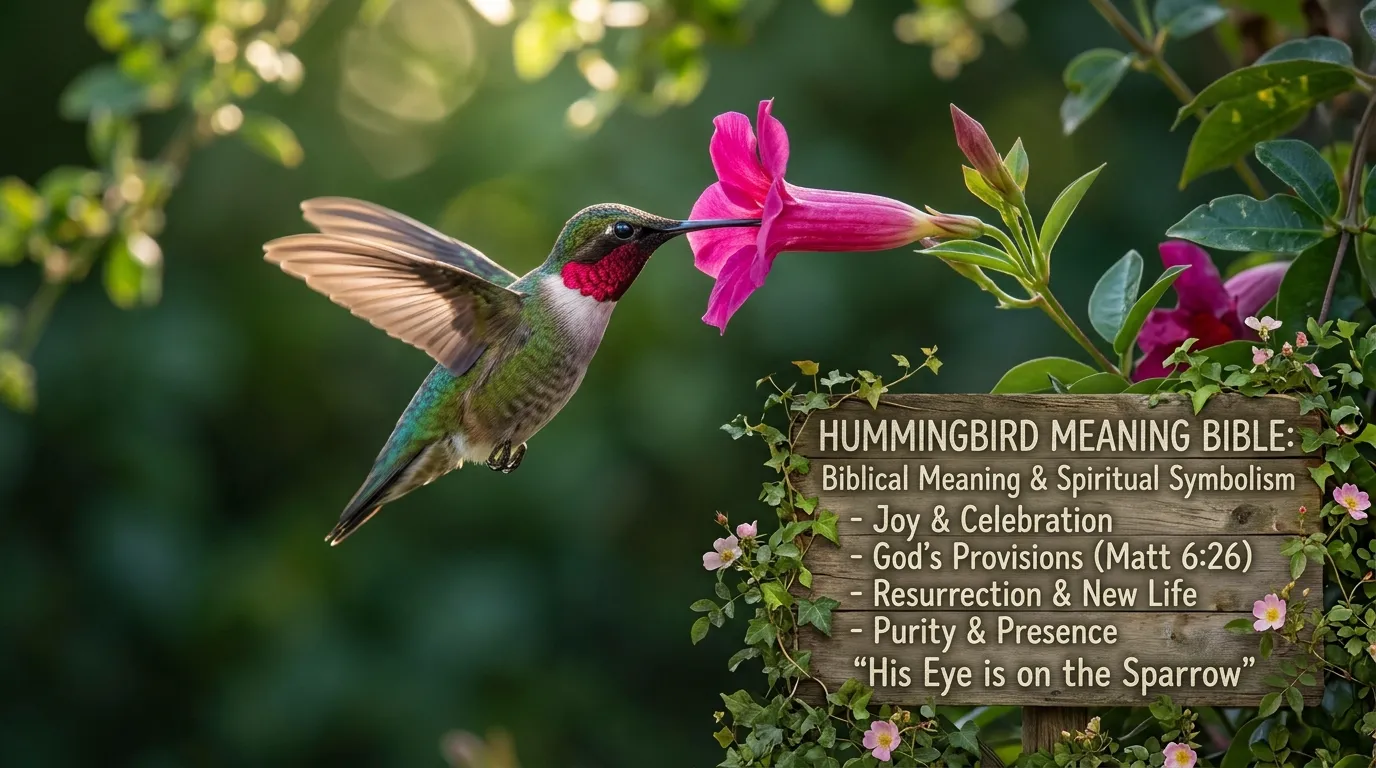
It hovers at your window, wings a blur, jewel-bright and impossibly small — there and gone in a breath. And because it came at just that moment — while you prayed, while you grieved, while you wondered — you ask the question so many have asked: did that hummingbird mean something? It’s a lovely question, and it deserves an honest answer. So here it is, stated with both warmth and clarity: hummingbirds are not mentioned in the Bible. No verse assigns them meaning. Anyone who tells you the “biblical meaning of a hummingbird sighting” is building on imagination, not Scripture. But the Bible has so much to say about birds, about creation’s testimony, and about how God speaks — that the honest answer turns out to be richer than the invented one.
Why the Honest “No” Matters
It matters because God is truth, and His people must love truth more than comfort. The hummingbird is native to the Americas; the biblical authors never saw one. To claim otherwise — or to import hummingbird symbolism from Native American spirituality or New Age dream dictionaries and label it “biblical” — is to put words in Scripture’s mouth. That may feel encouraging, but encouragement built on invention is sand, and Jesus warned about houses built on sand.
It also matters because misreading God’s communication dulls us to His real communication. If every bird becomes a coded message, we may miss the actual message — the still, small voice (1 Kings 19:12), the Scripture that is “profitable for teaching” (2 Timothy 3:16), the Spirit who guides into truth (John 16:13). God speaks clearly; we don’t need to make the creation louder than the Creator’s voice. “Test everything; hold fast what is good” (1 John 4:1) applies to spiritual impressions about birds as much as to prophecies.
What the Bible Does Say About Birds
Now the good news: Scripture’s teaching on birds is beautiful, and every bit of it applies to your hummingbird moment. Birds as recipients of God’s care: “Look at the birds of the air: they neither sow nor reap nor gather into barns, and yet your heavenly Father feeds them. Are you not of more value than they?” (Matthew 6:26). Jesus’ logic moves from lesser to greater: if God feeds them, how much more you. A hummingbird at your window can preach this sermon without a single word — you are fed, you are seen, you are valued beyond this tiny marvel.
Birds as images of God’s protection: “He will cover you with his pinions, and under his wings you will find refuge” (Psalm 91:4). “Even the sparrow finds a home… at your altars” (Psalm 84:3) — the smallest bird nested in the holiest place. If sparrows belong at the altar, then smallness is no barrier to nearness. Birds as pictures of renewal: “they who wait for the LORD shall renew their strength; they shall mount up with wings like eagles” (Isaiah 40:31). The hummingbird’s hovering — sustained, tireless, defying its size — is a living parable of strength renewed.
Birds as part of creation’s chorus: Genesis 1:20-21 records their making with divine delight — God saw the winged creatures and called them good. They were singing before we were listening. Your hummingbird is doing what it was made to do: display the Creator’s artistry. The proper response is the psalmist’s: “The heavens declare the glory of God” (Psalm 19:1) — and so, in miniature, does the hummingbird.
Creation as Testimony, Not Telegram
Here’s the crucial distinction Scripture draws: creation declares God’s glory (Psalm 19:1); it reveals His “eternal power and divine nature” (Romans 1:20). But declaration is not the same as personal messaging. The sunset declares God’s beauty to everyone; it does not tell you to take the job. The hummingbird testifies to God’s creativity, care, and attention to small things — to everyone who sees it. That testimony is real, and it’s enough. We don’t need to upgrade it into a private telegram (“your grandmother says hello”) to make it meaningful.
When does a creaturely encounter become personally significant? Scripture’s pattern: rarely, unmistakably, and confirmed. Gideon’s fleece (Judges 6), not every dewy morning. The dove at Jesus’ baptism (Matthew 3:16), not every bird overhead. God’s genuine signs are unambiguous in context — and even then, the wise test them. A hummingbird appearing while you prayed is a lovely coincidence that can prompt worship; it becomes a message only if God makes it unmistakably so, confirmed by Scripture and counsel. Hold the wonder; hold the interpretation loosely.
What Your Hummingbird Can Teach You (Biblically)
So what can a Christian rightly take from the hovering jewel? Plenty — as reflection, not revelation:
Joy is God’s idea. The hummingbird seems made for delight — iridescent, acrobatic, exuberant. “Rejoice in the Lord always” (Philippians 4:4) is a command, and creation’s merrymakers are its illustrations. If God bothers to paint a bird like a jewel, joy is not frivolous; it’s theological.
Smallness is no obstacle to glory. The hummingbird weighs less than a nickel and migrates across the Gulf of Mexico. “God chose what is weak in the world to shame the strong” (1 Corinthians 1:27). Your small prayers, small obediences, small faithfulness — God specializes in magnifying the miniature.
Dependence is the design. The hummingbird must feed constantly — every few minutes — or perish. It lives in total, unembarrassed dependence. So do we: “apart from me you can do nothing” (John 15:5). The bird’s frantic feeding is a parable of prayer: stay close to the nectar, or fade.
Morning mercies are real. “Weeping may tarry for the night, but joy comes with the morning” (Psalm 30:5). Hummingbirds appear with the light. Let the sight remind you: God’s mercies are “new every morning” (Lamentations 3:23) — and sometimes they hover.
Persistence is the design. The hummingbird’s wings beat up to 80 times per second; its heart, over a thousand. It lives at an intensity that would kill larger creatures — yet it thrives, because it was made for it. So the believer: “run with endurance the race set before us” (Hebrews 12:1) at a pace the world calls unsustainable — sustained not by our strength but by His. What looks frantic from the outside is, from heaven’s view, designed endurance. Keep beating your wings; the nectar holds.
More Small Preachers: Creation’s Minor Prophets
The hummingbird is not the only tiny theologian. Scripture delights in small creatures carrying large lessons. The ant: “Go to the ant, O sluggard; consider her ways, and be wise. Without having any chief, officer, or ruler, she prepares her bread in summer” (Proverbs 6:6-8). Industry without supervision — the ant preaches diligence to the procrastinator. The rock badger: “the rock badgers are a people not mighty, yet they make their homes in the cliffs” (Proverbs 30:26). Weakness wisely sheltered — the badger preaches refuge: know your Rock (Psalm 18:2) and hide there.
The locusts: “the locusts have no king, yet all of them march in rank” (Proverbs 30:27). Unity without hierarchy — the locust swarm preaches cooperation, the church moving as one body though Christ alone is Head. The lizard: “the lizard you can take in your hands, yet it is in kings’ palaces” (Proverbs 30:28). Smallness in high places — the lizard preaches that access is not about size; the humblest believer dwells in the King’s palace through Christ.
And Jesus’ own favorite: the lilies. “Consider the lilies of the field, how they grow: they neither toil nor spin, yet I tell you, even Solomon in all his glory was not arrayed like one of these” (Matthew 6:28-29). The argument, again, is lesser-to-greater: if God dresses grass that lasts a day, will He not clothe you? The lily preaches against anxiety; the hummingbird preaches the same sermon with wings. Agur, who collected these proverbs, concluded: “four things on earth are small, but they are exceedingly wise” (Proverbs 30:24). Exceedingly wise — heaven’s grading curve favors the small. Your hummingbird belongs to this wise, tiny faculty. Enroll as its student: watch, consider, and be wise.
Was my hummingbird sighting a sign from God or a loved one?
Scripture gives no basis for reading specific birds as messages from deceased loved ones — the dead do not send signs (Luke 16:27-31), and seeking such messages edges toward divination, which Scripture forbids (Deuteronomy 18:10-12). Receive the sighting as what it certainly is — a marvel of God’s creation arriving at a poignant moment — and let it prompt prayer and worship rather than speculation.
Can I still find comfort in it?
Absolutely. Comfort doesn’t require a coded message. The God who feeds the hummingbird (Matthew 6:26) feeds you; the God who painted it delights in beauty, including the beauty of your life. Let the comfort come from Him, through His world — that’s the biblical path from wonder to worship.
The hummingbird is not in the Bible — but the God who made it is on every page: the Father who feeds small birds and values you more, whose glory the smallest wings declare. Watch, wonder, worship — and let the little fire of joy do its work. For the remarkable creature itself, see hummingbird.










