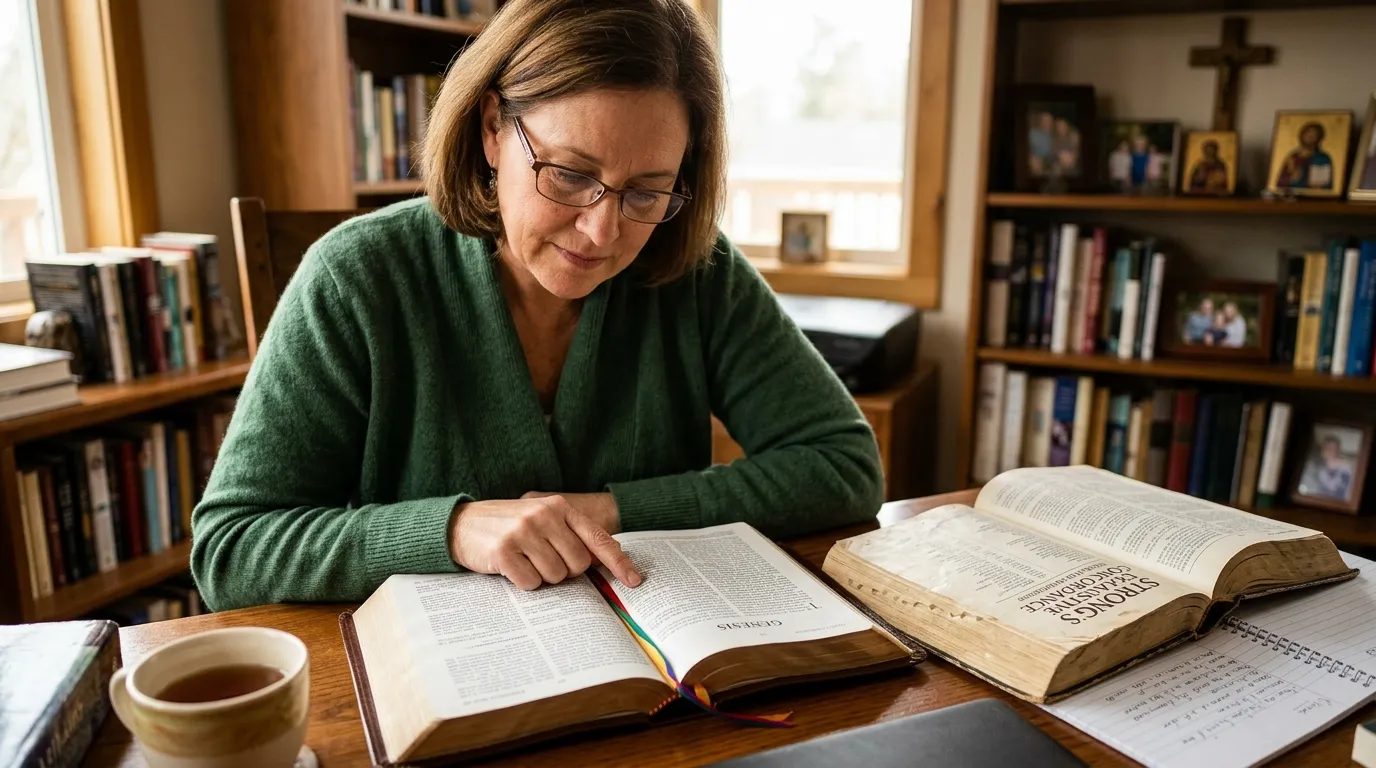
Almost everyone has wondered it at some point: what does my name mean — and does God care? Perhaps someone told you your name has a special meaning. Perhaps you’re choosing a name for a child. Or perhaps you simply sense that the word spoken over you every day of your life must carry some weight. The Bible suggests you’re right to wonder. Scripture treats names as revelations — of character, of calling, of God’s own purposes. This is a practical guide to discovering the spiritual meaning of your name through Scripture: how to research it, how to read it, and how to live it.
Step One: Find What Your Name Actually Means
Begin with honest linguistics, not wishful thinking. Look up your name’s genuine etymology — its language of origin and literal meaning. Reliable name dictionaries, not inspirational memes, are your friends here. Many names have clear meanings: David (beloved), Hannah (grace), Peter (rock), Theodore (gift of God). Others are murkier, and some modern coinages mean little beyond their sound.
Two cautions. First, verify the language. A name that is Irish does not have a Hebrew meaning; a name that is Germanic does not have a Greek one. The internet is full of fabricated “biblical meanings” for names that never appear in Scripture — well-meaning fiction that dishonors the God of truth. If your name isn’t biblical, that is fine; its meaning in its own language is still worth knowing, and its spiritual significance can still be explored (as we’ll see). Second, hold meanings loosely where scholars disagree. Some ancient names have debated etymologies; note the leading options rather than forcing certainty.
Step Two: Search Scripture for Your Name — and Its Story
If your name (or a variant) appears in the Bible, read every passage about its bearer — not just the flattering ones. Names in Scripture come wrapped in narratives, and the narrative is the commentary. David means “beloved,” and his story shows both the beloved’s heights (the shepherd-king after God’s heart) and the beloved’s depths (adultery, murder, repentance in Psalm 51). The name’s meaning is completed by the story: beloved does not mean perfect; it means pursued by grace.
Ask three questions of the biblical bearer: What did they do well? (imitate it), Where did they fail? (learn from it), and How did God deal with them? (trust Him the same way). If multiple people share your name — Mary, for instance, appears in several distinct portraits — let each one add a facet. Your name’s “biblical meaning” is the whole gallery, not a single snapshot.
If your name does not appear in Scripture, search for its meaning instead. Named “Protector”? Study the Bible’s teaching on protection (Psalm 91, John 10). Named “Light”? Meditate on Matthew 5:14-16 and John 8:12. The concept behind your name is in Scripture even when the syllables aren’t — and concepts are what shape character.
Step Three: Study How God Renames People
One of Scripture’s most thrilling patterns is the divine rename — and it reveals what God thinks names are for. Abram (“exalted father”) became Abraham (“father of many”) before he had a single child of promise (Genesis 17:5) — God named him for the future, not the past. Jacob (“deceiver,” literally “heel-grabber”) became Israel (“he struggles with God”) after wrestling all night (Genesis 32:28) — God renamed him for the transformed character, not the old scheming. Simon (“hearing”) became Peter (“rock”) before he was remotely rock-like (John 1:42; Matthew 16:18) — Jesus named him for what grace would build.
The pattern: God names people prophetically — according to what He intends to make them, not merely what they have been. This transforms how you read your own name. Whatever your name means — beloved, grace, protector, light — read it as assignment as well as description: the character God is forming in you, the calling He is growing you into. And if your name’s meaning feels like a rebuke rather than a promise (some names mean “sorrowful” or “bitter” — think Jabez, “pain,” in 1 Chronicles 4:9-10, whose prayer turned the meaning into testimony), remember: God specializes in renaming seasons, even when He keeps the syllables.
Step Four: Discover the Name God Calls You Now
Beyond your given name lies the name God speaks over you in Christ — and Scripture is explicit about it. “I have called you by name, you are mine” (Isaiah 43:1). To the overcoming believer, Christ promises “a new name… which no one knows except the one who receives it” (Revelation 2:17) — an intimate, individual identity known fully only between the soul and its Savior. Your earthly name was given by parents who loved you but couldn’t see your future; your true name is given by the Father who sees it completely.
In the meantime, Scripture gives believers a whole wardrobe of present-tense names: child of God (John 1:12), new creation (2 Corinthians 5:17 — “the old has passed away; behold, the new has come”), saint (literally “holy one” — Paul’s standard address to ordinary Christians), beloved (Romans 1:7), chosen (1 Peter 2:9). These are not aspirations; they are announcements. Whatever your name means in the dictionary, these are what it means in heaven.
A practical exercise: write your name at the top of a page, then list beneath it every name Scripture gives you in Christ. Read the list aloud. This is not positive thinking; it is confession — agreeing with God about who you are. Identity precedes behavior in Scripture’s logic: because you are a new creation, therefore live like one.
When God Names Children as Sermons
Sometimes God doesn’t just rename adults — He names children as walking prophecies. Isaiah’s son Shear-jashub meant “a remnant shall return” (Isaiah 7:3) — every roll call in the prophet’s house preached hope to a nation facing exile. His second son, Maher-shalal-hash-baz (“the spoil speeds, the prey hastens,” Isaiah 8:3), announced Assyria’s coming judgment in four thundering syllables. Hosea’s children carried even harder messages: Jezreel (judgment on Jehu’s dynasty), Lo-ruhama (“no mercy”), Lo-ammi (“not my people”) — and then, in the restoration promise, the names are reversed: “you shall be called… ‘children of the living God'” (Hosea 1:10; 2:23).
The lesson for name-study: God treats names as messages. He embedded theology in His prophets’ nurseries. So when you research your name, ask not only “what does it mean?” but “what message might God be speaking through it — to me, and through me to others?” A name meaning “grace” is a sermon to everyone who hears it; a name meaning “light” is a quiet evangelistic tract. Your name may be the shortest sermon you’ll ever preach — make sure you know what it says.
Step Five: Live the Meaning Forward
Knowledge becomes wisdom when it changes a Tuesday. Here’s how to carry your name’s meaning into life:
Pray your name’s meaning. If your name means “grace,” pray to become gracious. If it means “protector,” ask God whom to protect today. Turn etymology into intercession.
Let it check you. Names make gentle correctives: the man named “Peace” who loves a fight, the woman named “Joy” nursing bitterness — the name stands as a quiet question. “A good name is to be chosen rather than great riches” (Proverbs 22:1); keeping a good name is the daily work.
Speak others’ names with intention. In Scripture, naming is an act of love and authority — God names the stars (Psalm 147:4), Jesus names His sheep: “he calls his own sheep by name” (John 10:3). When Mary Magdalene wept at the tomb, one word — her name — spoken by Jesus turned her grief to recognition: “Jesus said to her, ‘Mary'” (John 20:16). Learn what people’s names mean; use them with care. You may be the only Bible of names someone ever reads.
For parents choosing a name: choose for meaning and hope, not merely sound or trend. A name is the first sermon you preach over your child — make it one worth hearing for eighty years.
What if my name has a bad or sad meaning?
Remember Jabez (“pain”), whose honest prayer — “Oh that you would bless me” — turned his story into blessing (1 Chronicles 4:9-10). A name’s dictionary meaning does not determine your destiny; God’s renaming grace does. And your identity in Christ (“beloved,” “new creation”) outranks every etymology.
Does God really care about names?
He invented the practice — the first human task in Eden was naming the animals (Genesis 2:19-20), and God has been naming, renaming, and calling people by name ever since. Your name matters to Him because you matter to Him — “I have called you by name, you are mine.”
Your name is not an accident of parental taste. It is a word spoken over you thousands of times — and words, Scripture insists, have weight. Discover its meaning, read its story, hear God’s renaming, and then live it forward: for the glory of the One who calls you by name. On the biblical practice of naming itself, see Hebrew name.