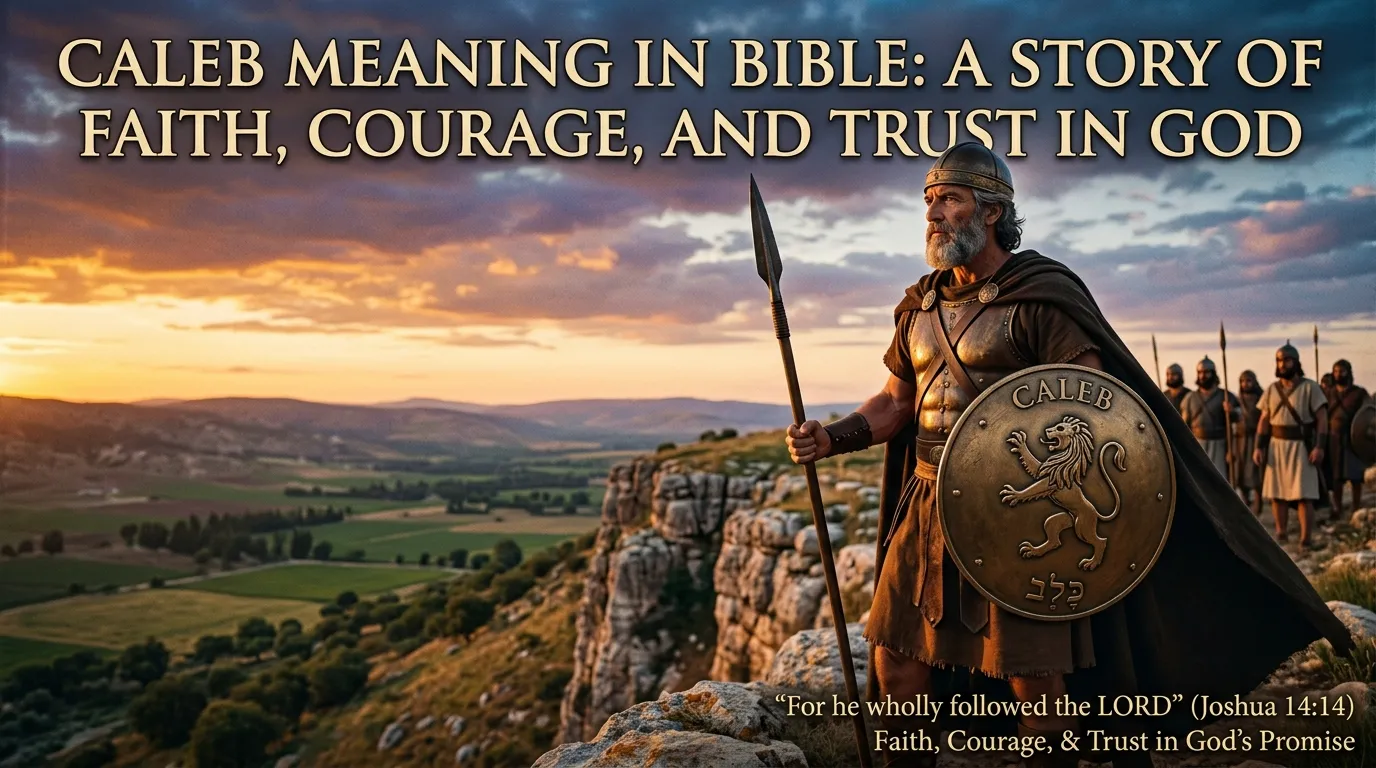
He was forty when he walked into the promised land as a spy. He was eighty-five when he finally claimed his portion of it. Between those two ages stretch forty-five years of wilderness wandering — years Caleb did not cause, did not deserve, and did not waste. The name Caleb means “dog” in Hebrew (kelev) — possibly “faithful like a dog,” loyal to the end — and no name ever fit its bearer better. Caleb is Scripture’s monument to wholehearted endurance: the man who believed God at forty and was still believing Him at eighty-five, asking for the hill country and its giants.
The Spy Who Said “We Can”: Numbers 13-14
The story begins with twelve spies and a bad majority report. Ten spies saw fortified cities and giant Anakim and concluded, “We are not able” (Numbers 13:31). They spread fear through the camp until the people wept all night and talked of stoning Moses. Into that panic stepped Caleb: he “quieted the people before Moses and said, ‘Let us go up at once and occupy it, for we are well able to overcome it'” (Numbers 13:30).
Caleb’s courage was not blindness — he saw the same giants. His courage was theology: the same facts, different God. The ten spies measured the giants against themselves (“we seemed to ourselves like grasshoppers,” Numbers 13:33); Caleb measured the giants against God (“their protection is removed from them, and the LORD is with us; do not fear them,” Numbers 14:9). This is the whole secret of faith in one contrast: giants look different depending on who stands beside you. The majority saw fortified cities; Caleb saw a fortified promise — God had sworn the land to Israel, and God’s oath outweighed every wall.
God’s verdict on the two minorities is immortal: “My servant Caleb, because he has a different spirit and has followed me fully [wholly, wholeheartedly], I will bring into the land” (Numbers 14:24). A different spirit. While the camp chose fear, Caleb chose full following. The Hebrew suggests whole-heartedness — no divided loyalties, no backup plans, no grasshopper self-image. Caleb’s spirit was different because his God was bigger.
The Forty-Five Years: Faithfulness Without a Timeline
Here is where Caleb’s story becomes extraordinary — and where most tellings stop too soon. Caleb was faithful at forty. His reward? Forty-five more years of wilderness — wandering with the very generation whose unbelief he had opposed, burying the peers of his youth, watching the clock run while the promise waited. He did not cause the delay. He deserved the land immediately. And he waited nearly half a century without a recorded word of complaint.
This is the chapter for everyone whose obedience has not yet been rewarded — the faithful servant in the obscure job, the praying parent with the prodigal still gone, the believer who did everything right and is still waiting. Caleb’s life declares: faithfulness is not validated by speed. God’s “soon” and our “soon” are different words. The wilderness years were not wasted years; they were the proving of the different spirit, the long obedience that turned a moment of courage into a lifetime of character.
Notice what the delay did not do: it did not sour him, shrink him, or make him cynical. Bitterness is the wilderness’s most common souvenir; Caleb brought back faith instead. When your promise is delayed, you are being given the chance to prove — to yourself, to watchers, to God — that your faith was in Him, not in His timetable.
“Give Me This Hill Country”: The Old Warrior at Eighty-Five
When the conquest was largely complete and the land divided, the eighty-five-year-old Caleb approached Joshua: “I am still as strong today as I was in the day that Moses sent me; my strength now is as my strength was then, for war and for going and coming. So now give me this hill country of which the LORD spoke on that day, for you heard on that day how the Anakim were there, with great fortified cities. It may be that the LORD will be with me, and I shall drive them out, just as the LORD said” (Joshua 14:11-12).
Every phrase deserves lingering. “I am still as strong today” — forty-five years had not diminished his vigor, a testimony to a life that kept moving with God rather than rusting in resentment. “Give me this hill country” — not the easy valley land but the hill country, the very territory of the Anakim giants who had terrified Israel at forty. Caleb did not merely want land; he wanted the giants’ land — unfinished business with fear itself. “It may be that the LORD will be with me” — the humility of the veteran: after a lifetime of God’s faithfulness, still no presumption, still dependence. The strongest statement of faith in the passage is wrapped in the gentlest uncertainty.
Joshua blessed him and gave him Hebron — and the text notes that Hebron had belonged to the Anakim, and that Caleb “drove out from before him the three sons of Anak” (Joshua 15:14). At eighty-five, Caleb finished what the ten spies had feared at forty. The giants fell to the man who never stopped believing they would.
The Rest of Caleb’s Story: Achsah and Othniel
Caleb’s story doesn’t end with Hebron — it multiplies. Having taken the hill country, Caleb offered his daughter Achsah in marriage to whoever captured Kiriath-sepher, and his nephew Othniel took the city (Joshua 15:16-17). Then comes one of Scripture’s most charming domestic scenes: Achsah, riding to her new husband, urged him to ask Caleb for a field — and then she herself approached her father: “Give me a blessing. Since you have given me the land of the Negeb, give me also springs of water.” And Caleb gave her “the upper springs and the lower springs” (Joshua 15:18-19).
Why does this matter? Because it shows Caleb’s faith reproducing. Othniel — the young warrior who won Achsah — would become Israel’s first judge, the Spirit-empowered deliverer who gave the land forty years of rest (Judges 3:9-11). The man who married into Caleb’s family absorbed Caleb’s spirit: courage, initiative, wholehearted following. And Achsah herself displays the family trait — bold asking. She didn’t settle for dry land when springs were available; she asked, and received double springs, upper and lower. The daughter of the man who asked for the giants’ hill country asked for the best water — and got it.
The generational lesson is profound: wholeheartedness is contagious. Caleb’s “different spirit” didn’t die with him; it discipled a nephew into a judge and emboldened a daughter into a bold asker. The faith you live at eighty-five shapes the twenty-five-year-olds watching you. And Achsah’s springs add a final grace note to the Caleb story: the God who gives hill countries also gives springs — the warrior’s conquest completed by the Father’s generosity. Ask for the land, yes — but don’t forget to ask for the water. The same God gives both.
And one detail crowns the story: Othniel, the nephew who married into Caleb’s line, became the first judge of Israel — the Spirit of the LORD came upon him, and he delivered the nation (Judges 3:10). The wholeheartedness Caleb modeled at forty and proved at eighty-five became, in the next generation, national deliverance. Your “different spirit” will outlive you: the faith you live in obscurity becomes someone else’s courage in crisis. Caleb never led Israel; he fathered — biologically and spiritually — those who did. That may be the highest calling of all.
The Different Spirit: What Wholeheartedness Means
Caleb’s epitaph — “he wholly followed the LORD” (Deuteronomy 1:36; Joshua 14:8-9) — is Scripture’s definition of the life God honors. Wholeheartedness has three marks in Caleb’s story. First, courage at the start: speaking truth when the majority panics, standing alone if necessary. Second, patience in the middle: enduring the long delay without bitterness, staying faithful when faithfulness seems unrewarded. Third, vigor at the end: finishing strong, still asking for hill country at eighty-five, still driving out giants.
Most believers manage one of the three. Some start brave and fade. Some endure but grow cynical. Caleb did all three — and his secret, stated twice by God Himself, was the different spirit: a spirit shaped by a big God rather than big giants. “Test everything” applies to our fears too (1 Thessalonians 5:21): hold every giant up against God’s promise and see which is bigger.
What does the name Caleb mean?
In Hebrew, Caleb (kalev) means “dog” — understood positively as faithful, loyal, devoted, like a faithful hound. Some scholars suggest “wholehearted” as the lived meaning, matching God’s own description of him. Either way, the name became synonymous with loyal courage.
Why is Caleb important if he wasn’t a king or prophet?
Precisely because he wasn’t. Caleb is Scripture’s great “ordinary faithful” — no crown, no miracles, no book named for him. His importance is his imitability: any believer can have a different spirit, follow wholly, and finish strong. Kings are admired; Calebs are followed.
From the spy’s minority report to the old warrior’s hill country, Caleb’s life preaches one sermon across forty-five years: follow wholly, wait patiently, finish strong — for the LORD is with you, and the giants will fall. For the historical and traditional background, see Caleb.










