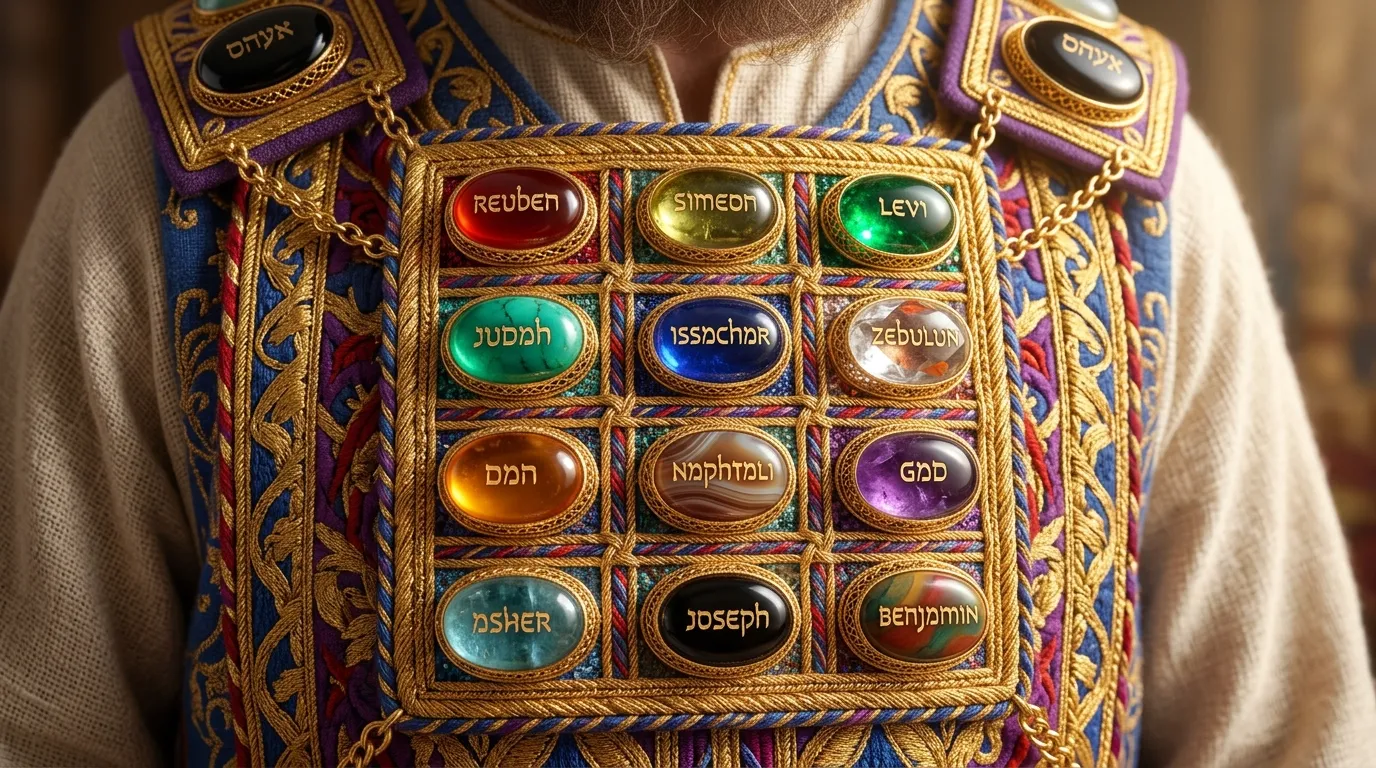
Of all the objects in Israel’s worship, the breastplate of the high priest may be the most personal. The ark held the law. The altar held the sacrifice. The lampstand held the light. But the breastplate — a square pouch of woven gold, blue, purple, and scarlet, set with twelve engraved gemstones — held the people. When Aaron entered the Holy Place, he carried the twelve tribes over his heart. Intercession, in Israel, had a weight, a texture, and a stone for every name.
The instructions occupy Exodus 28:15-30, and they repay slow reading. This was not decoration. Every detail — the size, the rows, the engraving, the chains, the pouch behind the stones — was specified by God, which means every detail was meant to teach.
The Pouch: Judgment Worn Over the Heart
The breastplate’s Hebrew name is choshen mishpat — the “breastplate of judgment” or “decision” (Exodus 28:15). The word mishpat is the Bible’s great justice word: it means judgment, ordinance, right order. This pouch was where decisions were sought from God — most likely connected with the Urim and Thummim kept inside it (Exodus 28:30).
It was a span square — about nine inches — doubled into a pouch, woven from the same gold-threaded fabric as the ephod. Four gold rings anchored it: two at the top, fastened with braided gold chains to the ephod’s shoulder pieces; two at the bottom, tied with blue cord to the ephod’s waistband. It could not swing loose, could not be lost, could not be separated from the priest. Exodus 28:28 is explicit: “The breastplate will not swing out from the ephod.” Intercession, God was saying, is not detachable from the intercessor’s person. It is bound on.
And its position: “over Aaron’s heart” (Exodus 28:29-30, twice stated). Not on his back, not at his side — over the heart. The organ of affection, of will, of inner life. The people were not carried administratively but affectionately. Whatever else the breastplate taught Israel, it taught this: you are on God’s heart when your intercessor stands before Him.
The Twelve Stones, Row by Row
Exodus 28:17-20 sets the stones in four rows of three. English translations differ on several identifications — the Hebrew gem names are genuinely difficult, and honest scholarship admits it — but the traditional list runs:
- First row: sardius (carnelian), topaz, carbuncle (garnet). The red row — sacrifice colors, blood tones, the stones of atonement’s palette.
- Second row: emerald, sapphire, diamond. Green, blue, white-fire — covenant, heaven, purity.
- Third row: jacinth (ligure), agate, amethyst. The fire-blue, the banded stone, the royal purple.
- Fourth row: beryl, onyx, jasper. Sea-green, layered dark, and the stone of glory that would one day wall the New Jerusalem.
Each stone was “engraved like a seal with the name of one of the twelve tribes” (Exodus 28:21) — not painted, not labeled, but cut into the mineral itself. Engraving is permanent in a way writing is not. Ink fades; carved stone endures. The tribes’ names were not noted on the breastplate; they were incised into it. And they were set in gold filigree — “enclosed in gold” — held fast in precious metal.
The order of the rows likely followed the birth order of Jacob’s sons or the camp’s marching order; the text does not specify, and speculation beyond the text is unprofitable. What the text does specify is completeness: twelve stones, twelve names, no tribe omitted — including the ones with the worst histories. Reuben the unstable, Simeon the violent, Judah of the Tamar episode: all engraved, all carried, all remembered. Grace, in the breastplate, is engraved before it is deserved.
The Memorial: Borne Before the Lord
Exodus 28:29 states the purpose: “Whenever Aaron enters the Holy Place, he will bear the names of the sons of Israel over his heart on the breastplate of decision as a continuing memorial before the Lord.” Verse 30 repeats it for the Urim and Thummim: “Thus Aaron will always bear the means of making decisions for the Israelites over his heart before the Lord.”
“Memorial” (zikkaron) in Scripture is never mere nostalgia. The Passover is a memorial that re-presents redemption (Exodus 12:14). The stones in the Jordan are a memorial that preaches to children (Joshua 4:7). A memorial before the Lord is a God-ordained prompt — as if God, who cannot forget, graciously ordains reminders within His own worship so that His people know they are remembered. The breastplate is God’s answer to the fear of being forgotten: look — your name is engraved, set in gold, carried over the heart of your priest into My presence, continually.
For the Christian reader, the New Testament draws the line straight to Christ. Hebrews presents Jesus as the great high priest who “always lives to intercede” for His people (Hebrews 7:25) — not once a year but continually, not with engraved stones but with His own wounds, “a continuing memorial” of a better covenant. Romans 8:34: Christ “is at the right hand of God and is also interceding for us.” The breastplate was the shadow; the intercession of Christ is the substance. Your name is still borne over a heart before the Lord — only now the heart is His own.
The Urim and Thummim: Guidance in the Pouch
Behind the stones, in the pouch itself, Moses was to place “the Urim and Thummim” (Exodus 28:30) — the “lights and perfections,” sacred lots by which God’s decisions were sought. They appear at critical moments: discerning Achan’s guilt (Joshua 7), directing battle (Judges 20), choosing Saul as king (1 Samuel 10), guiding David (1 Samuel 23, 30). Then they fade from the narrative — mentioned as lost after the exile (Ezra 2:63, Nehemiah 7:65), never described in operation.
Their obscurity is instructive. Scripture tells us what they were for (decisions) without telling us how they worked — and that reticence is itself a guardrail. Israel was not given a mechanism to master but a means to depend: when the way was unclear, the priest sought God, and God answered. The breastplate held both the people (the stones) and the guidance (the Urim and Thummim) together — intercession and direction in one pouch, over one heart. The God who carries His people also leads them.
Their disappearance after the exile points forward. With the coming of the Spirit — who “will guide you into all the truth” (John 16:13) — and the completion of Scripture, the church does not cast lots for guidance but seeks God in His Word, in prayer, in counsel, and in providence. The pouch is empty because the need it met is met more fully now.
What the Breastplate Still Preaches
The breastplate no longer exists. No priest wears it; no temple houses it. But its sermon outlives its fabric, and it preaches to every believer who fears being forgotten, unled, or unrepresented:
- You are engraved, not penciled in. The names were cut into stone and set in gold. God’s remembrance of His people is not a sticky note but an engraving — permanent, costly, unerasable. Nothing you do can un-engrave what grace has cut.
- You are carried over the heart, not on the back. Intercession is affection, not administration. Christ does not process His people; He loves them, bears them, presents them. Your standing before God is as beloved as it is secure.
- You are led as well as loved. The pouch held guidance with the names. God’s care for His people includes direction — not always immediate, not always by lot, but always real. The same God who carries you also shows you the way.
- Completeness is the point. Twelve stones, no gaps. The breastplate had no “miscellaneous” setting, no tribe left to fend for itself. Whatever your history — Reuben’s instability, Judah’s failure — the engraving includes you.
Bound So It Cannot Swing Loose
One construction detail carries more theology than it first appears. Exodus 28:28: the breastplate’s lower rings were tied “to the ephod with blue cord, connecting it to the waistband, so that the breastplate will not swing out from the ephod.” The stones were not merely placed; they were bound — chained at the top with gold, tied at the bottom with blue, lashed to the priest’s person so that no movement, no bending, no wind could separate them.
The binding preaches perseverance — God’s, not ours. Intercession, in this picture, is not a mood the priest might lose or a duty he might set down. It is fastened on. The names cannot swing loose because the cords hold them, and the cords were God’s design. Translate to the new covenant: Christ’s intercession for His people is not contingent on His attention span. It is bound to His office, His oath (Hebrews 7:21), His resurrection life. “He always lives to intercede” (Hebrews 7:25) — always, because the breastplate does not swing loose.
And the blue cord matters: heaven’s color, again, doing the binding. The same blue that wrapped the tabernacle, fringed the Israelite’s garment (Numbers 15:38), and paved the throne room now ties the people’s names to the priest’s chest. Blue binds. Heaven holds. The engraved stones stay — not because they grip, but because they are gripped.
Archaeologists and scholars continue to debate the stones’ exact identities — the traditional English names rest on centuries of translation guesswork over difficult Hebrew terms, and Wikipedia’s article on the priestly breastplate (the Hoshen) lays out both the biblical description and the scholarly debate. But the passage’s meaning never depended on mineralogy. Twelve names. Engraved in stone. Set in gold. Bound over the heart. Carried before the Lord, continually. That is the breastplate’s sermon, and it has not expired.










