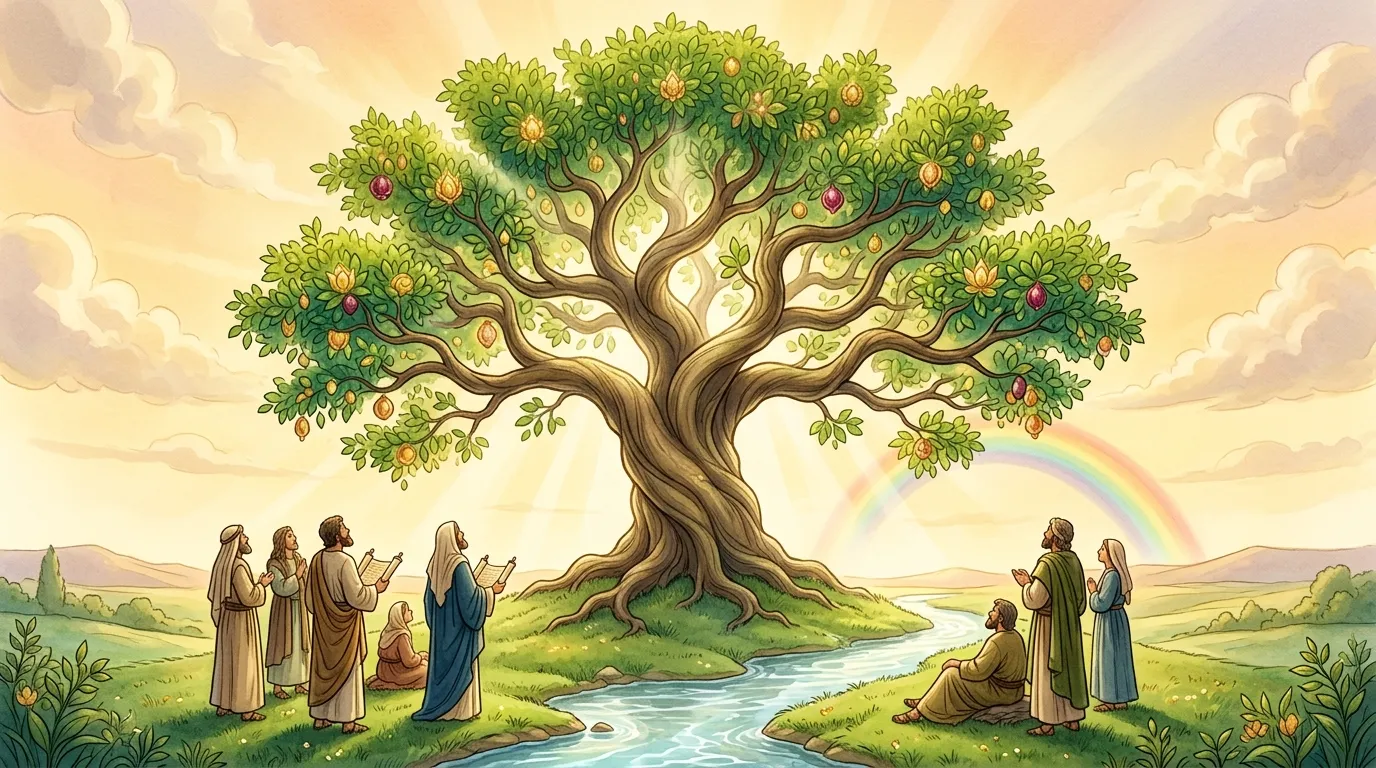
Open your Bible to the very first chapters and you meet a tree. Open it to the very last chapter and you meet a tree again. Between Genesis and Revelation, the tree of life keeps appearing — in the garden, in the Proverbs, and in John’s final vision — like a thread God never dropped. Whatever else Scripture’s symbols may be, this one is deliberate: the story of the Bible begins with life offered, loses it through disobedience, and ends with life restored.
That arc is what makes the tree of life worth more than a quick devotional thought. It is not a decoration in Eden or a piece of apocalyptic furniture. It is one of the Bible’s central images of what God always intended — and what Christ finally secures.
A Tree at Both Ends of the Story
The tree of life first appears in Genesis 2:9, planted by God Himself in the middle of the garden, beside the tree of the knowledge of good and evil. Adam was free to eat from every tree except one. The tree of life was never forbidden. It stood open — a standing invitation to live forever in fellowship with God.
After the fall, everything changes. Genesis 3:22 records God’s reasoning: man must not “take also of the tree of life, and eat, and live for ever” in a fallen state. An eternity of guilt, shame, and brokenness would not be mercy; it would be hell. So God stations cherubim with a flaming sword to guard the way to the tree (Genesis 3:24). The way is closed — not forever, but until the sin problem is dealt with.
That closing is the ache of the whole Old Testament. Every sacrifice, every priest, every promise of a coming Redeemer is a step back toward the tree. The guardians at Eden’s gate are not the end of the story; they are the reason the rest of the story is necessary.
The Tree in the Wisdom Books
Proverbs picks the image back up and uses it four times, each time to describe something that restores or sustains life. The Hebrew phrase is ‘etz chayyim — literally “tree of lives” — and the writer applies it to wisdom itself: “She is a tree of life to them that lay hold upon her” (Proverbs 3:18). Wisdom is not merely good advice here; it is a source of life, the way back to what Eden offered.
The other three uses widen the picture. “The fruit of the righteous is a tree of life” (Proverbs 11:30) — a godly life nourishes others the way the tree nourished Adam. “Hope deferred maketh the heart sick: but when the desire cometh, it is a tree of life” (Proverbs 13:12) — fulfilled longing tastes like Eden. “A wholesome tongue is a tree of life” (Proverbs 15:4) — even our words can give life or take it.
Notice the pattern: wisdom, righteousness, fulfilled hope, life-giving speech. Proverbs is teaching that the tree of life is not only a place or a plant; it is a quality — whatever brings God’s life into a dying world carries something of the tree’s nature.
Twelve Kinds of Fruit: John’s Last Vision
Then, in the final chapter of the Bible, the guarded tree reappears — unguarded. Revelation 22:1-2 shows the river of the water of life flowing from God’s throne, “and in the midst of the street of it, and on either side of the river, was there the tree of life, which bare twelve manner of fruits, and yielded her fruit every month: and the leaves of the tree were for the healing of the nations.”
Every detail answers Genesis. In Eden the tree was single and guarded; in the New Jerusalem it lines both sides of the river and stands in the open street. In Eden access was lost through sin; here “blessed are they that do his commandments, that they may have right to the tree of life” (Revelation 22:14). The curse that began in the garden is explicitly reversed: “there shall be no more curse” (Revelation 22:3).
The monthly fruit and healing leaves are worth pausing over. Heaven is not depicted as a static museum but as a living, fruitful, ever-renewing reality. The nations — the same nations torn by war and division through all of history — find healing in the tree’s leaves. God’s final answer to humanity’s brokenness is not destruction but restoration.
The Tree and the Cross
How does the guarded tree of Genesis become the open tree of Revelation? The New Testament gives the answer in an unexpected phrase: it calls the cross a “tree.” Peter writes that Christ “bare our sins in his own body on the tree” (1 Peter 2:24), and Paul says Christ redeemed us from the curse “being made a curse for us: for it is written, Cursed is every one that hangeth on a tree” (Galatians 3:13, quoting Deuteronomy 21:23).
The connection is not accidental. The tree of life was lost through disobedience at a tree; it is regained through obedience on a tree. Where Adam reached for what was forbidden and brought death, Christ hung on what was cursed and brought life. The flaming sword that guarded Eden is sheathed at Calvary — the way back to the tree is open through the One who is Himself “the way” (John 14:6).
This is why the tree of life is ultimately a symbol of Christ Himself. He is the wisdom Proverbs describes (1 Corinthians 1:24 calls Christ “the wisdom of God”), the righteousness whose fruit gives life, and the one through whom eternal life comes: “I am the resurrection, and the life” (John 11:25).
Eating From It Today
You do not have to wait for the New Jerusalem to taste something of the tree. Scripture describes present-tense access. Jesus said, “I am come that they might have life, and that they might have it more abundantly” (John 10:10). The one who believes already “hath everlasting life” (John 6:47) — present possession, not merely future hope.
What does partaking look like now? Proverbs already gave the menu: lay hold of wisdom (Proverbs 3:18), live righteously so your life nourishes others (Proverbs 11:30), let hope be fulfilled in God’s promises (Proverbs 13:12), and speak words that heal (Proverbs 15:4). Each is a small eating from the tree — a way of drawing on God’s life in the middle of an ordinary week.
Revelation adds a warning worth hearing: the right to the tree belongs to those who “do his commandments” and have washed their robes (Revelation 22:14). Access is grace, but it is not casual. The tree is open to the redeemed — those whose sin has been dealt with at the cross — not to those who presume on God’s mercy while ignoring His holiness.
Questions People Ask About the Tree of Life
Was the tree of life a real tree?
Genesis presents it as a real tree in a real garden, and there is no reason in the text to read it as pure allegory. At the same time, like the river and the gold of Revelation 22, it carries symbolic weight far beyond botany. It was a genuine tree that genuinely symbolized the life God offered.
What would have happened if Adam had eaten from it after sinning?
Genesis 3:22 implies he would have “lived for ever” — but forever in a fallen, decaying, guilt-ridden condition. God blocked the way as an act of mercy, preserving the possibility of redemption instead of freezing humanity in its brokenness.
Is the tree of life the same as the cross?
Not identical, but deeply connected. The New Testament deliberately calls the cross a “tree” (Acts 5:30; Galatians 3:13; 1 Peter 2:24), and theologians have long seen the cross as the means by which the lost tree is regained. The tree of judgment becomes the tree of life.
The River Beside the Tree
Revelation 22 pairs the tree with a river — “a pure river of water of life, clear as crystal, proceeding out of the throne of God and of the Lamb” (Revelation 22:1). The tree does not stand alone; it grows by the water, exactly as Psalm 1 describes the righteous: “like a tree planted by the rivers of water” (Psalm 1:3). Life in Scripture is always tree-plus-river, rootedness plus flow.
Ezekiel saw the same vision centuries earlier: water flowing from the temple, and “by the river upon the bank thereof, on this side and on that side, shall grow all trees for meat, whose leaf shall not fade… because their waters they issued out of the sanctuary: and the fruit thereof shall be for meat, and the leaf thereof for medicine” (Ezekiel 47:12). Fruit for food, leaves for healing — the same two ministries as Revelation’s tree. God’s life feeds and heals, nourishes and restores. The tree by the river is the Bible’s picture of a life — and a world — fully supplied.
The Bible’s first tree and its last tree frame everything in between. Eden’s guarded tree told humanity what was lost; Calvary’s cursed tree tells us what was paid; Revelation’s open tree tells us what is coming. And the invitation stands exactly where it stood in Genesis 2 — life, offered freely, to all who will come. If the symbol intrigues you, the Wikipedia overview of the tree of life traces how this image also appears in other ancient cultures, which only sharpens how distinctly Scripture uses it: not as myth, but as promise.










