Dear Jennifer — or dear parent considering the name, or friend searching late at night because someone you love carries it:
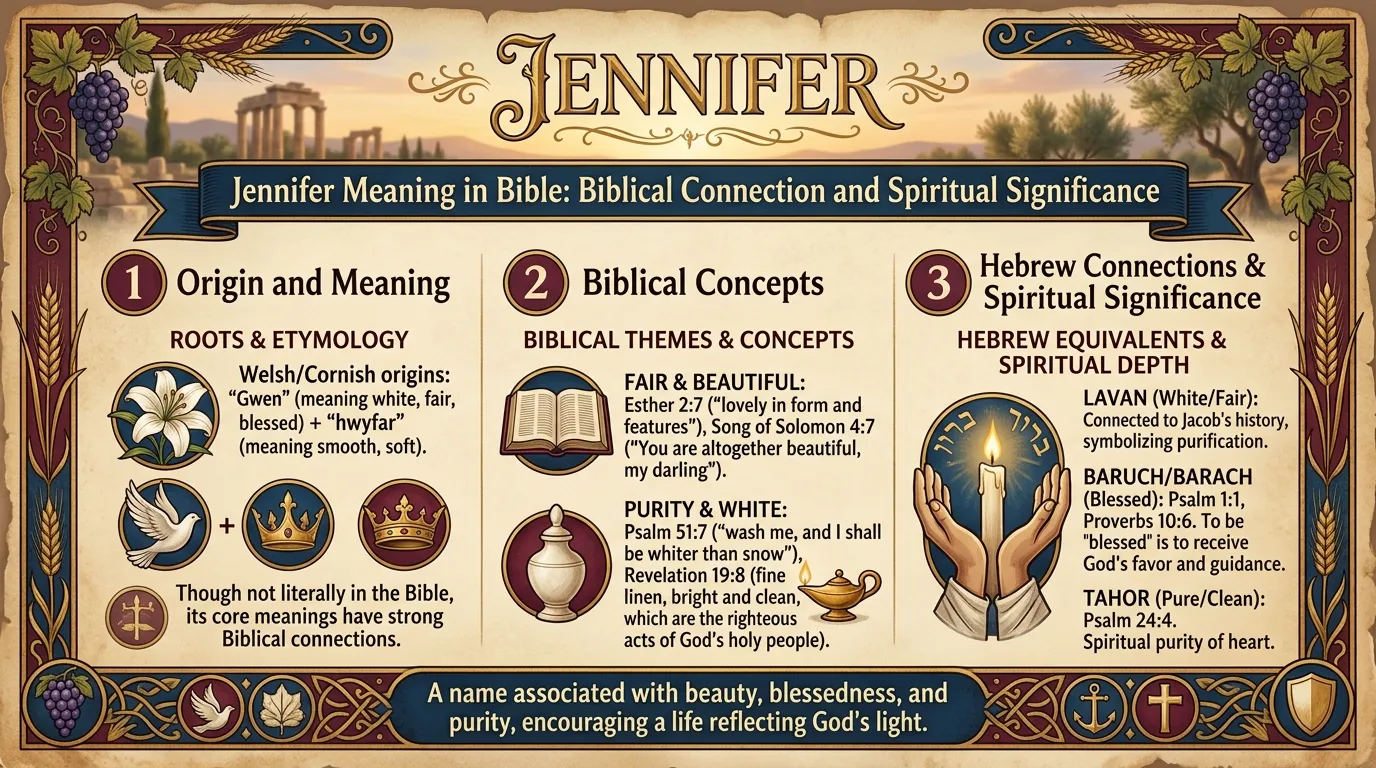
You asked whether your name is in the Bible, and you deserve a straight answer before anything else. The name Jennifer does not appear anywhere in Scripture. It is not Hebrew, not Greek, not Aramaic. It comes to us from the old Welsh Gwenhwyfar — the name of Arthurian legend — and most scholars trace its meaning to something like “fair one,” “white wave,” or “blessed and pure.”
That might sound like the end of the conversation. It is actually the beginning. Because while the Bible never says the name Jennifer, it says a great deal about everything the name means — purity, light, beauty, grace. And Scripture’s habit with names is never to leave a meaning lying on the table. God takes the meaning of a name and fills it with His own truth.
What the Name Actually Carries
Follow the name backward. Jennifer is the Cornish and English form of Guinevere, from Welsh gwen (“fair, white, blessed”) and possibly hwyfar (“smooth, gentle”). Across its variants — Guinevere, Ginevra, Genevieve-adjacent forms — the through-line is consistent: fairness, whiteness, purity, blessedness.
It entered the English-speaking world quietly and then all at once, becoming one of the most beloved girls’ names of the twentieth century. Millions of Jennifers have never met, yet they share a name whose oldest roots describe light-colored purity. That is a lovely accident of language. The Bible turns it into something more: a calling.
When God Renames, He Reveals
Scripture treats names as assignments, not labels. Abram (“exalted father”) becomes Abraham (“father of multitudes”) in Genesis 17:5, because God is about to make the name true. Jacob (“heel-grabber, deceiver”) becomes Israel (“he struggles with God”) in Genesis 32:28, because the man is being remade. Simon becomes Peter — “rock” — in John 1:42, long before he looks anything like one.
The pattern is unmistakable: God speaks the meaning over a person until the person grows into it. So take the old meaning of your name — pure one, fair one, blessed one — and hear it the way Abraham must have heard his new name: not as a description of what you already are, but as a declaration of what God intends to make you.
Purity: The White at the Heart of the Name
The Welsh gwen carries the sense of whiteness — and Scripture’s color language for whiteness is almost entirely about cleansing. “Though your sins be as scarlet, they shall be as white as snow,” God says in Isaiah 1:18. David prays, “wash me, and I shall be whiter than snow” (Psalm 51:7). The great multitude of Revelation stands before the throne in white robes, washed in the blood of the Lamb (Revelation 7:14).
Jesus locates purity where it matters: “Blessed are the pure in heart: for they shall see God” (Matthew 5:8). Not the pure in reputation — the pure in heart. If your name has whispered “pure one” over you since birth, here is its biblical translation: a heart undivided, washed clean, set on God. That is not a personality trait you are born with. It is a gift you receive, and then a direction you walk.
Light: The Fairness That Shines
“Fair” in the old sense meant bright, shining, beautiful to look at. Scripture takes that image and aims it at Christ: “I am the light of the world: he that followeth me shall not walk in darkness, but shall have the light of life” (John 8:12). And then — astonishingly — He turns it back on His followers: “Ye are the light of the world” (Matthew 5:14).
The Hebrew word ‘or (light) runs through the Old Testament like a sunrise, from “let there be light” (Genesis 1:3) to the promise that “the LORD shall be unto thee an everlasting light” (Isaiah 60:19). A name meaning brightness is, biblically speaking, a job description. You were named for shining; Scripture tells you what to shine with.
Grace: The Blessedness Behind It
The third strand — blessed — is the Hebrew chen, grace or favor, and it is everywhere in the biblical story. Noah “found grace in the eyes of the LORD” (Genesis 6:8). Mary is “highly favoured” (Luke 1:28). And the gospel’s summary of the Christian life is that we are saved “by grace… through faith; and that not of yourselves: it is the gift of God” (Ephesians 2:8).
Here is the honest tension the name creates, and the reason it is worth sitting with: no one is pure, radiant, or blessed by nature. “There is none righteous, no, not one” (Romans 3:10). The name sets a standard you cannot meet — which is exactly what grace is for. The Welsh root says “blessed one”; the Bible says blessedness is given, to the undeserving, through Christ. Your name’s meaning is not a compliment. It is a gospel.
Living Into the Name
So what does a Jennifer do with all this? Three practices, drawn straight from the name’s own roots:
Guard the white. Purity in Scripture is mostly about direction, not perfection — turning toward God quickly when you wander. “Draw nigh to God, and he will draw nigh to you. Cleanse your hands, ye sinners; and purify your hearts, ye double minded” (James 4:8). Confession is the laundry room of the soul; use it often.
Carry the light. Brightness that stays home is a lamp under a bushel (Matthew 5:15). The name’s old meaning of radiance becomes, in Christian hands, witness — kindness that stands out, truth spoken gently, joy that needs explaining.
Receive the blessedness. Stop trying to earn the “blessed” in your name. “The LORD bless thee, and keep thee” (Numbers 6:24) is pronounced over people, not achieved by them. Let grace do what striving cannot.
Women of Purity and Light in Scripture
If the name Jennifer means “pure, bright, blessed one,” Scripture offers portraits of women who embodied each strand — not as ideals to intimidate but as evidence that God really does this work in real people.
Esther: purity with courage. An orphaned Jewish girl in a pagan palace, Esther’s beauty opens a door — but it is her character that saves a nation. “Who knoweth whether thou art come to the kingdom for such a time as this?” (Esther 4:14). Her purity was not passivity; it was consecrated courage, risking her life for her people.
Mary: the favored one. The angel’s greeting — “Hail, thou that art highly favoured” (Luke 1:28) — is the chen (grace) word made personal. Mary’s blessedness was not earned but given, and her response is the model: “behold the handmaid of the Lord; be it unto me according to thy word” (Luke 1:38). Blessedness received becomes obedience rendered.
The virtuous woman: radiant in ordinary life. Proverbs 31 describes a woman whose “lamp goeth not out by night” (31:18) — light that keeps burning through the dark hours of ordinary faithfulness. Her brightness is not spotlight but lamplight: steady, warm, and domestic. Most Jennifers will shine this way — not on stages but in kitchens, classrooms, and sickrooms.
None of these women were named Jennifer. All of them lived its meaning. The name is the assignment; their lives are the examples. And the God who wrote purity, light, and grace into their stories is the same God writing yours — one ordinary, faithful day at a time.
A Blessing for Jennifers
Names in Scripture are often spoken as blessings, and this one deserves the same. So hear it, Jennifer — whether it is your name, your daughter’s, or your friend’s:
May the purity in your name be more than a word — may it be a washed heart, cleansed daily, “whiter than snow” (Psalm 51:7). May the brightness in your name be more than fairness — may it be the light of Christ shining through you, “that they may see your good works, and glorify your Father which is in heaven” (Matthew 5:16). May the blessedness in your name be more than good fortune — may it be grace received and grace given, the “blessed” of the Beatitudes lived out loud.
And when the name feels heavier than you can carry — when purity feels distant, brightness dim, blessedness undeserved — remember that names in the Bible are not job descriptions but promises. God spoke “father of multitudes” over a childless old man and made it true. He can speak “pure, bright, blessed” over you, and make it true as well.
You may never find “Jennifer” in a concordance. But open the Bible’s pages on purity, light, and grace, and you will find your name’s meaning on nearly every one — not as a word to look up, but as a life to live into. The Wikipedia entry on Jennifer as a given name traces its journey from Welsh legend to modern nurseries; Scripture picks up where history leaves off, and writes the rest of the story in grace.










