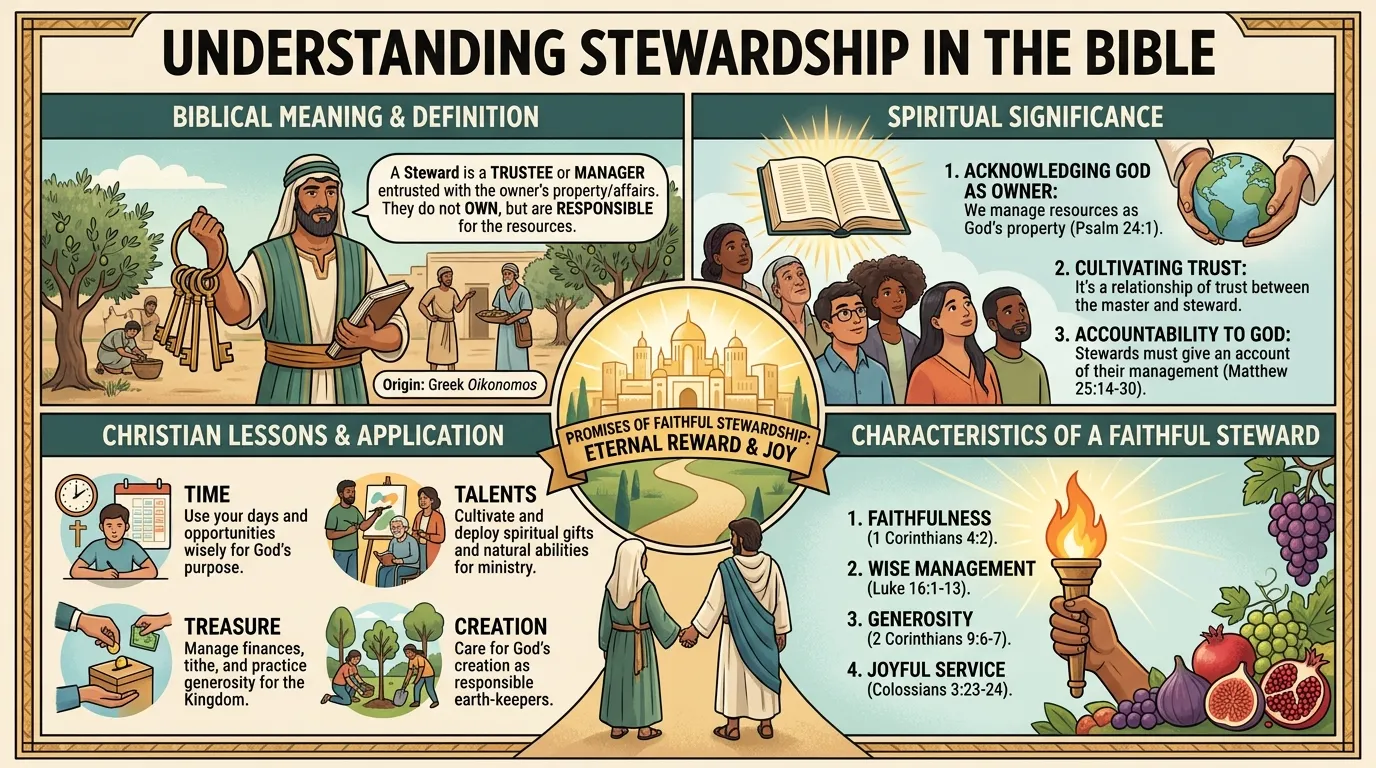
Picture a wealthy estate in the ancient world at dawn. The master is away — perhaps traveling for months — and everything he owns is in the hands of one man: the steward. The steward did not buy the fields, the livestock, the silver, or the servants. He owns nothing. Yet he decides everything: who works where, what is sold, what is stored, what is given. His authority is enormous and his ownership is zero.
That is the exact picture Scripture uses for the Christian life. A steward — in Greek, oikonomos, literally “house-law manager,” the keeper of the household — is someone entrusted with another person’s property. And the Bible’s claim, repeated from Genesis to Revelation, is that this is what you are: the manager of a life, a family, money, time, and gifts that all belong to someone else.
Joseph: The Steward Who Would Not Steal
The Bible’s great portrait of stewardship is Joseph, and it begins in a prisoner’s chains. Sold into Egypt, Joseph rises in Potiphar’s house until “he made him overseer over his house, and all that he had he put into his hand” (Genesis 39:4). Potiphar’s trust is total — “he knew not ought he had, save the bread which he did eat” (Genesis 39:6). Joseph runs everything.
Then comes the test that defines him. Potiphar’s wife demands his body, and Joseph’s refusal is a stewardship sermon in one sentence: “how then can I do this great wickedness, and sin against God?” (Genesis 39:9). Notice what he does not say. He does not say “this would betray your husband” — though it would. He says it would be sin against God. Joseph understands that the true Owner is not Potiphar. The estate ultimately belongs to the Lord, and a steward answers to the Owner, not merely the visible master.
The pattern repeats at the national scale. Pharaoh sets Joseph “over all the land of Egypt” (Genesis 41:41), and Joseph spends seven years of plenty storing grain he does not own, for a famine he did not cause, to save people who are not his subjects. Faithful stewardship, Joseph shows us, is long obedience in the same direction — managing well when no one is watching, and when everyone is watching.
The Parable That Makes Stewardship Unavoidable
Jesus returns to the steward image constantly, most searchingly in the parable of the talents (Matthew 25:14-30). A master entrusts his servants with his money — five talents, two, one — “to every man according to his several ability,” and goes away. When he returns, he settles accounts.
Two servants have traded and doubled their master’s money. The master’s response to each is identical and worth memorizing: “Well done, thou good and faithful servant: thou hast been faithful over a few things, I will make thee ruler over many things: enter thou into the joy of thy lord” (Matthew 25:21, 23). Faithfulness with little leads to responsibility with much — and to joy.
The third servant buried his talent. His excuse is revealing: “I knew thee that thou art an hard man” (Matthew 25:24). He misunderstood the master’s character, and the misunderstanding produced paralysis. Jesus is teaching something sharp here: your view of the Owner determines your stewardship. See Him as generous and you will risk and invest; see Him as harsh and you will hide and hoard. The buried talent is not condemned for losing money — it is condemned for doing nothing with a gift, out of a distorted picture of God.
The Shrewd Manager: Stewardship With Urgency
Luke 16 gives us the strangest steward in Scripture — the “unjust steward” who, learning he is about to be fired, quickly discounts his master’s debts to make friends for his future. Jesus does not praise the man’s dishonesty; He praises his shrewdness: “the children of this world are in their generation wiser than the children of light” (Luke 16:8).
The point stings: worldly people use present resources strategically for their future, while God’s people often drift. Jesus draws the lesson plainly: “Make to yourselves friends of the mammon of unrighteousness; that, when ye fail, they may receive you into everlasting habitations” (Luke 16:9). Use money — which is temporary and tainted — for eternal purposes: generosity, mercy, the gospel. A steward thinks about the audit before the master returns.
And the audit is certain. “It is required in stewards, that a man be found faithful” (1 Corinthians 4:2). Not brilliant. Not successful by the world’s metrics. Faithful.
Stewards of What, Exactly?
Paul widens the job description beyond money: “Let a man so account of us, as of the ministers of Christ, and stewards of the mysteries of God” (1 Corinthians 4:1). The gospel itself is a trust. Peter widens it further: “As every man hath received the gift, even so minister the same one to another, as good stewards of the manifold grace of God” (1 Peter 4:10). Your gifts, your story, your suffering redeemed — all of it is grace on loan, meant to be ministered to others.
The inventory, then, looks like this:
- Time. “Redeeming the time, because the days are evil” (Ephesians 5:16). Every hour is the Owner’s hour.
- Money and possessions. “The earth is the LORD’s, and the fulness thereof” (Psalm 24:1). You are the fund manager, not the fund owner.
- The body. “Ye are not your own… glorify God in your body” (1 Corinthians 6:19-20). Health, strength, and appetites are trust property.
- Gifts and opportunities. Whatever you are good at was deposited, not earned — “what hast thou that thou didst not receive?” (1 Corinthians 4:7).
- The gospel. The message itself is “committed unto us” (1 Thessalonians 2:4) — the greatest trust of all.
The Audit Is Coming — And That Is Good News
For the faithful steward, the master’s return is not dread but delight — “enter thou into the joy of thy lord.” The Christian doctrine of reward (1 Corinthians 3:12-15; 2 Corinthians 5:10) means nothing done in faithfulness is wasted. The cup of cold water (Matthew 10:42), the hidden prayer, the honest day’s work, the tithe given quietly — all of it is entered in the Owner’s ledger.
So the steward’s daily prayer is simple: What has the Master entrusted to me today, and how does He want it used? Ask it over your calendar, your bank account, your talents, your influence. Then manage like the Owner is coming home — because He is. And when He comes, may He find the estate thriving, the books honest, and the steward faithfully at his post.
The Pounds: A Second Parable, A Sharper Point
Luke 19 tells a companion parable — the pounds (minas) — with a twist that deepens the talents. Here each servant receives the same amount: one pound. The outcomes differ wildly: one earns ten, another five, another hides his in a napkin. The master rewards proportionally: “thou hast been faithful in a very little, have thou authority over ten cities” (Luke 19:17).
The lesson: faithfulness is measured against what you received, not against what others received. The servant with one pound is not judged by the ten-pound servant’s results. God does not grade on a curve across people; He audits each steward against his own deposit. The widow’s two mites outweighed the rich men’s fortunes (Luke 21:1-4) because stewardship is about proportion, not amount.
And the buried pound meets the same fate as the buried talent — taken away and given to the one with ten. “Unto every one which hath shall be given; and from him that hath not, even that he hath shall be taken away” (Luke 19:26). Unused gifts atrophy. Buried callings are eventually reassigned. The master would rather you risked and failed than preserved and stagnated.
Common Questions About Biblical Stewardship
Is stewardship just about money and tithing?
No — money is only one department of the estate. Scripture applies stewardship to time, the body, spiritual gifts, creation itself (Genesis 1:28; 2:15), and the gospel message. Tithing is a training exercise in the larger calling, not the whole of it.
What is the difference between ownership and stewardship?
An owner decides based on his own desires; a steward decides based on the owner’s will. Ownership asks “what do I want with this?”; stewardship asks “what does God want with this?” The shift from one question to the other is the heart of the Christian life.
Does faithful stewardship guarantee earthly success?
No. Joseph was faithful in prison before he was faithful in the palace. The parable promises the master’s joy, not the world’s applause. Some faithful stewards see visible fruit; all faithful stewards hear “well done.”
The estate is not yours. The authority is real, the responsibility is total, and the Owner is good — those three truths, held together, are the whole doctrine of stewardship. For the wider history of how households and estates were actually managed in the ancient world, the Wikipedia article on the office of steward gives useful background; Scripture takes that familiar role and makes it a picture of every believer’s life.










