Breathe out on a cold morning and watch what happens. The breath hangs in the air for a second — visible, real — and then it is gone. You cannot grab it. You cannot build on it. That little vanishing cloud is the entire message of the Bible’s most misunderstood word: vanity.
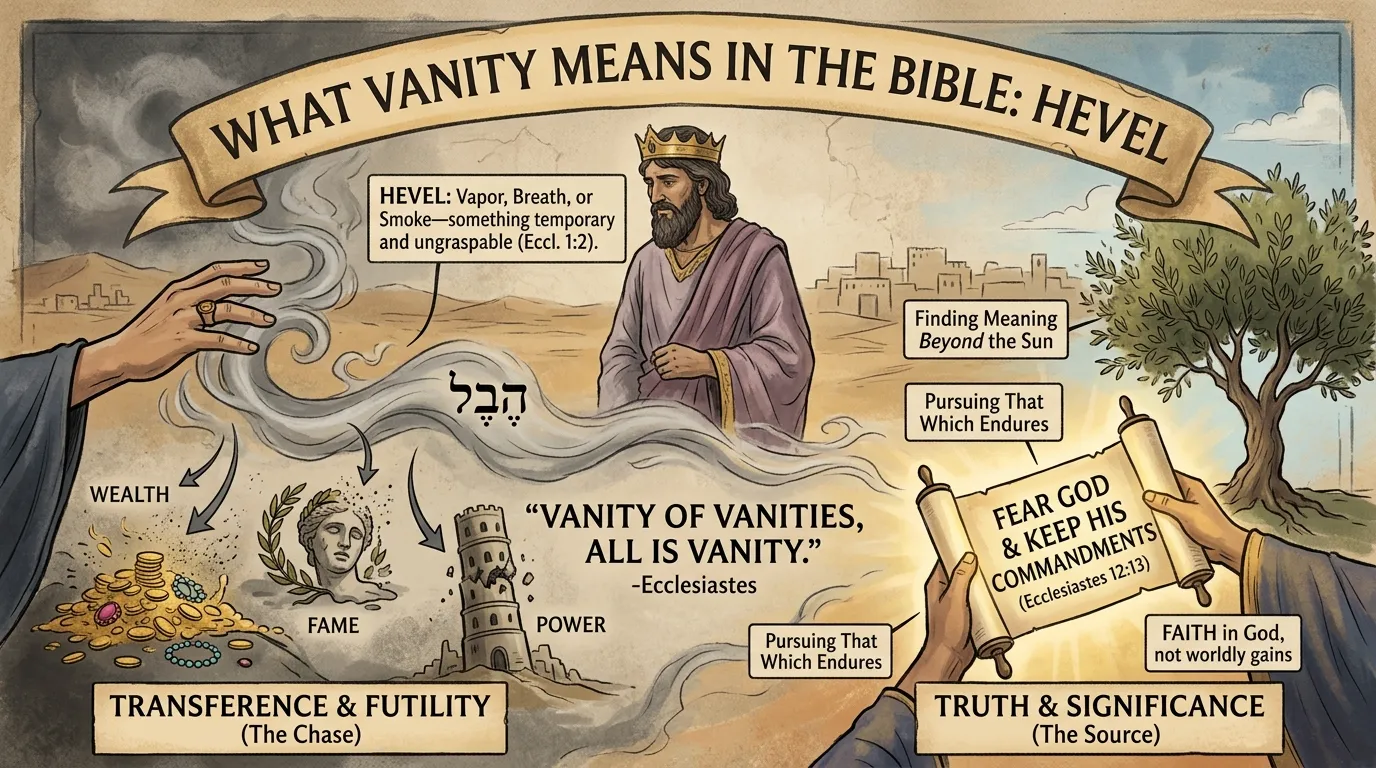
In Ecclesiastes the Hebrew word is hebel, and it appears nearly forty times. Translators render it “vanity,” but the word literally means breath, vapor, mist — like Abel’s name (Hebel), the son whose life was cut short like a puff of smoke. The Preacher’s famous opening — “Vanity of vanities; all is vanity” (Ecclesiastes 1:2) — is better heard as: Vapor of vapors. Everything is vapor. Not “everything is worthless.” Everything is fleeting.
That single correction changes the whole book. Ecclesiastes is not the Bible’s cynic, telling you life is pointless. He is the Bible’s realist, telling you life is fragile — and that building your identity on fragile things is the true vanity.
The Experiment: Chasing Vapor in Every Direction
The Preacher does not theorize about emptiness; he runs the experiment. With the resources of a king, he tests every candidate for lasting meaning, and reports the results with brutal honesty.
Wisdom. He devotes himself to understanding — “I gave my heart to seek and search out by wisdom concerning all things” (Ecclesiastes 1:13) — and concludes that even wisdom ends at the grave: “the wise man’s eyes are in his head; but the fool walketh in darkness: and I myself perceived also that one event happeneth to them all” (Ecclesiastes 2:14). Death, the great leveler, makes human wisdom vapor.
Pleasure. “I said in mine heart, Go to now, I will prove thee with mirth, therefore enjoy pleasure” (Ecclesiastes 2:1). Palaces, gardens, music, wine — Solomon had the ancient world’s entire entertainment industry at his disposal. Verdict: “behold, this also is vanity” (Ecclesiastes 2:1). Pleasure is real, but it evaporates; it cannot bear the weight of a life’s meaning.
Work and achievement. “I looked on all the works that my hands had wrought… and, behold, all was vanity and vexation of spirit” (Ecclesiastes 2:11). Worse, the worker cannot even keep the results: “I hated all my labour… because I should leave it unto the man that shall be after me” (Ecclesiastes 2:18). Every empire becomes someone else’s inheritance.
Wealth. “He that loveth silver shall not be satisfied with silver” (Ecclesiastes 5:10). Money promises security and delivers anxiety: “the abundance of the rich will not suffer him to sleep” (Ecclesiastes 5:12). And in the end, “as he came forth of his mother’s womb, naked shall he return” (Ecclesiastes 5:15).
This is not depression. It is demolition — clearing the ground so something solid can be built.
What Hebel Is Not
Two misunderstandings need clearing away, because they have done real damage.
First, hebel does not mean God’s creation is bad. The same book that calls life vapor also calls it gift, over and over: “there is nothing better for a man, than that he should eat and drink, and that he should make his soul enjoy good in his labour… this also I saw, that it was from the hand of God” (Ecclesiastes 2:24). Food, work, marriage, rest — these are not vanities to escape but gifts to receive. The vanity is not in the gift; it is in demanding from the gift what only the Giver can supply.
Second, hebel is not an excuse for apathy. “Whatever your hand finds to do, do it with all your might” is Ecclesiastes 9:10 — the vapor-view of life produces engaged living, not detached living. Knowing the tent is temporary makes you pitch it with care, not abandon it.
The New Testament Picks Up the Word
James reaches for the same image when he confronts our illusion of control: “What is your life? It is even a vapour, that appeareth for a little time, and then vanisheth away” (James 4:14). The Greek word is atmis — vapor, mist. Same sermon, new language. His application is practical: stop saying “we will go to such a city and continue a year and buy and sell” as if you owned tomorrow. Say instead, “If the Lord will, we shall live, and do this, or that” (James 4:15).
Jesus made the same point with barns. The rich fool in Luke 12 builds bigger barns to store a vaporous life, and God calls him “thou fool, this night thy soul shall be required of thee” (Luke 12:20). The parable’s punchline is a definition of true wealth: “so is he that layeth up treasure for himself, and is not rich toward God” (Luke 12:21).
Paul adds the cosmic dimension: creation itself “was made subject to vanity” — the Greek is mataiotes, emptiness — “not willingly, but by reason of him who hath subjected the same in hope” (Romans 8:20). The vapor-condition of the world is not the final word. It is the birth pang before “the glorious liberty of the children of God” (Romans 8:21).
The Conclusion the Preacher Actually Reaches
After twelve chapters of demolition, Ecclesiastes lands — and the landing is solid rock: “Let us hear the conclusion of the whole matter: Fear God, and keep his commandments: for this is the whole duty of man” (Ecclesiastes 12:13). Then the final sobriety: “For God shall bring every work into judgment, with every secret thing, whether it be good, or whether it be evil” (Ecclesiastes 12:14).
Read the book backward from that ending and everything reorganizes. Life is vapor — therefore anchor it in what is not vapor: God Himself, His commands, the coming judgment that gives every hidden act eternal weight. The fear of the Lord is the one building material that does not evaporate.
Living Lightly in a Vaporous World
What does this look like on a Tuesday? It looks like holding things with open hands. Enjoy the meal, the work, the friendship — Ecclesiastes insists on enjoyment — but stop demanding that any of them justify your existence. It looks like planning without presumption: make the plans, then add “if the Lord wills.” It looks like investing in the non-vaporous: “Lay up for yourselves treasures in heaven, where neither moth nor rust doth corrupt” (Matthew 6:20).
And it looks like urgency. Vapor does not wait. “Remember now thy Creator in the days of thy youth” (Ecclesiastes 12:1) — before the clouds return, before the years come when you say “I have no pleasure in them.” The brevity of life is not bad news for the one anchored in eternity. It is simply the truth that sets priorities straight.
The Solid Thing: Christ, the Answer to Hebel
Ecclesiastes demolishes every foundation except one — and the New Testament names the foundation the Preacher could only point toward. “For other foundation can no man lay than that is laid, which is Jesus Christ” (1 Corinthians 3:11). Every vapor the Preacher tested — wisdom, pleasure, work, wealth — finds its solid form in Christ.
Wisdom’s vapor, answered: Solomon found wisdom ending at the grave; Paul declares Christ “is made unto us wisdom” (1 Corinthians 1:30) — and then rose from the grave, carrying wisdom through death to the other side.
Pleasure’s vapor, answered: Solomon’s mirth evaporated; Jesus promises “that my joy might remain in you, and that your joy might be full” (John 15:11) — joy as remainder, not evaporation.
Work’s vapor, answered: Solomon hated leaving his labor to another; Jesus says, “I will build my church; and the gates of hell shall not prevail against it” (Matthew 16:18) — a work that outlasts its Worker because the Worker outlasted death.
Wealth’s vapor, answered: Solomon watched riches take wings; Paul describes “the unsearchable riches of Christ” (Ephesians 3:8) — wealth that cannot be lost because it is a Person, not a possession.
This is why Ecclesiastes belongs in the canon: it is the Old Testament’s great via negativa, clearing every false foundation so that when Christ arrives, we recognize Him as the one solid thing. “Vanity of vanities” is not the last word. It is the dark backdrop against which “I am the way, the truth, and the life” (John 14:6) shines brightest.
Vanity, in the Bible’s sense, is not the sneer of a cynic. It is the clear-eyed confession of a realist who has tested everything and found one solid thing: God. Everything else is breath — beautiful, God-given breath, but breath. Build on the Rock, enjoy the vapor, and fear the Lord. That is the whole of the matter — and it is worth settling today, not tomorrow, for the vapor does not wait, and eternity does not negotiate, and the wise settle accounts early. Those wanting the literary and historical background of the book that coined this vocabulary will find a solid survey in the Wikipedia article on Ecclesiastes, and then the wisest next step is to read the twelve chapters themselves, slowly.