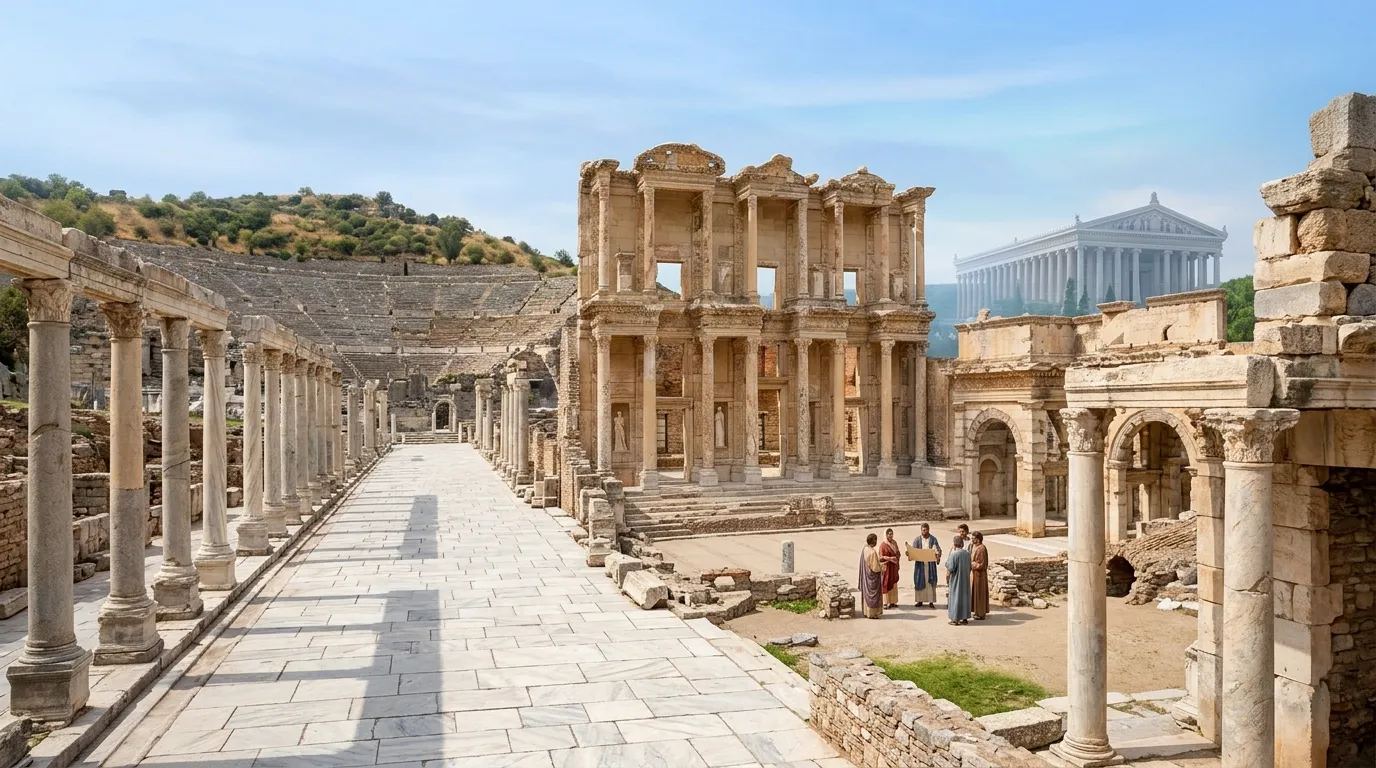
Ephesus was the city where the early church learned what it meant to hold the truth and lose the heart. Paul spent more time there than anywhere else on his journeys. The church there received one of his greatest letters. The risen Jesus sent it one of His seven messages in Revelation, and that message contained both high praise and a devastating warning: “You have abandoned the love you had at first” (Revelation 2:4). Ephesus is therefore a city of both encouragement and caution, and its story speaks to any Christian who has ever been right, busy, and cold at the same time.
A City of Trade, Religion, and Magic
Ephesus stood on the west coast of Asia Minor, near the Aegean Sea, at the mouth of the Cayster River. It was one of the great cities of the Roman province of Asia, a port and commercial hub where trade routes from the interior met the sea. Its most famous landmark was the Temple of Artemis, one of the Seven Wonders of the Ancient World, which drew pilgrims and tourists from across the Mediterranean. The city was also known for magic; the “Ephesian writings,” collections of spells and charms, were famous enough to be mentioned by writers far from Ephesus.
This was the city Paul entered on his third missionary journey. Acts 19 records a ministry of extraordinary power and extraordinary conflict. Paul taught in the lecture hall of Tyrannus for two years, so that, Luke says, all the residents of Asia heard the word of the Lord (Acts 19:10). Extraordinary miracles accompanied the preaching. And then came the backlash: a riot led by Demetrius the silversmith, whose trade in silver shrines of Artemis was threatened by the gospel. The city clerk eventually calmed the crowd, but the message was clear. The gospel had become an economic and religious threat to the city’s most cherished institution.
The Book of Ephesians: The Church at Its Heights
Paul’s letter to the Ephesians is one of the most majestic documents in the New Testament. It opens with a sweeping vision of God’s plan: believers chosen in Christ before the foundation of the world, redeemed by His blood, sealed with the Holy Spirit, and seated with Him in the heavenly places (Ephesians 1:3-14). It moves through the great doctrine of salvation by grace through faith (Ephesians 2:8-9) to the mystery of Jew and Gentile united in one body (Ephesians 2:11-22), and then to practical teaching on marriage, family, work, and spiritual warfare.
The letter shows what the Ephesian church was capable of at its best. This was a community that had turned from magic and idolatry in a dramatic way. Luke records that many who had practiced magic brought their books together and burned them publicly, a bonfire worth fifty thousand pieces of silver (Acts 19:19). The Ephesians knew what it cost to follow Christ, and they had paid it. The church at Ephesus was not a lukewarm community. It was a church with a history of costly obedience.
The Message of Revelation: The First Love Lost
Decades later, the risen Jesus sent a message to the church at Ephesus through John. It begins with praise that matches the church’s history: “I know your works, your toil and your patient endurance, and how you cannot bear with those who are evil, but have tested those who call themselves apostles and are not, and found them to be false. I know you are enduring patiently and bearing up for my name’s sake, and you have not grown weary” (Revelation 2:2-3). This is a church that worked hard, endured suffering, and guarded the truth.
Then comes the wound: “But I have this against you, that you have abandoned the love you had at first” (Revelation 2:4). The church that had burned its magic books, faced down a riot, and tested false teachers had lost something essential. The Greek word for “abandoned” suggests leaving something behind, not losing it in a moment of crisis but drifting from it over time. The Ephesians had not denied the faith. They had cooled in their love for Christ and, by implication, for one another.
Jesus’ remedy was threefold: “Remember therefore from where you have fallen; repent, and do the works you did at first” (Revelation 2:5). Remember, repent, return. The cure for lost love was not a new program or a new doctrine. It was a return to the devotion that had marked the beginning: the love that had burned the magic books, welcomed the gospel, and endured the riot.
How Truth and Love Drift Apart
The Ephesus story diagnoses a danger that haunts every serious church. A community can become skilled at testing error, enduring hardship, and working hard for the truth, and in the process grow cold toward the Christ it serves. Orthodoxy without love is not a lesser form of faithfulness. In the eyes of Jesus, it is a falling that requires repentance.
Notice what Jesus did not do. He did not tell the Ephesians to relax their standards, tolerate false teaching, or stop testing claims. The praise for their doctrinal vigilance stands. The problem was not that they had too much truth. The problem was that truth had become disconnected from love. The church needed both, and the loss of either was a crisis. The letter to the Ephesians itself had said the same thing in different words: Christians are to speak “the truth in love” (Ephesians 4:15). Ephesus had kept the truth and misplaced the love.
The Warning and the Promise
Jesus closed His message to Ephesus with both a threat and a promise. If the church did not repent, He would come and remove its lampstand from its place (Revelation 2:5). A church that loses its first love risks losing its witness altogether. But to the one who conquers, He promised the right to eat of the tree of life, which is in the paradise of God (Revelation 2:7). The promise reaches back to Eden and forward to the new creation: the love that began in a garden will be restored in a garden.
History records that the lampstand was eventually removed. Ephesus declined as its harbor silted up, and the city that had once housed one of the great churches of the world faded into ruins. Today the site is an archaeological park, and the church there is a memory. The warning was real. But the promise stands, and the letter to Ephesus remains a standing call to every church that has grown busy, careful, and cold.
What Ephesus Asks of Us
Ephesus asks every Christian a searching question: is my love for Christ as warm as my convictions about Him? It is possible to be theologically precise, morally disciplined, and hardworking in ministry, and still to have abandoned the first love. The remedy Jesus prescribed is as simple as it is demanding: remember, repent, and do the first works. Return to the devotion that marked the beginning. Let truth and love come back together.
The Ephesian Elders and the Miletus Farewell
Paul’s connection to Ephesus did not end when he left the city. On his way to Jerusalem, he stopped at Miletus and sent for the elders of the Ephesian church, delivering the farewell speech recorded in Acts 20. The speech shows what Paul thought of the Ephesian leaders: he trusted them, warned them, and commended them to God. He told them that fierce wolves would come in among them and that men from their own number would arise to draw away the disciples. The warning was prophetic. The later letters to Timothy, who ministered in Ephesus, show Paul still concerned about false teaching in the city (1 Timothy 1:3-7). Ephesus was a church that needed constant vigilance, because its location at the crossroads of the empire meant every new teaching arrived there first.
Timothy and John in Ephesus
Tradition holds that two more great figures of the early church were connected to Ephesus: Timothy, whom Paul left there to set things in order, and John the apostle, who is said to have lived in Ephesus in his later years and to have written his Gospel and letters there. Whether or not every detail of the tradition is accurate, the association is fitting. Ephesus was the city where the apostolic generation handed on the faith: Paul to Timothy, and, by tradition, John to a new generation of believers. The church that had heard Paul’s preaching, received his letter, and been warned by the risen Christ became the place where the apostolic testimony was preserved and passed on. Ephesus was not only a recipient of the gospel. It became a transmitter.
Ephesus and the Spread of the Gospel
Ephesus was not only a recipient of the gospel. It became a center from which the gospel spread. Luke says that during Paul’s two years of teaching in the lecture hall of Tyrannus, “all the residents of Asia heard the word of the Lord, both Jews and Greeks” (Acts 19:10). The church at Ephesus planted or strengthened churches across the province of Asia, including the seven churches addressed in Revelation. The city’s position on the trade routes made it a natural hub, and the gospel used the same roads that had carried Artemis worship to carry the message of Christ. Ephesus shows that a church’s influence is measured not by its size but by its sending.
For the archaeological and historical background of the city, its great theater, the library of Celsus, and the remains of the Artemision, the Wikipedia article on Ephesus is a good starting point.










