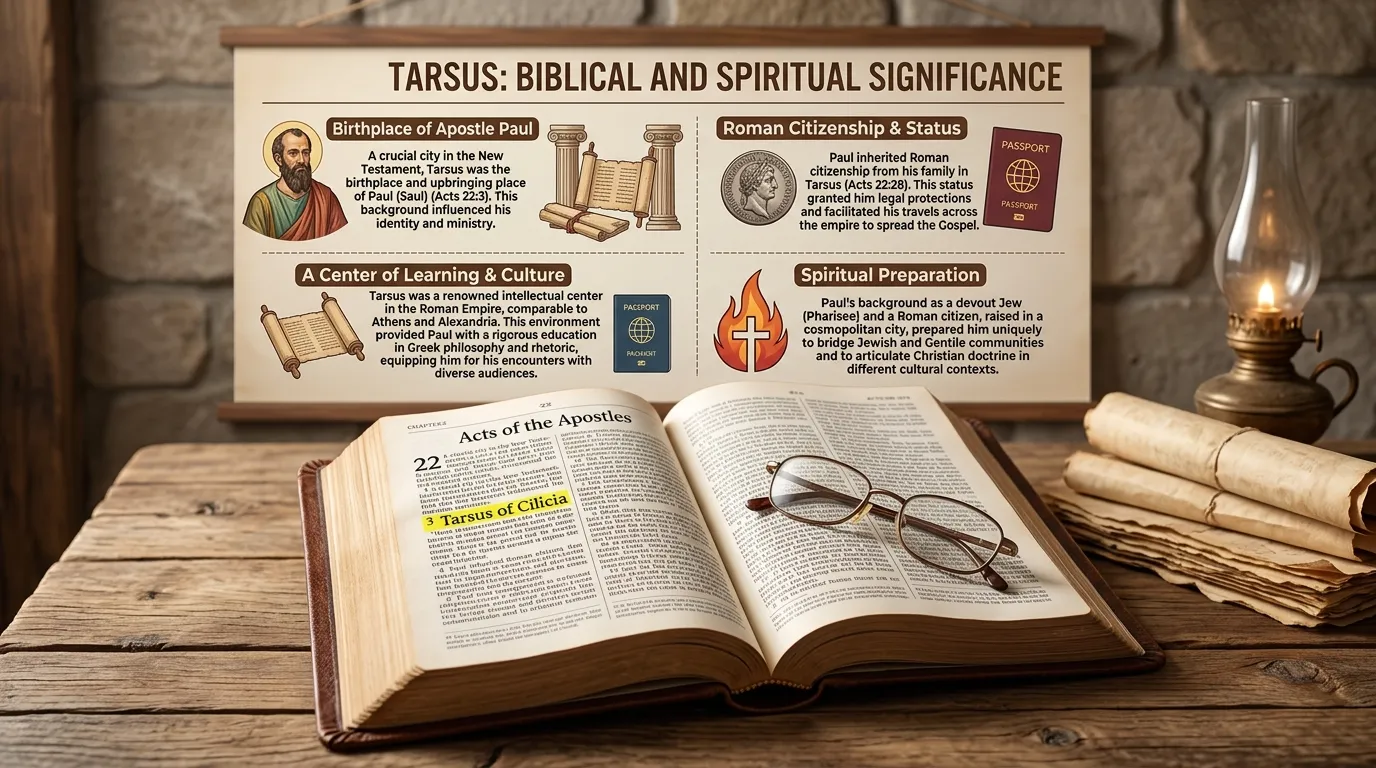
Every apostle had a hometown, but only Paul’s hometown is named with such pride in Scripture. “I am a Jew, from Tarsus in Cilicia, a citizen of no ordinary city,” he told a hostile crowd in Jerusalem (Acts 21:39). He repeated the claim in his defense: “I am a Jew, born in Tarsus in Cilicia” (Acts 22:3). Tarsus was not a footnote in Paul’s story. It was the place that shaped his languages, his citizenship, his education, and his identity long before he met Jesus on the road to Damascus. Understanding Tarsus helps explain how a man from a provincial city became the apostle to the nations.
A City of Learning and Trade
Tarsus stood on the Cydnus River in Cilicia, in what is now southern Turkey, about twelve miles inland from the Mediterranean. It was an ancient city, already old when Paul was born, and in the first century it was one of the great centers of learning in the Greek-speaking world. The geographer Strabo, writing around Paul’s time, ranked the city’s enthusiasm for philosophy and education above that of Athens and Alexandria. Students came to Tarsus to study, and its schools were famous.
The city was also a commercial center, known for its linen and for a cloth made from goat hair called cilicium, the material of the tents Paul would later make with his own hands. Tarsus sat on the trade routes between Anatolia and the sea, and its wealth and culture made it a place where Greek, Roman, and Jewish worlds overlapped. Paul grew up at a crossroads, and that crossroads would become his life’s work.
Born a Jew, Born a Roman
Paul’s identity had two layers, and both came from Tarsus. He was born into a Jewish family, a Hebrew of Hebrews, from the tribe of Benjamin, circumcised on the eighth day (Philippians 3:5). His family kept the law, spoke the language of the synagogue, and raised him in the traditions of Israel. But he was also, remarkably, born a Roman citizen. When a Roman commander prepared to flog him in Jerusalem, Paul’s quiet question, “Is it lawful for you to flog a man who is a Roman citizen and uncondemned?” stopped the proceedings cold (Acts 22:25). The commander had bought his citizenship at great cost. Paul said, “But I was born a citizen.”
How the family obtained citizenship is unknown. Perhaps an ancestor had been granted it for service to Rome, or the family had received it when Tarsus became a free city. Whatever the route, the result shaped Paul’s ministry. His citizenship protected him from summary punishment, gave him the right to appeal to Caesar, and carried him to Rome. The boy from Tarsus held a legal status that most people in the empire could only long for, and God would use it to carry the gospel to the capital.
Education: Jerusalem and Gamaliel
Paul’s education was split between two worlds. His early years were in Tarsus, where he would have absorbed Greek language and culture. But his religious formation took place in Jerusalem, where he studied under Gamaliel, one of the most respected teachers of the law (Acts 22:3). Gamaliel was a Pharisee known for his careful judgment; it was Gamaliel who urged the Sanhedrin to leave the apostles alone, warning that if their movement was from God it could not be stopped (Acts 5:34-39).
Under Gamaliel, Paul became a Pharisee of Pharisees, zealous for the traditions of his fathers (Galatians 1:14). He knew the Scriptures deeply, argued from them skillfully, and applied them with rigor. When he later wrote letters arguing that the law was fulfilled in Christ, he was not writing as an outsider criticizing a tradition he did not understand. He was writing as a man who had mastered that tradition from the inside and found it pointing to Jesus. Tarsus gave him the Greek world. Gamaliel gave him the Jewish one. Both would be needed.
The Silent Years
After Paul’s conversion, Tarsus became a place of waiting. When the church in Jerusalem feared for his life, the believers sent him away to Tarsus (Acts 9:30). He stayed there for years. Scripture says little about this period, but it was probably not idle. Tarsus was in Cilicia, and Paul later wrote that he preached in the regions of Syria and Cilicia (Galatians 1:21). The silent years in his hometown were likely years of quiet ministry, of learning to preach the gospel he had once tried to destroy.
Then Barnabas came to find him. The church in Antioch needed teachers, and Barnabas remembered the man he had vouched for in Jerusalem. He went to Tarsus to look for Saul and brought him to Antioch (Acts 11:25-26). The partnership that followed would change the world. But it began with a trip to a hometown, to fetch a man who had been waiting there in obscurity. Tarsus was not only Paul’s birthplace. It was his hiding place, his school of patience, and the place from which his public ministry was finally launched.
The Tentmaker’s Hands
Paul’s trade also came from Tarsus. He was a tentmaker, working with the goat-hair cloth for which Cilicia was known. In Corinth he practiced that trade alongside Aquila and Priscilla (Acts 18:3), and he repeatedly pointed out that he worked with his own hands so as not to be a burden to the churches (1 Thessalonians 2:9). The trade gave him independence, a way to support himself, and a natural point of contact with working people in every city he visited.
There is a quiet dignity in this detail. The apostle who reasoned with philosophers in Athens and stood before kings and governors also stitched tents. His hometown’s industry became his means of self-support. God used not only Paul’s education and citizenship but his hands.
What Tarsus Teaches
Tarsus teaches that God prepares people long before they understand their purpose. Paul’s languages, citizenship, education, and trade all came from his upbringing, and all became tools of his apostleship. None of it looked like preparation at the time. A Jewish boy growing up in a Greek city, studying in Jerusalem, learning a trade, and waiting in obscurity did not look like a man being prepared to carry the gospel to the nations. But that is what he was.
The City’s Schools and Paul’s Mind
Tarsus was famous for its schools, and that reputation matters for understanding Paul’s letters. The geographer Strabo wrote that the people of Tarsus were so devoted to learning that their city surpassed Athens and Alexandria in philosophical enthusiasm. Paul grew up in a city where argument, rhetoric, and philosophy were part of the air. When he later stood on the Areopagus in Athens and quoted Greek poets to make his case for the gospel (Acts 17:28), he was using skills that his hometown had cultivated. When he wrote letters structured like the rhetorical arguments of his day, with opening, case, and appeal, he was writing as a man formed by a city of learning.
This does not mean Paul’s theology came from Greek philosophy. It came from Scripture, from the revelation of Christ, and from the apostolic tradition. But the tools he used to express it, the Greek language, the rhetorical forms, the ability to argue with Stoics and Epicureans, were tools sharpened in Tarsus. God prepared His apostle not only in the synagogue and under Gamaliel but in the schools and streets of a Greek city.
Tarsus in the Later Story
Tarsus appears once more in the book of Acts, in a quiet but pivotal moment. After Paul’s conversion, when the church in Jerusalem feared for his life, the believers sent him to Tarsus (Acts 9:30). He stayed there for years, in the city of his birth, while the church grew without him. Then Barnabas came to find him, because the church in Antioch needed teachers (Acts 11:25). The partnership that followed changed the world. But it began with a trip to a hometown, to fetch a man who had been waiting in obscurity.
The pattern is worth noticing. Paul’s public ministry was launched from his hometown, the same place where he had been born, educated, and hidden. The city that formed him also sheltered him, and the city that sheltered him became the place from which he was called. Tarsus was not a footnote in Paul’s story. It was the beginning, the refuge, and the launching point.
It also teaches that no hometown is too ordinary for God’s purposes. Tarsus was a fine city, but it was not Jerusalem, Athens, or Rome. It was a provincial city on a river in Cilicia. Yet God chose it as the birthplace of the apostle who would write a third of the New Testament. The places that form us, even the ones we leave and return to in obscurity, are part of the story God is writing. For the city’s history, from its ancient origins to its present-day form, see the Wikipedia article on Tarsus.










