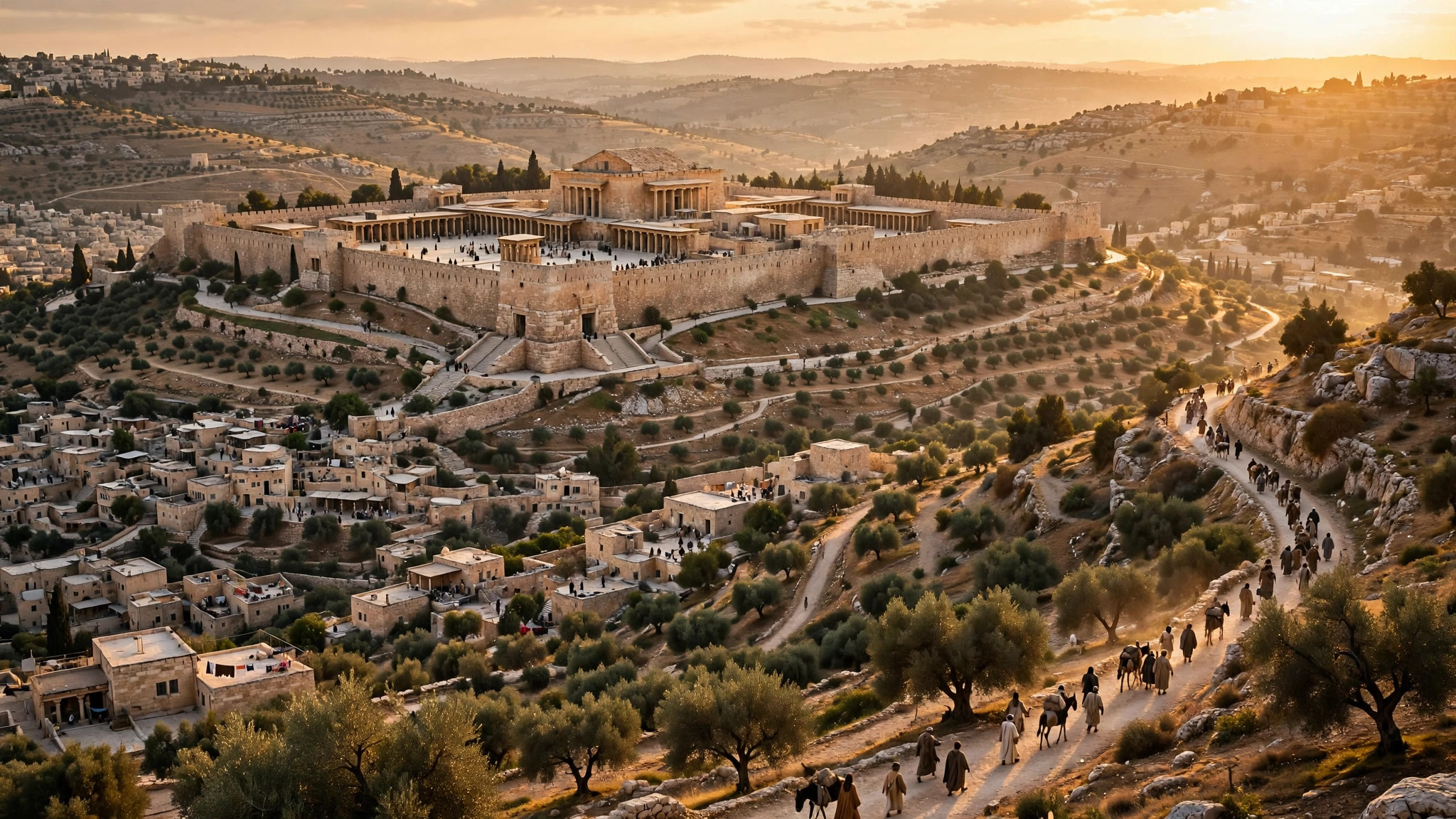
Long before Jerusalem was a headline, it was a promise. Before Bethlehem was a Christmas carol, it was a barley field where a widowed foreigner gleaned grain to survive. The Bible never just tells us what God said — it tells us where He said it. And the where matters far more than we tend to think. Each city in Israel’s story is a window into the character of the God who chose to meet His people on real streets, in real towns, under a real Middle Eastern sun.
Jerusalem: Where God Put His Name
No city in Scripture carries more weight than Jerusalem. It appears more than 800 times in the Bible — called the “city of God” (Psalm 46:4), the “holy city” (Nehemiah 11:1), and the “city of the Great King” (Psalm 48:2; Matthew 5:35). Around 1000 BC, David made it his capital and brought the ark of the covenant into it (2 Samuel 6). His son Solomon raised the temple there (1 Kings 6–8), the place where heaven and earth seemed to touch.
Outside those same walls, centuries later, Jesus was crucified and rose again (Luke 23–24). Inside them, the church was born at Pentecost when the Spirit fell (Acts 2). And the story ends where it began: with a New Jerusalem descending from heaven, God dwelling with His people forever (Revelation 21:2).
Even the name preaches. Jerusalem likely means “foundation of peace” or “city of peace,” built on shalom — which is almost ironic, since the city has known so little peace. Yet the irony itself is the point: true shalom was never going to come from walls or armies. It would come from the Prince of Peace, who wept over this city (Luke 19:41) and will one day rule from it. Jerusalem’s meaning in the Bible is, above all, this: God insists on dwelling with His people. He puts His name on a place, and then He shows up.
Bethlehem: Greatness in a Grain House
Bethlehem means “house of bread” — and into this little house of bread was born the One who called Himself “the bread of life” (John 6:35). The prophet Micah called it “small among the clans of Judah” (Micah 5:2), yet from it would come the ruler of Israel, whose origins are “from of old, from ancient times.”
Bethlehem’s lesson is God’s upside-down arithmetic: He does His greatest works in the humblest places. A feeding trough instead of a palace. A village instead of Rome. As Paul would later write, God chose “the foolish things of the world to shame the wise” and “the weak things of the world to shame the strong” (1 Corinthians 1:27). Bethlehem whispers to every overlooked person: your smallness does not disqualify you. It may be exactly what God is looking for.
Nazareth: The Town Nobody Bragged About
“Can anything good come from there?” Nathanael asked about Nazareth (John 1:46) — and the question has echoed for two thousand years. This was the despised town where Jesus grew up, worked as a carpenter, and lived most of His earthly life (Luke 2:39–40). He would forever be known as “Jesus of Nazareth.”
Even the name carries gospel freight: Nazareth is linked to netzer, the Hebrew word for “branch” — the Branch prophesied in Isaiah 11:1 that would spring from Jesse’s stump. The town the world dismissed became the hometown of the world’s Savior. Nazareth’s meaning is redemption of origins: where you come from does not determine where God can take you.
Capernaum: Privilege Has a Price Tag
Capernaum — “village of comfort” — sat on the northern shore of the Sea of Galilee and became the headquarters of Jesus’ ministry. He taught in its synagogue, healed in its streets, and performed many of His mightiest miracles there. And yet, Capernaum largely rejected Him.
Jesus’ verdict was chilling: “You will be brought down to Hades,” He told the city, “for if the miracles that were done in you had been done in Sodom, it would have remained to this day” (Matthew 11:23). Capernaum teaches the sobering side of the cities’ witness: privilege brings responsibility. To be near the light and refuse it is worse than never having seen it at all.
Jericho: Walls That Fell to a Song
Jericho — possibly “city of the moon,” or “fragrant place” — was the first city Israel faced in Canaan, and God gave them the strangest battle plan in military history: march around it for six days, seven times on the seventh, blow trumpets, shout, and watch the walls fall (Joshua 6). No siege engines. No battering rams. Just obedient faith with instruments.
Centuries later, near that same city, Jesus healed blind Bartimaeus and transformed the corrupt tax collector Zacchaeus (Mark 10:46–52; Luke 19:1–10). Jericho’s meaning runs on two tracks: some victories come only through obedient faith rather than human strength — and no city, however fortified by sin, is beyond the reach of grace.
Bethel: The House of God in the Middle of Nowhere
Bethel means “house of God,” and Jacob gave it that name after waking from his ladder dream in what had seemed like an empty field. “Surely the Lord is in this place, and I was not aware of it,” he said. “How awesome is this place! This is none other than the house of God” (Genesis 28:16–17).
Bethel’s witness is beautifully ordinary: God meets ordinary people in ordinary places. You don’t need a cathedral or a pilgrimage. Jacob found the house of God at a roadside with a stone for a pillow. Any ground becomes holy ground when He shows up (Exodus 3:5).
Hebron: Where the Promises Were Buried — Literally
Hebron was Abraham’s neighborhood. He lived there, and there he bought the cave of Machpelah to bury Sarah — the first parcel of the promised land actually owned by the promise’s heir (Genesis 23). The name comes from chavar, “to join” or “to fellowship,” and the city embodies covenant roots: the promises of God buried deep, waiting centuries to bloom.
Hebron reminds us that God’s promises often look like graves before they look like fulfillments. Abraham owned a burial plot, not a kingdom. But the God of Hebron keeps His word on His own timetable.
What the Map Is Really Telling You
Step back and look at all seven cities together, and three truths emerge. First, biblical faith is stubbornly historical — it is rooted in geography you can visit, not myths you must imagine. Second, God keeps choosing the overlooked: Bethlehem over Rome, a manger over a palace, a carpenter’s town over the capital’s courts. Third, no place is too ordinary to become holy. The ground of your kitchen, your commute, your hospital waiting room can become Bethel the moment His presence fills it.
The cities of Israel are not just ancient history. They are a map of God’s character: present (Jerusalem), humble (Bethlehem), redeeming (Nazareth), just (Capernaum), powerful (Jericho), near (Bethel), and faithful (Hebron). You may never travel to Israel, but you can walk with the God of Israel today, right where you are. If you want the historical side of the story — the walls, the temples, the centuries layered stone upon stone — the Wikipedia article on Jerusalem is a good place to start.










