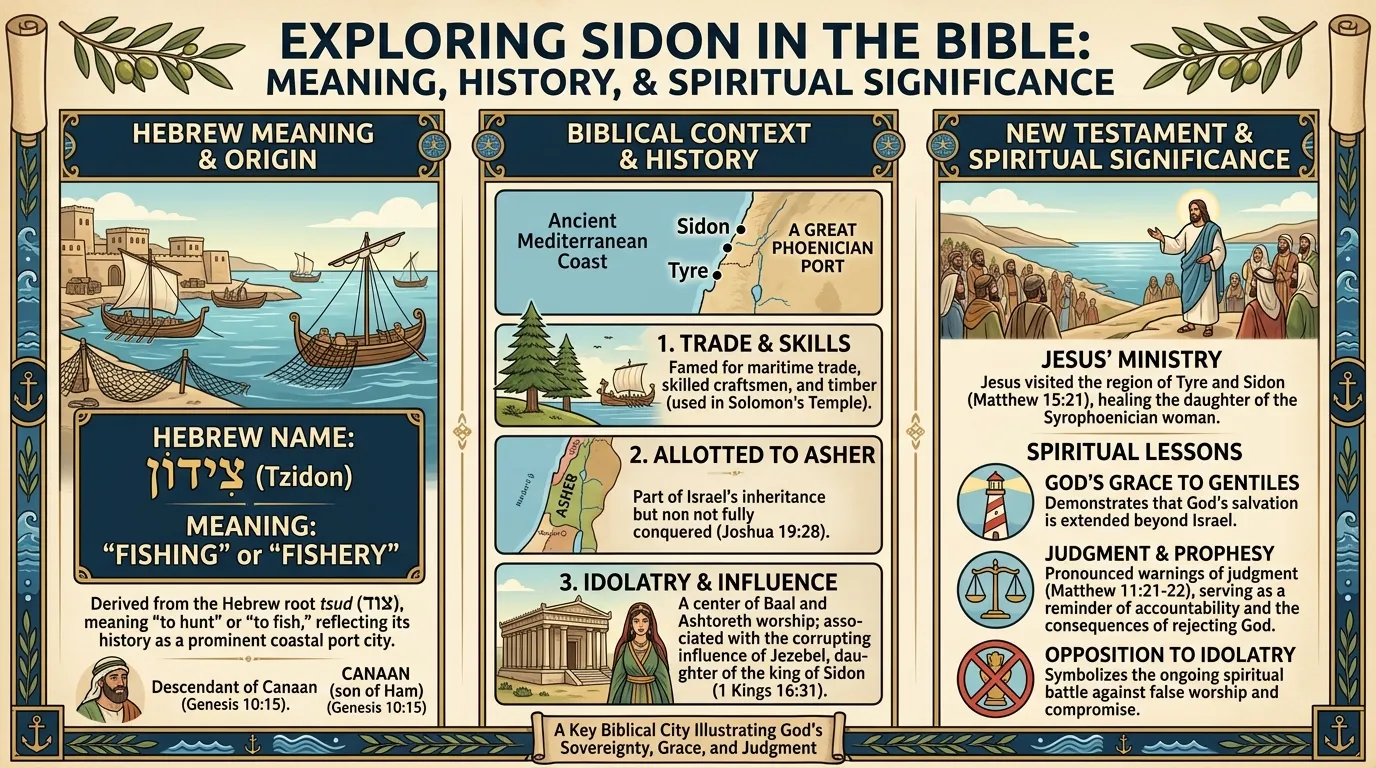
Sidon enters the Bible in the book of Genesis and does not leave it until the book of Revelation. It was a city of ships, craftsmen, and trade, the older sister of Tyre and the mother of Phoenician seafaring. Its story in the Old Testament is largely a story of influence: the influence of a wealthy, skilled, idolatrous neighbor on Israel, and the judgment that influence eventually brought. If you read Sidon only through the Old Testament, the city stands as a warning about what happens when God’s people borrow the worship of their neighbors.
A City in the Table of Nations
Sidon first appears in Genesis 10, in the Table of Nations. Canaan’s firstborn was Sidon (Genesis 10:15), which makes the city older than Israel itself and ties it to the very origins of the peoples of Canaan. When Joshua divided the land, the territory of Asher was said to reach as far as “great Sidon” (Joshua 11:8), but the Sidonians were never fully driven out. They remained on Israel’s northern border, a permanent presence: neighbors, trading partners, and a constant religious temptation.
Sidon’s wealth came from the sea. Its sailors were famous across the Mediterranean, its craftsmen produced purple dye, glass, and fine metalwork, and its ships carried timber, especially the cedar of Lebanon, to every port. The city was prosperous, cultured, and confident. In the ancient world, that combination often went together with a sense of self-sufficiency, and the prophets noticed.
Jezebel, Daughter of Sidon
The most consequential Sidonian in the Bible is Jezebel. She was the daughter of Ethbaal, king of the Sidonians, and she married Ahab, king of Israel (1 Kings 16:31). The marriage was a political alliance, the kind of union kings made to secure trade and peace. But it carried a religious cost. Jezebel brought the worship of Baal and Asherah into Israel with royal backing, built a temple for Baal in Samaria, and supported hundreds of Baal’s prophets. The conflict that followed defined a generation: Elijah on Mount Carmel, the drought, the fire from heaven, and the long struggle for Israel’s soul.
Jezebel’s story shows how Sidon’s influence worked. It did not arrive as an invading army. It arrived as a marriage, a trade agreement, and a queen’s household. The danger of Sidon was not that it would conquer Israel but that it would convert Israel, slowly and from the inside, by making foreign worship seem sophisticated, royal, and normal. The prophets’ warnings against Sidon were warnings against that kind of quiet surrender.
The Prophets’ Verdict on Sidon
Several prophets pronounced judgment on Sidon. Isaiah grouped it with Tyre in an oracle against the proud trading cities of the coast (Isaiah 23). Ezekiel delivered a direct word against Sidon: God would send pestilence and blood into its streets, and the city would know that He is the Lord (Ezekiel 28:20-24). The charge was not merely that Sidon worshiped other gods. It was that Sidon had been a “pricking thorn” to Israel, a neighbor whose influence drew God’s people away from Him.
Joel accused the people of Tyre and Sidon of selling the people of Judah into slavery to the Greeks (Joel 3:4-8), a reminder that Sidon’s trade was not always innocent. Zechariah also named Sidon among the proud coastal cities facing judgment (Zechariah 9:2). The prophetic picture is consistent: a city gifted with skill, wealth, and seafaring, whose gifts had become instruments of pride and exploitation.
The Craftsmen of Sidon and the Temple
Yet Sidon’s story in the Old Testament is not only negative. The city’s craftsmen were renowned, and when David and Solomon built, Sidonian skill was part of the work. The Sidonians supplied cedar timber and skilled labor for the temple project (1 Kings 5:6), and Solomon acknowledged that no people cut timber like them. The same hands that built idols could build the house of God. Sidon’s skill, like all human skill, was a gift that could serve either worship or idolatry.
This ambiguity is part of what makes Sidon interesting. The city was neither purely enemy nor purely friend. It was a neighbor with gifts Israel needed and gods Israel had to resist. The Old Testament does not resolve that tension with a single verdict. It holds both truths: Sidon blessed Israel with its craftsmanship and cursed Israel with its worship.
What the Old Testament’s Sidon Teaches
The Old Testament’s Sidon teaches that influence is often more dangerous than invasion. Armies can be resisted. A royal marriage, a trade partnership, and a fashionable religion are harder to recognize as threats, because they arrive as benefits. The story of Jezebel is a case study in how a culture can be changed from the inside by alliances that seemed wise at the time.
It also teaches that God judges pride in every nation, not only in Israel’s enemies. The oracles against Sidon are part of a larger pattern in the prophets: God holds all nations accountable. Wealth, skill, and seafaring did not exempt Sidon from judgment. Neither do they exempt any nation today.
Sidon in the Conquest and the Judges
After the conquest of Canaan, Sidon remained a power on Israel’s border that Israel could not subdue. The book of Judges lists the Sidonians among the peoples God left in the land to test Israel (Judges 3:3), and the test proved severe. The Sidonians’ gods, their trade, and their culture exerted a steady pull on the tribes. When the tribe of Dan sought a new territory, its spies found the city of Laish, a Sidonian colony, living in quiet security, and the Danites conquered it and renamed it Dan (Judges 18:7-10, 27-29). The episode shows Sidon’s reach: its colonies dotted the region, and its influence extended far beyond its walls.
The book of Judges also records that the Sidonians oppressed Israel at one point, and that God delivered Israel from their hand (Judges 10:12). The relationship between Israel and Sidon was never simple. Sidon was neighbor, oppressor, trading partner, and tempter, sometimes all at once. The Old Testament does not flatten the city into a single role. It shows a complicated neighbor whose presence shaped Israel’s history for centuries.
The Cedar Trade and the Kings of Israel
Sidon’s most constructive relationship with Israel came through timber. The cedars of Lebanon, harvested and shipped by Phoenician craftsmen, were the finest building material in the ancient world, and Sidon’s sailors and loggers controlled the trade. When David built his palace, Sidonian craftsmen were part of the work. When Solomon built the temple, the arrangement became formal: Solomon asked Hiram of Tyre for cedar and cypress, and the Phoenician cities supplied the timber and the skilled labor (1 Kings 5:6-10). The temple that stood at the center of Israel’s worship was built, in part, with Sidonian skill.
This partnership shows that the Old Testament’s view of Sidon is not one of unrelieved hostility. The city’s gifts were real, and when those gifts served God’s purposes, they were a blessing. The same hands that built idol temples could build the house of the Lord. The same trade networks that carried idols could carry cedar for the temple. Sidon’s story in the Old Testament is therefore a story of gifts that could serve either worship or idolatry, and the difference was never in the gift. It was in the god it served.
Sidon in the Days of Jesus’ Contemporaries
Sidon continued to matter in the period between the Old Testament and the New. The city passed from Persian to Greek to Roman control, and its trade networks adapted to each new empire. By the first century, Sidon was a prosperous Roman-era port, still known for its craftsmen and its ships, still standing on Israel’s northern border. The old hostilities had faded into a wary coexistence. Jews and Sidonians traded, traveled, and lived alongside one another, and the region’s mixed population meant that a journey to the region of Tyre and Sidon was a journey into a Gentile world that was both familiar and foreign.
That history helps explain why Jesus’ visit to the region was significant. He was not traveling to a mythical land. He was traveling to a real place with a long, complicated history with Israel, a place whose influence had once corrupted Israel’s worship and whose craftsmen had once built Israel’s temple. The region carried both memories at once: the memory of Jezebel and the memory of the cedar trade. Jesus’ encounter with the Canaanite woman, told in the companion article on Sidon, took place against that whole backdrop, and it is richer for it.
The Weight of a Neighbor’s Influence
The Old Testament’s Sidon ultimately teaches that the most dangerous influences are rarely the ones that attack from outside. They are the ones that move in next door, marry into the family, and make their worship seem normal. Jezebel did not conquer Israel. She married into it. Sidon’s trade did not invade Israel. It enriched it. The prophets’ warnings against Sidon were warnings against the slow, comfortable drift that happens when God’s people stop noticing the difference between their worship and their neighbors’. That drift is the oldest temptation in the Bible, and Sidon is one of its clearest case studies.
Finally, the Old Testament’s Sidon teaches that God’s purposes are bigger than any one city’s failures. The same coastline that produced Jezebel would later hear the footsteps of Jesus. The same region whose worship had corrupted Israel would become a place where a Gentile woman’s faith would be praised. That part of the story belongs to the New Testament, and it is told in the companion article on Sidon. The historical background of the ancient city, its harbor, and its long history can be found in the Wikipedia article on Sidon.










