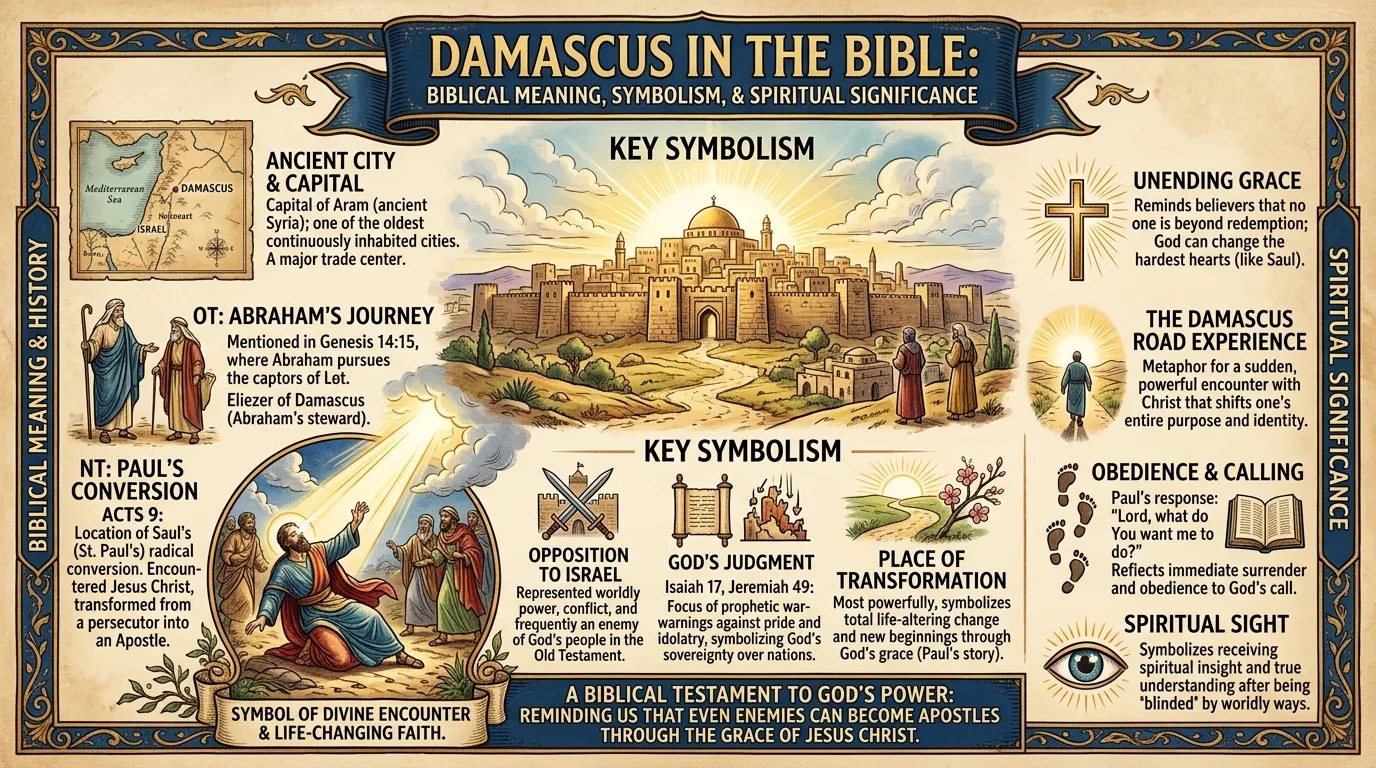
Damascus is one of the oldest continuously inhabited cities on earth, and its story in the Bible spans almost the whole of Scripture, from Genesis to the letters of Paul. It appears as a neighbor, a rival, a conqueror, and finally as the place where the church’s greatest persecutor became its greatest apostle. No single verse defines what Damascus means. Its meaning emerges from the long arc: a city that stood against God’s people, received God’s judgment, and then became the stage for one of the most startling acts of mercy in the Bible.
The City in the Patriarchs’ World
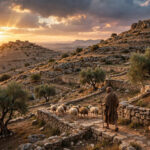
Damascus enters the biblical story quietly. When God promised Abraham an heir, Abraham pointed out that his household was headed by Eliezer of Damascus (Genesis 15:2). The city was already ancient, a great oasis settlement on the trade routes between Mesopotamia and Egypt, watered by the rivers Abana and Pharpar. Later, when Abraham’s servant went to find a wife for Isaac, the journey passed through the same world of caravan routes that made Damascus rich.
In David’s reign, Damascus became a military matter. David defeated the Arameans of Damascus and stationed garrisons there (2 Samuel 8:5-6). Under Solomon, the city slipped from Israel’s control. From then on, Damascus was usually Israel’s rival rather than its possession. The kingdom of Aram, with Damascus as its capital, fought a long series of wars against Israel and Judah, sometimes alone and sometimes in alliance with others. The prophets spoke of Damascus often, and their words were usually words of judgment against its pride and violence (Amos 1:3-5; Isaiah 17:1-3).
Naaman and the Rivers of Damascus
One of the most memorable Damascus stories comes from the days of Elisha. Naaman, the commander of the Syrian army, suffered from leprosy and traveled to Israel seeking healing. When Elisha told him to wash seven times in the Jordan River, Naaman was furious. “Are not Abana and Pharpar, the rivers of Damascus, better than all the waters of Israel?” he demanded (2 Kings 5:12). He had expected a grand ceremony. He got a humiliating instruction.
Naaman’s servants persuaded him to obey, and he was healed. The story has become a classic picture of how God’s grace works: it does not flatter our sense of importance, and it often comes through a path we consider beneath us. Naaman came from Damascus expecting Damascus to be better. He left knowing that the God of Israel was the God of the whole earth, and he carried Israelite soil home with him so he could worship the Lord on it (2 Kings 5:17). Damascus, the city of the proud commander, produced a man who learned humility.
The Road to Damascus
For most Christians, Damascus means one thing above all: the road. Saul of Tarsus was traveling toward Damascus with letters from the high priest authorizing him to arrest followers of Jesus and bring them to Jerusalem (Acts 9:1-2). He was not wandering or doubting. He was a man on a mission, convinced that the followers of Jesus were a threat to God’s law. Near Damascus, a light from heaven flashed around him, he fell to the ground, and he heard a voice: “Saul, Saul, why are you persecuting me?” (Acts 9:4). The voice identified itself as Jesus.
Saul entered Damascus blind, led by the hand. For three days he neither ate nor drank. Then a disciple named Ananias, who had every reason to fear him, came to him at the Lord’s command, laid hands on him, and called him “Brother Saul.” Saul’s sight returned, he was baptized, and he began at once to proclaim Jesus in the synagogues of Damascus, to the astonishment of everyone who had known his purpose in coming (Acts 9:20-22).
The road to Damascus has become the Bible’s great image of interrupted purpose. Saul had a plan, a commission, and a destination. God stopped him in the middle of it and gave him a new one. The city that was meant to be the scene of his triumph over the church became the scene of his surrender to Christ.
Escape in a Basket
Damascus also holds the end of that first chapter of Paul’s Christian life. The opposition that had once sent Saul to Damascus now turned against him there. The Jews plotted to kill him, and the governor under King Aretas guarded the city gates to arrest him. The disciples lowered Paul down the city wall in a basket at night, and he escaped (Acts 9:23-25; 2 Corinthians 11:32-33). Paul would later recall this humiliating escape as a defining memory, a reminder that his apostleship began not with triumph but with being smuggled out of a city in a basket.
The detail matters. Paul’s story in Damascus is bookended by two kinds of helplessness: blind and led by the hand at the beginning, lowered down a wall in a basket at the end. The man who had arrived as a feared enforcer left as a fugitive. God’s strength, Paul would later write, is made perfect in weakness (2 Corinthians 12:9). Damascus was where he first learned that.
Judgment and Mercy in the Same City
Damascus thus carries two strands of meaning that run through all of Scripture. The prophets’ strand is judgment: a proud city that trusted in its walls, its wealth, and its armies would face the consequences of its violence. The Acts strand is mercy: the persecutor who came to arrest Christians met Christ on the road and became a Christian himself. Both strands are true, and the second does not cancel the first. God’s judgment is real, and God’s mercy is real, and Damascus shows both.
Damascus in the Prophets’ Warnings
Between the patriarchs and Paul, Damascus appears repeatedly in the prophetic books, and the tone is consistently severe. Amos opens his oracles with a judgment on Damascus for its cruelty in war: “For three transgressions of Damascus, and for four, I will not revoke the punishment, because they have threshed Gilead with threshing sledges of iron” (Amos 1:3). The image is of a nation that treated its neighbors the way a farmer treats grain, grinding them under iron. Isaiah pronounced that Damascus would cease to be a city and become a heap of ruins (Isaiah 17:1). Jeremiah and Zechariah added their own oracles against the city.
These warnings are not arbitrary. Damascus had been a persistent aggressor against Israel and Judah, and its power rested on military strength and trade wealth. The prophets held it accountable the same way they held Israel accountable: not because it was foreign, but because it was unjust. The oracles against Damascus are part of a larger biblical claim that God judges all nations by the same moral standard. Power does not exempt a city from accountability, and neither does antiquity.
The Damascus That Paul Knew
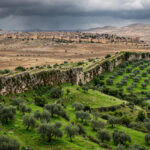
By Paul’s day, Damascus was a prosperous city under the shadow of Roman power, governed through the Nabatean king Aretas IV, whose governor controlled the city (2 Corinthians 11:32). It had a significant Jewish population, with synagogues where Paul, after his conversion, preached Jesus as the Son of God. The city sat on the trade routes between Arabia, Mesopotamia, and the Mediterranean, and its bazaars and caravan traffic made it one of the great crossroads of the Near East.
The road Paul traveled to Damascus was itself part of the city’s story. It was a well-worn route, used by armies, merchants, and pilgrims. Saul traveled it as an enforcer, armed with letters of authority. He returned along the same route, or left by a different one, as a fugitive in a basket. The road that had carried his mission of persecution became the road of his conversion, and the city that had been the destination of his threats became the birthplace of his apostleship. Damascus holds both halves of Paul’s story: the man he was when he arrived and the man he became before he left.
Damascus and the Early Church’s Expansion
Damascus also played a role in the early spread of the gospel beyond its walls. Paul himself, after his conversion and his escape in a basket, went into Arabia before returning to Damascus (Galatians 1:17). The churches in the region grew, and Damascus became one of the early centers of Christianity in Syria. The city that had been the destination of Saul’s persecution became a base for the gospel’s advance into the east. The reversal was complete: the city where Saul had meant to arrest Christians became a city where Christians worshiped freely, and the man who had come to destroy them became their apostle.
The transformation of Damascus is a picture of what the gospel does to places as well as people. It does not merely change individuals. It changes cities, cultures, and histories. The road to Damascus is not only Paul’s story. It is the story of a city that was interrupted by grace and never the same again.
For readers today, Damascus stands as a reminder that no city, no institution, and no person is beyond the reach of either truth. The proud may fall. The persecutor may be converted. The road we travel with one purpose may become the road where God gives us another. Damascus is where God interrupted a man at full speed, and the church has never been the same. Readers who want the city’s long history, from its ancient origins to the present, can find it in the Wikipedia article on Damascus.