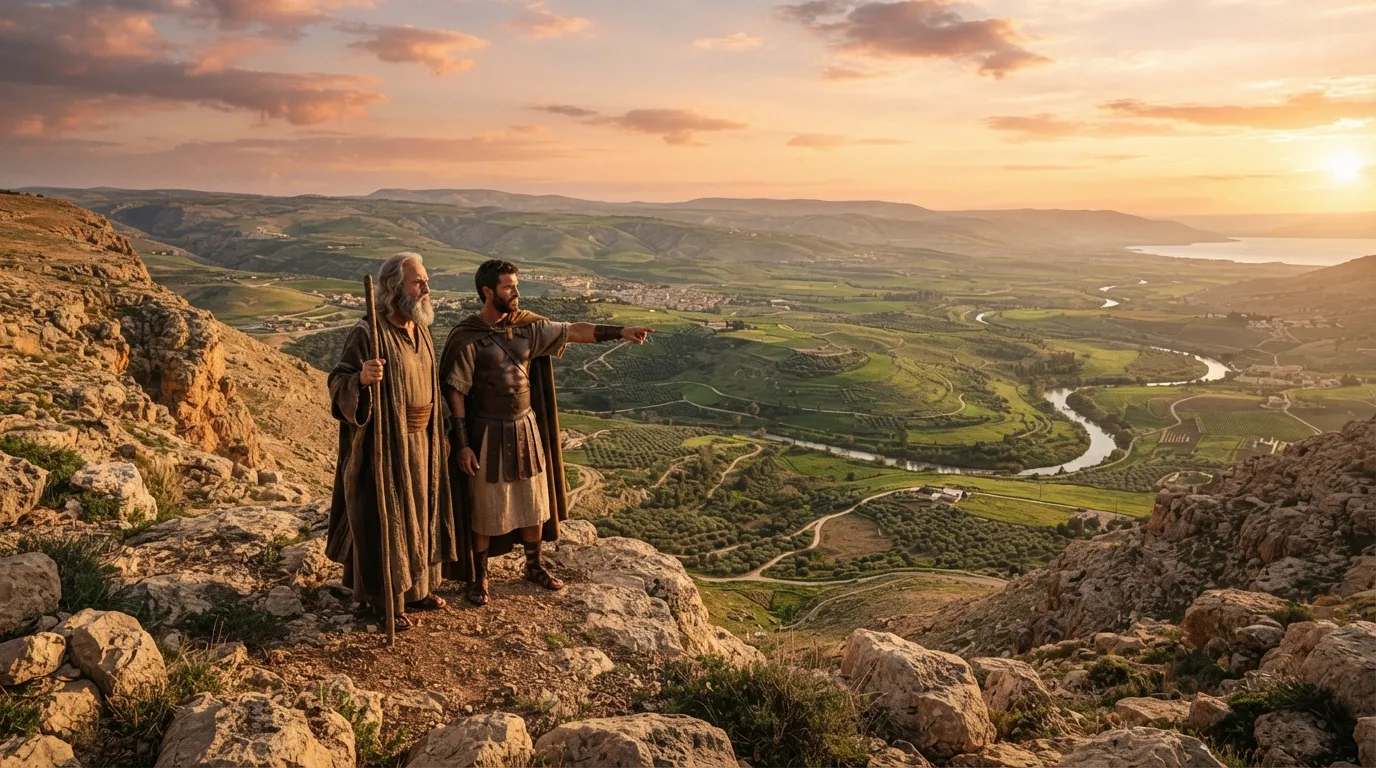
The promise was made to a man with no land, no son, and no army. God told Abram to leave his country and his family, and go “to the land that I will show you” (Genesis 12:1). Abram did not get a map. He got a voice and a promise. Everything that follows in the Bible — slavery, exodus, wilderness, conquest, exile, return — is the long story of God keeping that promise to people who kept failing to believe it.
The Promised Land is first of all a real place: Canaan, the region between the Jordan River and the Mediterranean Sea, where Israel settled after the exodus. But it is never only a place. In Scripture it becomes the stage on which God demonstrates His faithfulness, His justice, His patience, and His longing to dwell with His people. To understand it, follow the journey in four movements: promise, delay, entry, and rest.
Movement One: The Promise
God’s promise to Abraham unfolds in stages. In Genesis 12, the land is promised but unnamed. In Genesis 13, Abraham is told to look in every direction — “all the land that you see I will give to you and to your offspring forever.” In Genesis 15, God formalizes it in a covenant, walking alone between the pieces of sacrificed animals, signifying that He takes the entire obligation on Himself. The boundaries given in Genesis 15:18–21 stretch from the river of Egypt to the Euphrates — a vast territory that Israel never fully possessed at any one time.
The promise was repeated to Isaac and Jacob, and it became the anchor of Israel’s identity. When Joseph died in Egypt, he made his brothers swear to carry his bones back to the land, “for God will surely visit you” (Genesis 50:25). Four hundred years of slavery did not erase the promise. It only made the people who remembered it more desperate for it.
Notice what the promise is not. It is not a reward for Abraham’s goodness. Abraham was chosen by grace, and his record — lying about his wife twice, taking a shortcut through Hagar — is not the record of a man who earned a continent. The land is gift, not wage. That matters because every later generation of Israel would be tempted to treat the land as entitlement. Scripture insists it was always grace.
Movement Two: The Delay
Between promise and possession lay a wilderness. Israel left Egypt with miracles, crossed the Red Sea on dry ground, and then spent forty years circling because of unbelief. At Kadesh Barnea, twelve spies scouted the land; ten came back terrified, and the people refused to enter. “Would that we had died in the land of Egypt!” they cried (Numbers 14:2). God’s response was sobering: that generation would die in the wilderness, and their children would enter instead.
The delay teaches something uncomfortable: God’s promises are certain, but our experience of them can be delayed by our own unbelief. The land was still promised. God did not revoke it. But the people who refused to trust Him did not get to enjoy it. Faith is not the price of the promise; it is the hand that receives it. A closed hand receives nothing.
The wilderness was not wasted, though. It was where Israel learned to depend on daily manna, to follow the pillar of cloud and fire, to receive the law, and to discover that God was with them in the desert, not only in the destination. Many believers live their whole lives in the wilderness between promise and fulfillment — praying for healing, for a child, for a prodigal, for a calling — and the wilderness is where they learn that God Himself is the promise, before the land is.
Movement Three: The Entry
When Joshua finally led the people across the Jordan, the crossing echoed the Red Sea: God parted the waters again, and Israel walked through on dry ground. The message was unmistakable — the same God who brought them out of Egypt was bringing them into Canaan. The conquest that followed was not a land grab; Scripture presents it as God’s judgment on the Canaanites’ entrenched wickedness, centuries in the making (Genesis 15:16), and as God’s gift to His people.
But entry was not the end of the struggle. The land had to be occupied tribe by tribe, and Israel’s obedience was partial. Judges records the tragic cycle: compromise with the Canaanites, idolatry, oppression, crying out, deliverance — repeated for generations. The land was God’s gift, but keeping it required covenant faithfulness. Possessing the promise and enjoying the promise turned out to be two different things, and Israel often had the first without the second.
Joshua’s retrospective is the high-water mark: “Not one word of all the good promises that the LORD had made to the house of Israel had failed; all came to pass” (Joshua 21:45). The promise-keeper kept His word. The failure was never on God’s side of the covenant.
Movement Four: The Rest That Remains
The story does not end with Joshua. The book of Hebrews re-reads the Promised Land as a picture of something greater. If Joshua had given Israel the final rest, Hebrews argues, God would not later speak of “another day.” “So then, there remains a Sabbath rest for the people of God” (Hebrews 4:9). The land was real, but it was also a shadow of the rest that comes through Christ — rest from striving, from guilt, from the wilderness of self-salvation.
This is where Christians find themselves in the story. The New Testament never promises believers a piece of Middle Eastern real estate. It promises something the land pointed to: an inheritance “imperishable, undefiled, and unfading, kept in heaven for you” (1 Peter 1:4). The land was a down payment. The full inheritance is the new creation, where God will dwell with His people and there will be no more wilderness, no more giants, no more unbelief.
That reframes how Christians read the Old Testament land promises. The land mattered enormously to Israel, and it still matters in the history of the Jewish people. But the Christian hope is not a return to a map. It is a return to the God of the map — the God who promised, waited, delivered, and will one day finish what He started.
What the Land Teaches About God
First, God keeps His promises, but on His timetable. Four centuries passed between Abraham and Joshua. Generations lived and died in the gap. A promise delayed is not a promise denied. Second, God’s gifts come with God’s conditions: the land was grace, but enjoying it required obedience. Third, God is present in the wilderness, not only in the destination. The same pillar of fire that led Israel through the desert is the Spirit who leads believers today. Fourth, every earthly fulfillment is a foretaste. The land was good, but it was not final. The best is still ahead.
The Land Lost and Regained
The story of the land does not end with Joshua. Israel’s possession of it was conditional on covenant faithfulness, and Israel’s faithfulness failed again and again. The prophets warned that continued idolatry and injustice would cost the nation the land, and the warnings came true. In 722 BC, Assyria conquered the northern kingdom and scattered its people. In 586 BC, Babylon destroyed Jerusalem and carried Judah into exile. The land that had been promised, entered, and enjoyed was lost — not because God broke His promise, but because the people broke the covenant. The exile is the dark mirror of the exodus: the same God who brought His people into the land brought them out of it, in judgment.
Yet even in exile, the promise survived. The prophets who announced judgment also announced return. Jeremiah promised that after seventy years, God would bring His people back. Isaiah spoke of a highway in the desert. Ezekiel saw dry bones come to life. And in 538 BC, under the Persian king Cyrus, a remnant did return, rebuilt the temple, and resettled the land. The return was smaller and poorer than the exodus, but it proved the point: God’s promises outlast His people’s failures. The land was lost by sin and regained by grace — the same pattern that runs through the whole Bible.
The exile also deepened Israel’s understanding of the land. The exiles learned that God was not confined to one territory — Ezekiel saw God’s glory by the river Chebar in Babylon. They learned that the land was a gift, not a possession, and that the deepest promise was not a place but a presence. That lesson prepared the way for the New Testament’s re-reading of the land as a picture of the rest that remains — a rest that no exile can take away, because it is kept in heaven.
That is why the Promised Land still stirs the hearts of people who will never live there. Everyone knows what it is to stand between a promise and its fulfillment — to have heard God’s word and not yet seen it. The story of the land says: the God who spoke is the God who delivers, the wilderness is not the end, and the rest that remains is worth the whole journey. For the geography, history, and significance of this land across the biblical story, see the overview of the Promised Land in biblical and later tradition.










