“Teacher,” the expert in the law asked, “what must I do to inherit eternal life?” It sounded like a sincere question. Luke tells us it was a test (Luke 10:25). What follows is one of the most famous stories ever told — and one of the most misunderstood. The Parable of the Good Samaritan is routinely reduced to a moral about being nice, quoted by people who have never read its context and would be shocked by its original punch. Jesus did not tell this story to inspire random acts of kindness. He told it to detonate a lawyer’s theology, to redefine the word “neighbor,” and to expose what religion looks like when it has a Bible but no heart.
The setup matters. The lawyer answers his own question correctly — love God, love your neighbor (Luke 10:27) — and Jesus says, “Do this and you will live.” Then comes the verse that lights the fuse: “But he wanted to justify himself, so he asked Jesus, ‘And who is my neighbor?'” (Luke 10:29). He is not seeking information; he is seeking limitation. Give me the boundaries of my obligation, he is saying. Tell me exactly whom I must love, so I can be sure about whom I may ignore. Jesus answers with a story that refuses to stay inside any boundary the lawyer can draw.
The Road Down to Jericho
“A man was going down from Jerusalem to Jericho, when he was attacked by robbers. They stripped him of his clothes, beat him and went away, leaving him half dead” (Luke 10:30). Jesus’ audience knew this road. The seventeen-mile descent from Jerusalem (2,500 feet above sea level) to Jericho (800 feet below) wound through desert ravines — a notorious ambush corridor. To a first-century listener, the traveler is immediately sympathetic and the situation immediately tense: a half-dead man on a bandit road, and the story is just beginning.
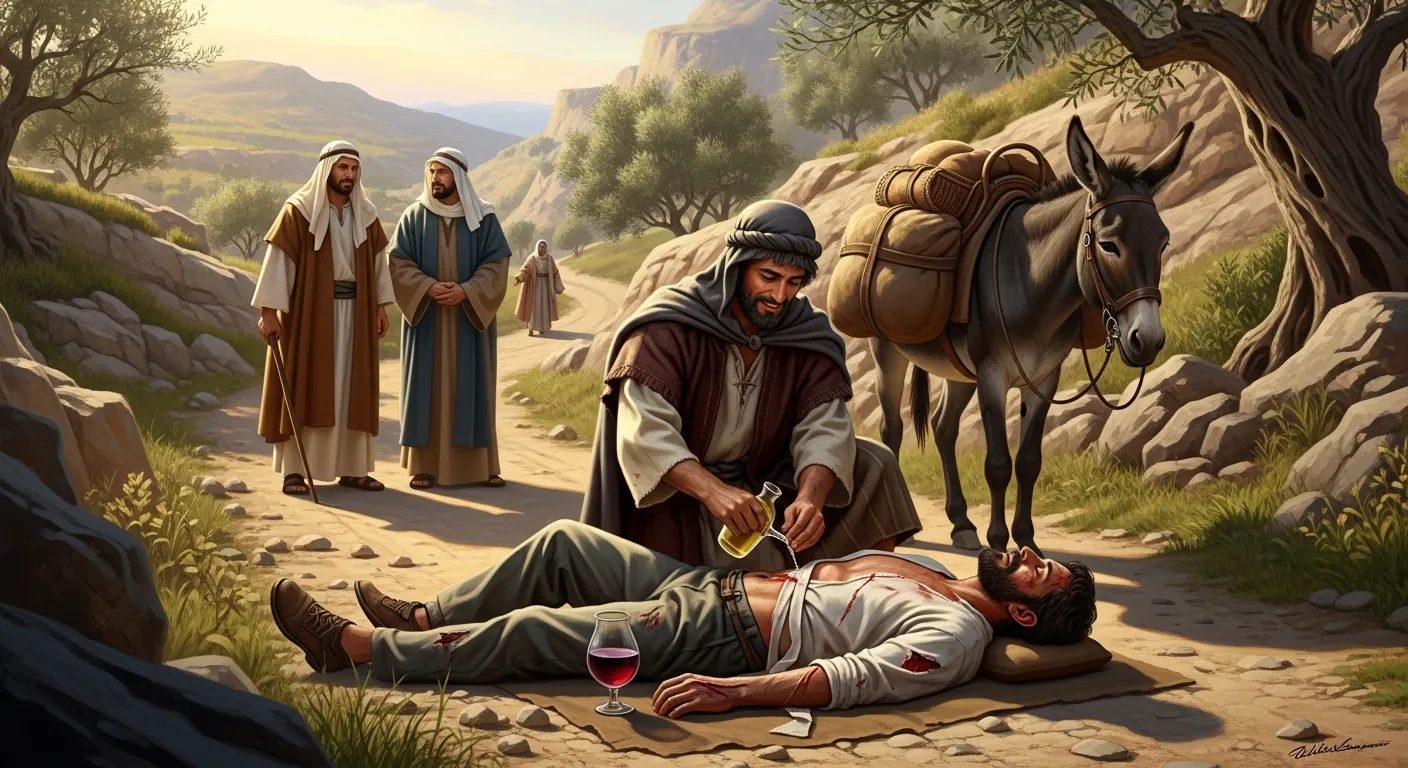
Then the priest appears, “going down the same road.” Then a Levite. Both see the man. Both “passed by on the other side” (Luke 10:31–32). The Greek is blunt; they deliberately crossed to the far side of the road. Jesus’ audience would have felt the scandal building. These are the religious professionals, the men who teach the law the lawyer is an expert in. Their reasons for passing by are easy to imagine — ritual purity (touching a possibly-dead body would defile them), safety, schedule, the calculation that someone else will deal with it. Jesus does not explain their motives. He does not need to. The crossed road says everything.
The Hero Nobody Wanted
“But a Samaritan, as he traveled, came where the man was; and when he saw him, he took pity on him” (Luke 10:33). The word “but” does enormous work. The audience expected the third traveler to be an ordinary Israelite — the hero who shames the clergy by doing what they would not. Instead Jesus makes the hero a Samaritan, a member of the despised half-breed sect that Jews considered heretics and traitors. The lawyer who asked “who is my neighbor” would have considered Samaritans the very definition of non-neighbor.
That choice is the parable’s detonator. Jesus does not merely say “help hurting people.” He says: the man you consider racially and religiously beneath you is the one who understands God’s law, while the men you admire walk past a dying man to keep their purity. It is a complete inversion of the lawyer’s moral universe. The “neighbor” is not the person in your group; the neighbor is the person who acts like one — even, especially, when he comes from the group you despise.
What Mercy Actually Did
Look closely at what the Samaritan does, because Jesus describes it with unusual concreteness. He bandages the wounds, pouring on oil and wine — the first-century field medic’s kit, wine to disinfect, oil to soothe. He puts the man on his own donkey, which means the Samaritan walks. He takes him to an inn and “took care of him.” The next day he pays the innkeeper two denarii — two days’ wages — and says, “Look after him, and when I return, I will reimburse you for any extra expense you may have” (Luke 10:34–35).
This is not a feeling; it is a ledger. Mercy, in this story, has costs: time, effort, money, an open-ended commitment (“whatever more you spend”). The Samaritan does not merely feel pity — the priest and Levite may have felt pity too, from the other side of the road. He converts pity into action, and action into ongoing responsibility. James would later write that faith without works is dead (James 2:17); this parable is that epistle in narrative form, told years before James wrote a word.
The Question Turned Around
Jesus ends not with a moral but with a question: “Which of these three do you think was a neighbor to the man who fell into the hands of robbers?” (Luke 10:36). Notice the reversal. The lawyer asked, “Who is my neighbor?” — a question about the other person’s identity, designed to limit obligation. Jesus asks, “Who was neighbor to him?” — a question about my behavior, which admits no limits. The lawyer wanted a definition; Jesus gave him a vocation.
The lawyer’s answer is telling: he cannot even say the word “Samaritan.” “The one who had mercy on him,” he mutters. Jesus does not let him off with abstraction: “Go and do likewise” (Luke 10:37). The story that began as a theological test ends as a marching order.
The Deeper Picture
Many Christians through the centuries have also seen a second, deeper layer in the story — an allegory of salvation itself. In this reading, the traveler is fallen humanity, beaten and left half-dead by sin; the priest and Levite are the law and the sacrifices, which see our wound but cannot heal it; the Samaritan is Christ himself, the unexpected Savior, who finds us on the road, binds our wounds, carries us, pays our debt, and promises to return. The early church fathers loved this reading, and there is real beauty in it: the inn as the church, the two denarii as the present age’s provision, the promised return as the second coming.
Whether or not Jesus intended every detail allegorically, the two readings converge on the same center: mercy that crosses boundaries and pays the price. God did not pass by on the other side of the road when humanity lay beaten. He came down the road himself. And those who have received that mercy are conscripted into showing it — to the wounded person in front of them, whoever he is, wherever the road has left him.
The parable’s final challenge is uncomfortably concrete. It does not ask whether you feel compassion for suffering in general. It asks about the specific half-dead traveler on your road — the difficult colleague, the estranged family member, the person from the group you have written off — and whether you will cross to their side instead of passing by on yours. The lawyer wanted to know the minimum. Jesus showed him there isn’t one.
Who Were the Samaritans?
The parable’s shock depends on understanding who the Samaritans were to Jesus’ audience — and it was not a mild dislike. After Assyria conquered the northern kingdom (722 BC), it resettled the region with foreign peoples who intermarried with the remaining Israelites (2 Kings 17:24–41). The result was a mixed population with a mixed religion: they worshiped the LORD but also served their own gods, and they built a rival temple on Mount Gerizim, rejecting Jerusalem.
By Jesus’ day, the hostility was centuries deep. Jews considered Samaritans racially impure and religiously heretical; Samaritans returned the contempt. The woman at the well states it as common knowledge: “Jews do not associate with Samaritans” (John 4:9). “Samaritan” was even used as a slur — Jesus’ opponents hurled it at him: “Are we not right in saying that you are a Samaritan and demon-possessed?” (John 8:48).
This is why the parable is not merely about kindness but about prejudice. Jesus could have made the hero a third Jewish traveler — a farmer, a merchant — and the story would still teach mercy. By choosing a Samaritan, he forces his audience to receive moral instruction from the very people they despised, and to imagine themselves beaten on the roadside, dependent on the mercy of someone they would cross the street to avoid. The neighbor question is answered, but the answer indicts the asker’s entire worldview. Mercy, Jesus insists, does not check identity papers.
Those curious about the parable’s long afterlife — in law, ethics, art, and the famous legal principle of the “duty to rescue” debates it inspired — can start with the Wikipedia article on the Parable of the Good Samaritan, which traces its cultural and interpretive history.










