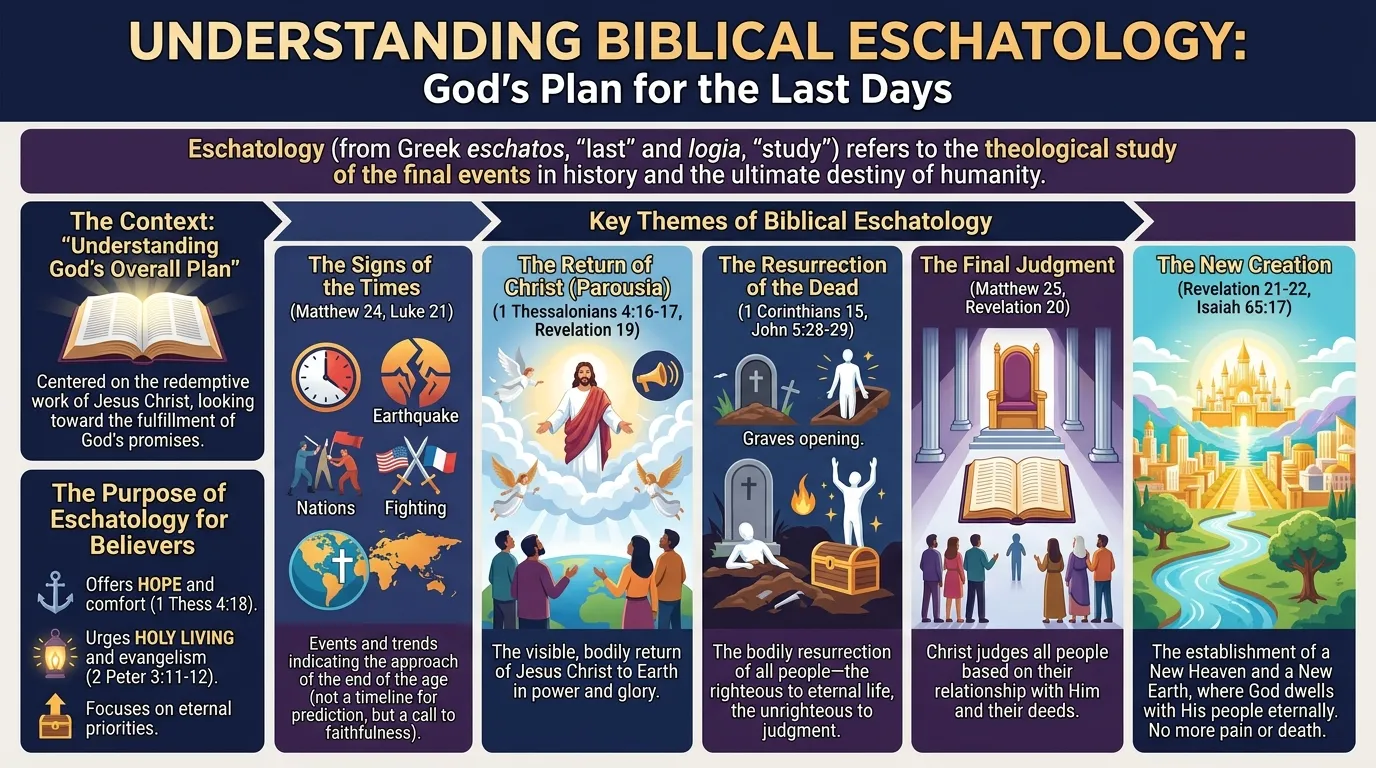
Eschatology is the study of last things — from the Greek eschatos (last) and logos (word, study). It asks the biggest questions the Bible raises: How will history end? What happens when Christ returns? What is the final judgment, and what comes after? Christians have studied these questions for two thousand years, and they have not always agreed on the answers. This article surveys what the Bible clearly teaches, where faithful Christians differ, and how to hold convictions about the future without losing charity in the present.
One ground rule first: the Bible forbids date-setting. Jesus said plainly, “Concerning that day and hour no one knows, not even the angels of heaven, nor the Son, but the Father only.” Every prediction of Christ’s return date has failed, without exception, and each failure has damaged the church’s credibility. Eschatology is the study of what God has promised, not the calculation of when. Keep that boundary, and the study is fruitful. Cross it, and it becomes folly.
What All Christians Confess
Before the disagreements, the consensus — and it is substantial. The creeds that have united Christians for seventeen centuries affirm the same future: Christ will return visibly and bodily. The dead will be raised. There will be a final judgment. The righteous will enter eternal life and the wicked eternal punishment. God will make all things new — a new heaven and a new earth, where He dwells with His people forever.
These are not minor details. They are the load-bearing walls of Christian hope. The return of Christ means history has a destination, not just a drift. The resurrection means death is not the end of the person. The judgment means evil will be answered. The new creation means the story ends in restoration, not annihilation. Christians who disagree about the millennium agree about all of this — and all of this is enough to live and die on.
The Old Testament foundation matters too. The Hebrew prophets spoke of “the day of the Lord” — a coming day of divine intervention, judgment on evil, and vindication of the righteous. The phrase acharit hayamim, “the latter days” or “the end of days,” frames prophecies from Jacob’s blessing of his sons to Isaiah’s vision of the mountain of the Lord. Eschatology did not begin with Revelation. It began with the promise that God would act decisively at the end.
The Millennium: Three Faithful Readings
The main disagreement concerns Revelation 20 and its “thousand years” — the millennium, during which Christ reigns and Satan is bound. Three major interpretations have been held by orthodox Christians, and each deserves a fair hearing.
Premillennialism reads the thousand years as a future earthly reign of Christ, following His return. In the classic dispensational form, history proceeds through distinct eras, Israel and the church have separate destinies, and Christ returns before (hence “pre-“) the millennium to establish His kingdom in Jerusalem. In the historic form, held by many early church fathers, the return precedes a literal thousand-year reign without the dispensational framework. Strengths: it takes Revelation’s sequence at face value and honors the Old Testament’s unfulfilled kingdom promises. Challenges: it must explain how a perfected earthly kingdom coexists with the final rebellion Revelation describes.
Amillennialism reads the thousand years symbolically — as the present church age, during which Christ reigns from heaven and Satan is “bound” in the sense that he can no longer deceive the nations as he once did. The millennium is happening now, spiritually. Strengths: it fits the New Testament’s “already/not yet” tension and avoids speculative timelines. Challenges: it must explain in what sense Satan is currently bound, given the evident evil in the world. Held by Augustine, the Reformers, and much of the historic church.
Postmillennialism expects the gospel to progressively triumph in history, producing a golden age of Christian influence — the millennium — before Christ returns at its close. Strengths: it takes the Great Commission’s scope seriously and fuels cultural engagement. Challenges: the twentieth century’s horrors made optimism about history harder to sustain, though its advocates reply that God’s timetable is longer than ours.
Which is right? Faithful scholars disagree, and the church has never made any of the three a test of orthodoxy. What matters is not the chart but the confession: Christ is coming, the dead will rise, and God will make all things new. Hold your millennial view with conviction and your brothers and sisters with charity.
The Signs: What Jesus Said to Watch For
Jesus’ great eschatological discourse — delivered on the Mount of Olives and recorded in Matthew 24, Mark 13, and Luke 21 — lists signs preceding the end: wars, famines, earthquakes, persecution, false messiahs, the gospel preached to all nations. The discourse has generated endless debate about which signs are fulfilled and which are future, but Jesus’ own applications are clear and repeated.
First, do not be alarmed. Wars and disasters are “the beginning of birth pains,” not the end. Panic is not a spiritual gift. Second, do not be deceived. False christs will come with impressive signs; the elect must test everything. Third, stay awake. The parables of the discourse — the faithful servant, the ten virgins, the talents — all press the same point: live ready, work faithfully, keep oil in your lamp. The discourse is not given to satisfy curiosity. It is given to produce readiness.
Note what Jesus does not do: He does not give a timeline. He explicitly says the timing is unknown. The entire history of failed predictions is a monument to ignoring this. The right response to the signs is not calculation but consecration — not “when?” but “am I ready?”
Death, Judgment, and the In-Between
Eschatology is not only about the end of the world. It is about the end of each life. The Bible teaches that death is followed by conscious existence: Jesus tells the repentant thief, “Today you will be with me in paradise.” Paul desires “to depart and be with Christ.” Theologians call this the intermediate state — the believer’s presence with Christ between death and resurrection.
Then the resurrection: “an hour is coming when all who are in the tombs will hear his voice and come out.” The body — not a ghost, not a memory, but the body, transformed — will rise. Paul devotes 1 Corinthians 15 to this, calling Christ “the firstfruits” and insisting that without resurrection, Christian faith is futile. The resurrection of the body is the church’s great “nevertheless” to death.
Then the judgment: “We must all appear before the judgment seat of Christ.” For believers, this is not a trial to determine destiny — that was settled at the cross — but an assessment of stewardship, with rewards for faithfulness. For unbelievers, it is the great white throne, and the outcome is solemn beyond words. The Bible does not soften this. Neither should we — though we should speak of it with tears, as those who were themselves rescued.
The New Creation: The End That Is a Beginning
The Bible does not end with escape from the world. It ends with the world’s renewal: “Then I saw a new heaven and a new earth.” The new creation is not a replacement but a resurrection — this world, purged of sin and death, made glorious. The New Jerusalem descends. God dwells with His people. “He will wipe away every tear from their eyes, and death shall be no more.”
This matters enormously for how Christians live now. If the end were evacuation, the present would not matter. But the end is renewal — which means the present is the workshop where renewal begins. Every act of justice, every work of beauty, every deed of mercy is a preview, a first installment, of the world to come. Eschatology is not escapism. It is the foundation of engagement: we work for the future because the future is guaranteed.
And the final words of Scripture are not a doctrine but a prayer: “Amen. Come, Lord Jesus!” Two thousand years of Christians have prayed it. The study of last things, rightly done, always ends there — not in a chart, but in a cry. The future belongs to God, and He has promised to share it with His people. That is enough to study, enough to hope, and enough to live on.
The field’s full scope — its history, its schools, its key texts — is mapped in the overview of Christian eschatology, a solid reference for the terms and traditions this study touches.