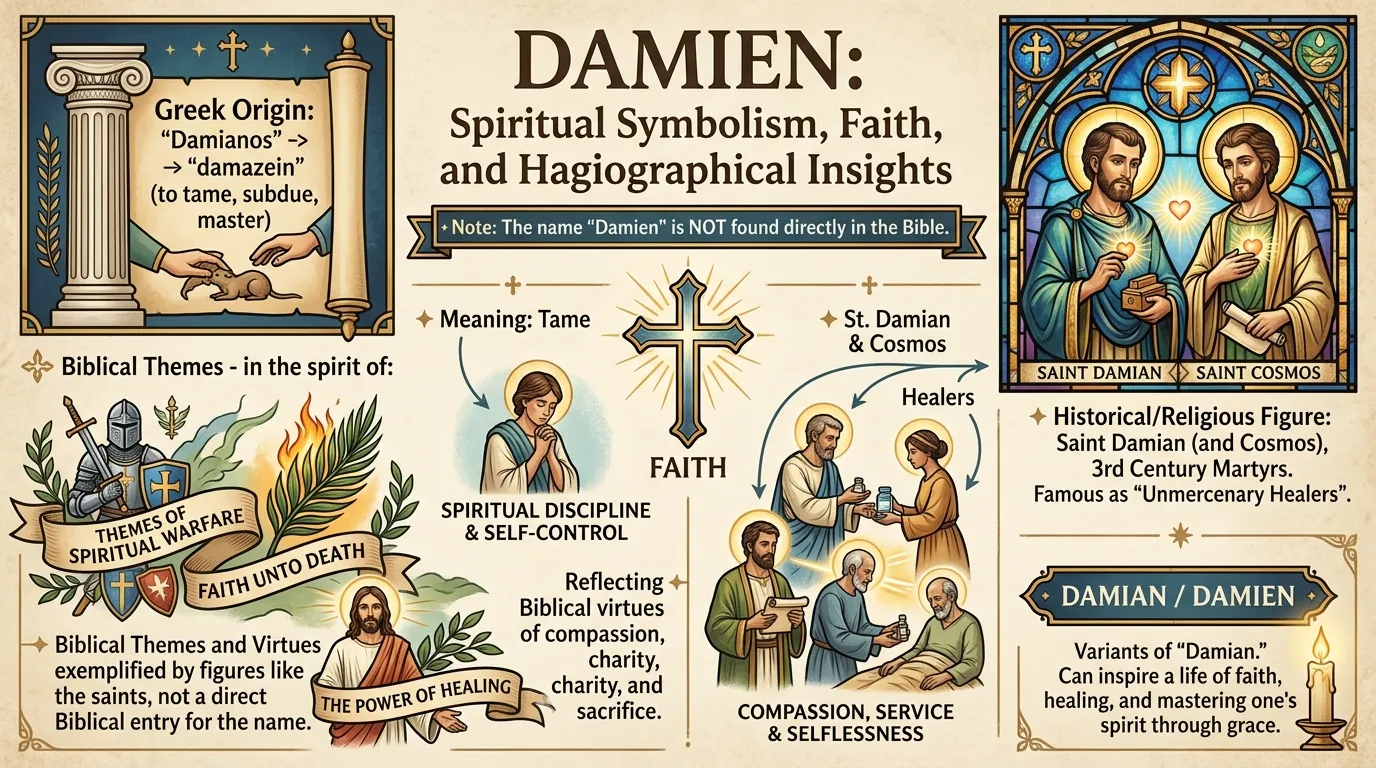
For a lot of people, the name Damien lands with a chill. A horror film from the 1970s put a fictional boy named Damien at the center of a story about evil, and ever since, some parents hesitate over the name, some people feel uneasy meeting someone who carries it, and some quietly wonder whether the Bible itself says anything dark about it. That worry is understandable, but it deserves an honest answer rather than a fearful one. So let us begin where every faithful answer about a name must begin: with what Scripture actually says, and what it does not say.
The Honest Starting Point: Damien Is Not in the Bible
The name Damien does not appear anywhere in Scripture, in any translation, in either testament. No person, place, or tribe in the Bible carries this name. That matters, because it means there is no biblical story, prophecy, or warning attached to it. The fear some people feel toward the name comes entirely from modern culture, not from God’s Word.
This distinction is worth holding onto. The Bible is full of names that carry weight because God gave them or because the lives behind them taught something. Damien is simply not one of them. So the right question is not “What does the Bible say about the name Damien?” but rather “What can the Bible teach us about names, fear, and the things this name makes people think about?”
And on that last point, the connection many people feel to the name is worth addressing directly. The word behind Damien traces to the Greek Damianos, connected to a verb meaning “to tame” or “to subdue.” That single root opens a door into some of the richest themes in Scripture: God’s power to tame chaos, Christ’s victory over darkness, and the taming of the human heart.
What “Tamer” and “Subduer” Mean in Scripture
The Bible repeatedly pictures God as the One who subdues what is wild and threatening. At creation, He brings order out of chaos. The psalmist writes that God stills the roaring of the seas and the turmoil of the nations (Psalm 65:7). What is untamable to us is not untamable to Him.
That theme runs through the whole story. God subdues enemies before His people, not so Israel can gloat, but so they can learn that deliverance belongs to Him. The prophets looked forward to a day when God would subdue all things under the Messiah. And the New Testament announces that this has begun: Jesus “disarmed the powers and authorities” and “made a public spectacle of them, triumphing over them by the cross” (Colossians 2:15).
Notice what this means for the fear behind the question. If someone worries that a name sounds dark or cursed, Scripture’s answer is that darkness has already been subdued. There is no name, no syllable, no sound that carries a curse God has not already broken. The cross is God’s final word on every supposed power of evil.
The Saints Behind the Name: Cosmas and Damian
History gives the name a very different face than the movies do. In the third century, two brothers, Cosmas and Damian, were physicians who treated the sick without charging fees, earning them the title “the moneyless ones.” They became some of the most beloved saints of the early church, and their story is one of healing and generosity, not horror.
This is worth knowing for a simple reason: the cultural shadow over the name is recent and fictional, while the historical weight of the name is ancient and Christian. Millions of believers across the centuries have carried the name Damian with honor. The name’s real legacy is service to the suffering, not villainy.
So if the question is whether the name itself is tainted, history answers no. A name is not a destiny. Scripture is clear that people are judged by their hearts and their choices, not by the sounds their parents chose for them. Saul became Paul; Simon became Peter. God renames people by grace, and He never treats anyone as cursed because of a label.
Christ the Subduer: The Stronger Theme
There is a deeper biblical theme hiding inside the root meaning of Damien, and it is worth sitting with. The New Testament describes Jesus as the One who subdues everything that enslaves us. Hebrews 2:14-15 says that by His death He destroyed “him who holds the power of death” and freed “those who all their lives were held in slavery by their fear of death.”
Think about that connection. The very thing some people fear about the name, fear of evil, fear of death, fear of the dark, is exactly what Christ came to subdue. The cross did not merely forgive sins; it broke the power of the fear that sin creates. A name that means “tamer” can, for a Christian, become a reminder not of horror but of victory: the One who tamed death itself.
This is how believers have always handled frightening associations. They do not pretend the fear does not exist. They answer it with a bigger truth. Whatever the movies suggest, Scripture insists that evil is real but defeated, dangerous but disarmed, present but on a leash, and that leash is held by nail-scarred hands.
Taming the Wild Things Inside Us
Scripture also turns the idea of taming inward. James writes that no human being can tame the tongue, “a restless evil, full of deadly poison” (James 3:8), and yet the gospel is precisely the story of God doing what we cannot. The fruit of the Spirit includes self-control (Galatians 5:23), which is simply taming by another name: the wild impulses of the heart brought under the gentle rule of Christ.
Every believer knows this work from the inside. Anger that flares, appetites that demand, anxieties that roar like caged animals, these are the untamed things in us. The promise of the gospel is not that we tame ourselves by willpower but that the Holy Spirit subdues us from within, patiently, over a lifetime. Sanctification is taming with love.
There is a quiet encouragement here for anyone carrying the name Damien or choosing it for a child. Instead of hearing a shadow in it, a Christian can hear a prayer: Lord, tame what is wild in me. Subdue what fights against You. Make me gentle where I am fierce. That is a thoroughly biblical way to wear a name.
The Bible also reminds us that God’s people have always lived surrounded by names borrowed from cultures that did not know Him. Daniel served in Babylon under a name given by pagans. Esther carried a Persian name. Joseph’s sons bore Egyptian names. Scripture never treats a name’s cultural baggage as a spiritual verdict. What matters is whose you are, not what you are called, and Daniel’s faithfulness in Babylon is proof that a name cannot decide a person’s allegiance.
What to Do With Fear About a Name
If you came to this question because the name Damien makes you uneasy, Scripture gives you something better than unease: a test. “There is no fear in love. But perfect love drives out fear” (1 John 4:18). Fear that lingers and grows is not a message from God; it is the very thing God’s love is meant to drive out.
Practically, this means a few things. First, do not make decisions about people based on their names. To judge someone by the sound of their name is the opposite of how God judges, who “looks at the heart” (1 Samuel 16:7). Second, do not treat fiction as revelation. A horror film is not a prophecy, and a screenplay is not Scripture. Third, if fear persists, bring it into the light. Pray about it, talk about it, and let God’s Word do what it promises: replace fear with faith.
And if you are a parent considering the name, consider it freely. The Bible gives no reason to avoid it and, as we have seen, the name’s actual history is one of Christian service. Name your child in hope, raise them in the Lord, and let their life write the name’s meaning, not the other way around.
A Final Word for the Worried Heart
Behind the question about Damien is often a deeper question: Can evil attach itself to me, or to someone I love, through something as small as a name? Scripture’s answer is a firm and tender no. “If God is for us, who can be against us?” (Romans 8:31). No name, no dream, no coincidence, no movie can place you outside the reach of the God who subdues all things.
The Bible’s treatment of names is ultimately about God’s power to define us. He called Abraham out of idolatry and gave him a new name. He called Jacob the deceiver and renamed him Israel. Whatever name you were given, and whatever associations cling to it, the name that matters most is the one God speaks over you: beloved, forgiven, mine. For the history of how this name has actually been carried through the centuries, including the story of the physician saints who bore it, the Wikipedia entry on Cosmas and Damian gives a helpful overview of the tradition the movies left out.










