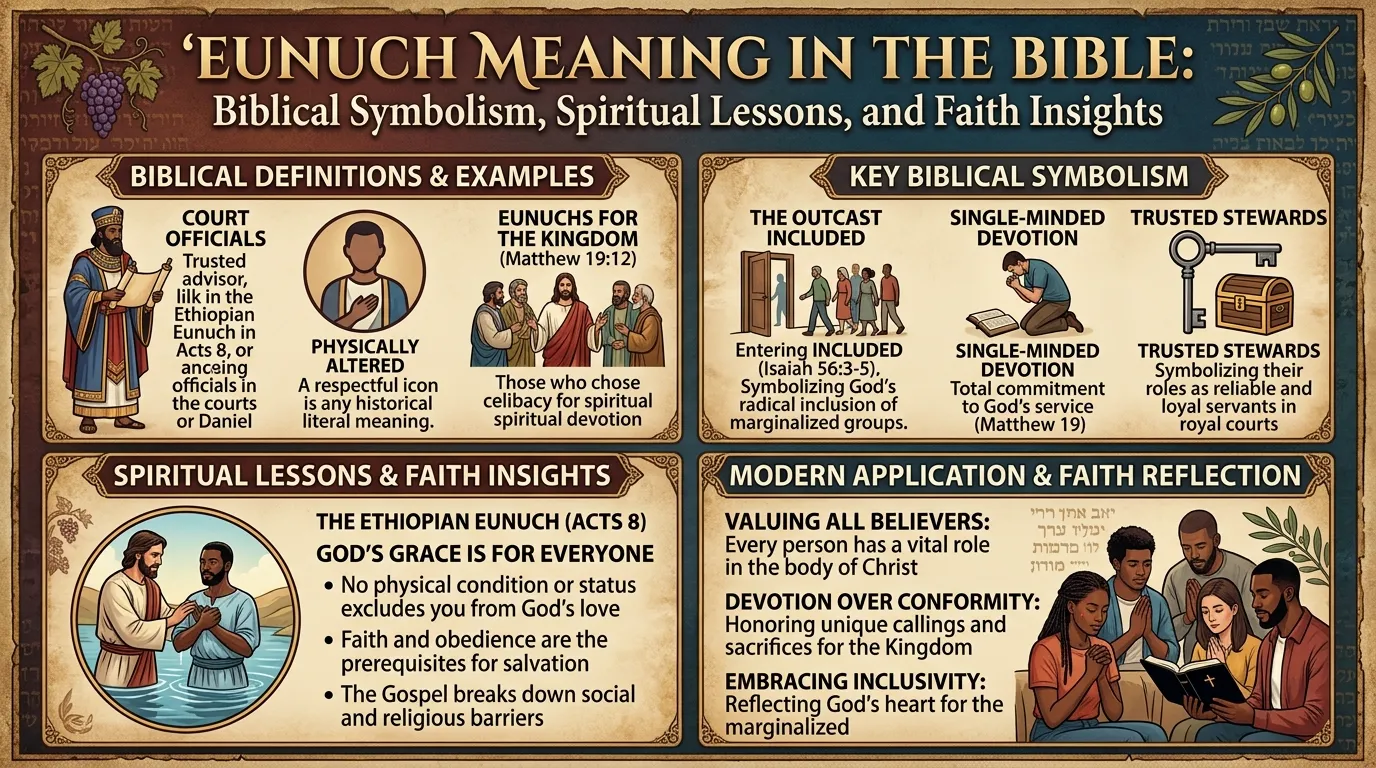
The dust hung in the air along the desert road from Jerusalem to Gaza. In a chariot rattling south, a high official of the queen of Ethiopia, a man trusted with her entire treasury, was reading aloud from the prophet Isaiah. He had traveled hundreds of miles to worship in Jerusalem, and he was going home with his questions unanswered. Then a stranger came running alongside the chariot, heard the words of Isaiah 53, and asked the question that changed everything: “Do you understand what you are reading?” (Acts 8:30). The man in the chariot was a eunuch. And what happened next is one of the most tender stories of inclusion in the whole Bible.
Who Eunuchs Were in the Ancient World
A eunuch was a man who had been made unable to father children, usually by castration, and who served in a royal court. Because they could father no rival heirs and were considered fully devoted to their duties, eunuchs were trusted with extraordinary responsibility: guarding harems, managing treasuries, and advising kings. The Ethiopian official in Acts 8 was, in modern terms, something like a finance minister, a man of immense standing and wealth.
Scripture mentions eunuchs serving in many courts. In the book of Esther, eunuchs attend the Persian king. In 2 Kings, eunuchs serve in Israel’s own royal household. In Daniel, young Jewish captives, quite possibly including Daniel himself, were placed under the chief of the eunuchs in Babylon (Daniel 1:3-7). The Bible does not hide this practice or pretend it was gentle. It simply records it as part of the world its people lived in.
But the Bible is not merely interested in court politics. It is interested in what God thinks of people whom the world marks as different, and that is where the story of eunuchs becomes a story about all of us.
The Old Law That Shut Them Out
Here is the hard part, and it must be faced honestly. The Law of Moses said, “No one who has been emasculated by crushing or cutting may enter the assembly of the Lord” (Deuteronomy 23:1). A eunuch could not fully participate in Israel’s worship. He could not stand in the assembly. By the letter of the law, the door was closed.
We should not soften what this meant. To be barred from the assembly was to be cut off from the visible community of God’s people, from the festivals, the sacrifices, the shared life of worship. A eunuch could be wealthy, powerful, and devout, like the Ethiopian official, and still stand outside the gate. The law drew a line, and he was on the wrong side of it.
But the Law was never God’s final word about outsiders. It was a shadow of something greater, and the prophets began to say so, centuries before Philip ran down that desert road.
Isaiah’s Astonishing Reversal
Long before the chariot ride, Isaiah spoke directly to eunuchs, and what he said overturned everything. “Let no eunuch complain, ‘I am only a dry tree.’ For this is what the Lord says: To the eunuchs who keep my Sabbaths, who choose what pleases me and hold fast to my covenant, to them I will give within my temple and its walls a memorial and a name better than sons and daughters; I will give them an everlasting name that will endure forever” (Isaiah 56:3-5).
Read that slowly. The very people the law excluded are promised a place within God’s temple and a name better than sons and daughters. The thing a eunuch could never have, children to carry on his name, God promises to replace with something greater: an everlasting name, given by God Himself, that no one can take away.
This is one of the Bible’s great reversals, and it follows a pattern. God consistently chooses the barren woman, the younger son, the outsider, the overlooked, and gives them the central place in His story. Isaiah 56 is God’s announcement that the old exclusions were temporary. A new day was coming when the gates would open wide.
Jesus Redefines the Word Entirely
When Jesus spoke about eunuchs, He did something startling: He turned the word into a picture of devotion. “For there are eunuchs who were born that way, and there are eunuchs who have been made eunuchs by others, and there are those who choose to live like eunuchs for the sake of the kingdom of heaven” (Matthew 19:12).
Jesus acknowledges three groups: those born unable to marry, those made eunuchs by others (the court officials of the ancient world), and those who voluntarily set marriage aside for the sake of God’s kingdom. The third group is metaphorical, but the point is real: singleness, freely chosen for God’s sake, is not a lesser life. It is a kingdom calling, honored by Christ Himself.
Notice what Jesus does not do. He does not repeat the old exclusion. He does not treat eunuchs as damaged or disqualified. He folds them into a teaching about devotion and even holds up voluntary singleness as a path of honor. The trajectory from Deuteronomy to Isaiah to Jesus moves in one direction only: toward wider welcome.
The Chariot on the Desert Road
Now return to Acts 8. The Ethiopian eunuch had gone to Jerusalem to worship, and he was reading Isaiah, the very prophet who had promised eunuchs a place in God’s house. Guided by the Spirit, Philip climbed into the chariot, “and beginning with this Scripture he told him the good news about Jesus” (Acts 8:35).
What happened next is the quiet climax of the whole biblical story of eunuchs. They came to some water, and the eunuch said, “Look, here is water. What can stand in the way of my being baptized?” (Acts 8:36). What can stand in the way? Under the old law, the answer would have been: everything. But under the gospel, Philip’s answer was: nothing. The eunuch was baptized, and he “went on his way rejoicing” (Acts 8:39).
Church tradition holds that this man carried the gospel back to Africa, and whether or not the details are certain, the symbolism is unmistakable. The first person explicitly converted and baptized after the gospel began spreading beyond Jerusalem’s borders was a man the old law would have excluded. God chose him deliberately. The rejoicing eunuch is the living proof of Isaiah’s promise.
Daniel: Faithfulness in a Foreign Court
There is another eunuch story worth remembering, though it is quieter. When Babylon carried off young nobles from Judah, they were placed under Ashpenaz, “chief of the eunuchs” (Daniel 1:3, KJV). Jewish tradition has long understood that Daniel and his friends may themselves have been made eunuchs in Babylon’s service. The text does not say so directly, and we should not claim more than it says, but the possibility casts Daniel’s story in a new light.
Here was a man, possibly cut off from the future of marriage and family, serving a pagan king in a foreign land, who nevertheless prayed three times a day toward Jerusalem, refused the king’s food when it violated his conscience, and rose to the highest offices of an empire without compromising. If Daniel was a eunuch, his life is proof that God does not measure a person’s worth by what the world has taken from them, but by the faithfulness of their heart.
Either way, the principle stands. God’s favor never depended on the categories the ancient world used to sort people. It depended on trust, and Daniel trusted. His promotion to ruler over Babylon’s wise men, his survival in the lions’ den, and his visions of God’s coming kingdom all declare that no human label can limit what God does through a surrendered life.
What Eunuchs Teach the Church Today
The Bible’s teaching about eunuchs lands with surprising force in the modern church. Every congregation has people who feel like outsiders: the unmarried in a family-centered culture, the childless, those whose bodies or histories make them feel different, anyone who has stood outside the gate wondering if there is a place for them inside.
Scripture’s answer is the same one Philip gave on the desert road: nothing stands in the way. Not your past, not your body, not your marital status, not what others have done to you. “There is neither Jew nor Gentile, neither slave nor free, nor is there male and female, for you are all one in Christ Jesus” (Galatians 3:28). The categories that divided the ancient world, and divide ours, dissolve in Christ.
This also rebukes any church tempted to treat some believers as second-class. The Ethiopian eunuch went home rejoicing, not as a tolerated exception but as a full member of God’s people, baptized into the same body as everyone else. Where the world sees a dry tree, God sees a name written forever within His walls. For a fuller historical picture of how eunuchs served in ancient courts and how different cultures understood them, the Wikipedia article on eunuchs provides useful background that makes these biblical stories even more vivid.










