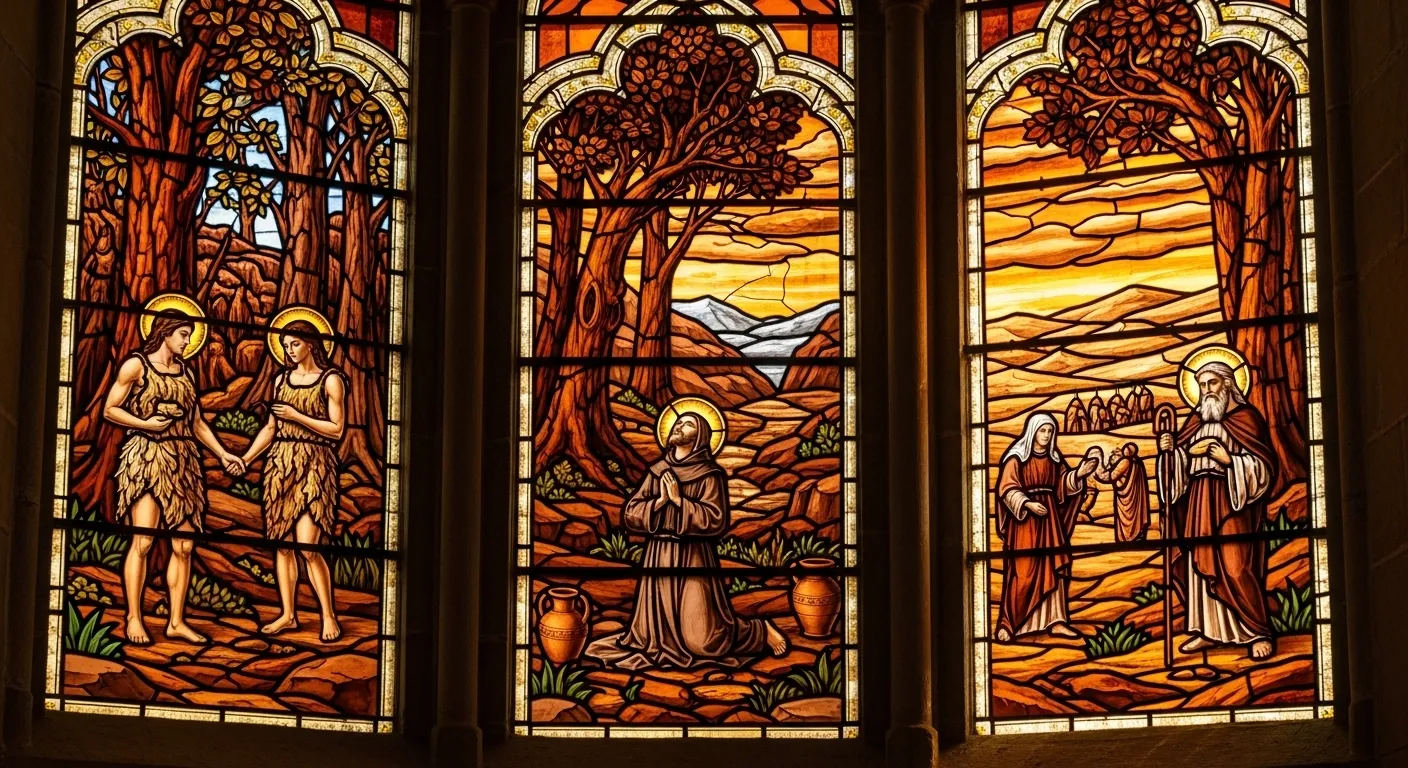
Brown never shouts. It has no rainbow, no throne room, no dye worth a fortune. It is the color of dirt under fingernails, of plain wooden beams, of the road beneath the traveler’s feet. And yet the Bible cannot tell the human story without it — because the human story begins in brown. “And the LORD God formed man of the dust of the ground” (Genesis 2:7). Before there was a temple or a tabernacle, before there was a single commandment, there was brown earth in the hands of God, being shaped into a living soul. The color of humility, of groundedness, of patient endurance — brown is Scripture’s quietest color, and one of its most honest.
Dust and the Human Story
The Hebrew word adamah means ground, earth, soil — and adam, the word for man, is built from it. Humanity’s very name is a color swatch: we are the brown-earth creatures. The link is deliberate and humbling. Whatever else human beings become — kings, prophets, image-bearers of God — they remain, at the foundation, shaped soil. “All are of the dust, and all turn to dust again” (Ecclesiastes 3:20).
This is not an insult; it is an identity. Brown reminds the believer of two truths at once: smallness and shaping. Smallness, because dust is dust — “what is man, that thou art mindful of him?” (Psalm 8:4). Shaping, because this particular dust was touched by divine hands and breathed into by the Spirit of God. Brown holds the paradox of human existence: common material, uncommon maker.
The whole biblical drama can be read as the story of brown earth learning to bear heaven’s breath. Every act of pride is dust forgetting it is dust. Every act of worship is dust remembering whose hands shaped it. Brown is the color that keeps theology honest.
Soil That Receives the Seed
Jesus’ most famous agricultural parable is, at bottom, a meditation on brown earth. The sower scatters the same seed on four soils — the path, the rocks, the thorns, the good ground — and the harvest depends entirely on the condition of the dirt (Matthew 13:3-8, 18-23). The seed is the word of God; the variable is the soil of the heart.
Brown here becomes a picture of receptivity. Good soil does nothing spectacular. It does not manufacture the seed, command the rain, or hurry the harvest. It simply receives, holds, and nourishes what is planted. This is the brown virtue: quiet readiness. The heart that hears the word and understands it (Matthew 13:23) is doing the soil’s work — making room, staying soft, letting something greater grow.
And soil must be broken to be useful. Unplowed ground grows nothing. “Break up your fallow ground,” Hosea pleads (Hosea 10:12) — the hard, unused field of the heart must be turned over before it can bear fruit. Brown seasons of life — the plowing times, when everything feels overturned — are often preparation, not punishment. The farmer breaks the earth because he intends a harvest.
Brown Seasons: Waiting and Endurance
There are stretches of the spiritual life that feel unmistakably brown: plain, slow, unglamorous. Nothing is blooming. The prayers seem to go into soil, not sky. The Bible honors these seasons more than we do. The seed growing “secretly” (Mark 4:26-29) does its decisive work underground, in the dark brown earth, long before anything green appears.
Consider how much of Scripture’s formation happens in brown places: Moses’ forty years in Midian’s dust. David’s years in the caves. Jesus’ thirty hidden years in Nazareth — a carpenter’s son, working with brown wood, in a brown town, while heaven waited. God is never in a hurry, and He does some of His finest shaping in the monochrome seasons.
“Let us not be weary in well doing: for in due season we shall reap, if we faint not” (Galatians 6:9). The promise is addressed precisely to brown-season believers — the weary, the unseen, the ones still showing up. The harvest has a season, and the season is due, which is to say: certain, though not yet. Brown faith is faith that keeps planting when the field still looks like dirt.
The Potter and the Clay
Brown’s most tender biblical image is the potter’s workshop. “O LORD, thou art our father; we are the clay, and thou our potter; and we all are the work of thy hand” (Isaiah 64:8). Clay is brown — wet earth, formless, unimpressive. And yet in the potter’s hands it becomes vessels of purpose and beauty. Jeremiah was sent to watch the potter at work: when the vessel was marred in the potter’s hand, “he made it again another vessel, as seemed good to the potter to make it” (Jeremiah 18:4).
The image holds the whole gospel of brown. Clay contributes nothing but malleability. It does not design itself, fire itself, or choose its shape. Its entire vocation is pliability — yielding to the hands that shape it. And when it is marred — when the vessel collapses on the wheel — the potter does not discard it. He remakes it. Brown is the color of second chances: the same clay, reworked, given another form.
This is profoundly comforting for anyone who feels marred. The collapsed vessel is not thrown away; it is re-centered on the wheel. Failure, in the potter’s house, is not final — it is material for the next attempt. “Being confident of this very thing, that he which hath begun a good work in you will perform it until the day of Jesus Christ” (Philippians 1:6). The Potter does not abandon brown clay. He keeps His hands on it.
But the image also carries a warning, and Jeremiah delivers it: clay can resist. “O house of Israel, cannot I do with you as this potter? saith the LORD. Behold, as the clay is in the potter’s hand, so are ye in mine hand” (Jeremiah 18:6). The difference between a vessel of honor and a vessel of judgment is not the clay — it is the yielding. Brown’s sermon, from the potter’s wheel, is simple: stay soft. The moment clay hardens, it can no longer be shaped — it can only be broken.
The Humility of the Color
Brown does not compete. Set it beside gold or scarlet and it disappears — which is exactly its sermon. “He hath shewed thee, O man, what is good; and what doth the LORD require of thee, but to do justly, and to love mercy, and to walk humbly with thy God?” (Micah 6:8). The humble walk is a brown walk: low to the ground, unshowy, steady.
Jesus Himself wore brown, in a sense — the plain life of a Galilean laborer, born in a stable, buried in a borrowed tomb. The King of kings chose the palette of the common. When believers embrace simplicity, anonymity, and unnoticed faithfulness, they are wearing their Lord’s colors.
There is a final brown image worth keeping: the cross was brown wood. The instrument of humanity’s redemption was not gold or ivory but rough timber — the plainest material, carrying the greatest weight. God has always preferred to do His mightiest work through humble means. Brown is the color of that preference. And there is the manger, too — brown straw, brown wood, a feeding trough for a newborn King. From Bethlehem’s stable to Calvary’s cross, the Son of God kept choosing the brown end of the palette: the ordinary, the lowly, the overlooked. He did not despise the humble things. He became them. So the believer who feels plain, unremarkable, brown — take heart. You are in the color scheme of the incarnation itself.
So if your life feels brown right now — ordinary, dusty, slow — you are in good company. You are made of the same earth God has been shaping since Eden, planted in the same soil where He grows His harvest, walking the same humble road His Son walked. The brown seasons are not the absence of God’s work. They are usually where it happens. For the natural and cultural history of this earthiest of colors, the Wikipedia article on brown makes interesting reading; the Bible’s verdict is simpler and deeper — from dust we came, in dust the seed grows, and through humble brown earth God is still forming living souls.










