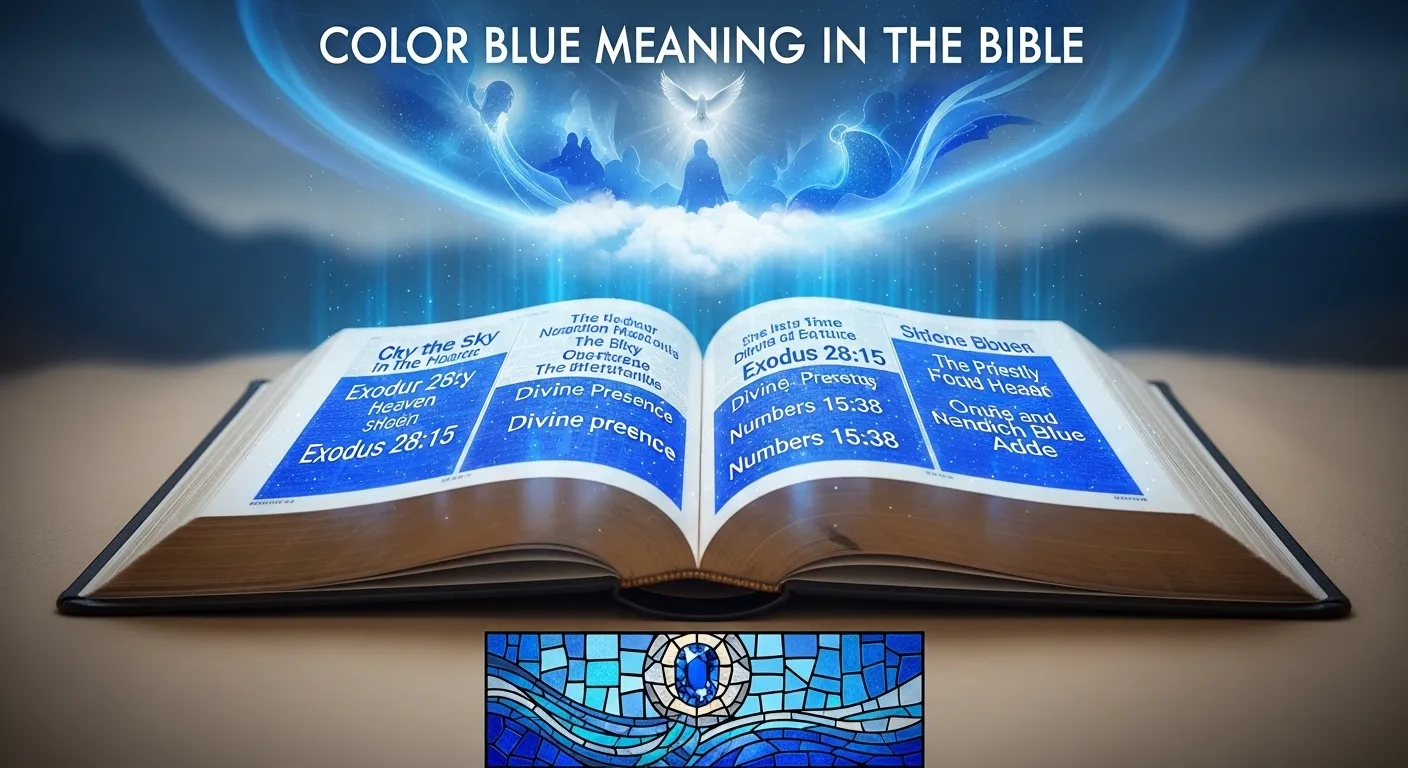
Follow the blue thread through the Bible and it leads somewhere extraordinary. It starts in a dyer’s vat on the Mediterranean coast, runs through the curtains of a desert tent, gets tied into the corner of every Israelite’s cloak, and ends upholstering the floor beneath God’s own feet. No other color in Scripture makes quite this journey. Blue — the tekhelet of the Hebrew text, a rich azure dye extracted at great cost from sea snails — is the Bible’s color of heaven come down to earth. Wherever it appears, it is saying the same thing in different words: look up; remember whose you are; the sky is not empty.
The Thread in the Tassel
The most personal appearance of blue in Scripture is also the most ordinary. God commands every Israelite to attach tassels to the corners of their garments, “and that they put upon the fringe of the borders a ribband of blue” (Numbers 15:38). The purpose is explicit: “that ye may look upon it, and remember all the commandments of the LORD, and do them” (Numbers 15:39).
Consider what this meant in daily life. A farmer bending over his field, a merchant counting coins, a mother sweeping her house — each would catch sight of that blue cord dozens of times a day. It was a wearable sermon, a thread of heaven tied to an earthly robe. The color did what no lecture could: it interrupted the ordinary with the eternal, turning every glance downward into a reminder to look upward.
The psychology is profound. God did not command Israel to think about His commandments in the abstract; He gave them a color to see. Blue became the visual shorthand for covenant loyalty — a daily, wordless catechism woven into clothing. For the modern believer, the principle survives the practice: faith needs visible anchors, small daily reminders that pull the wandering mind back to God.
The Color of the Tent
Before the tassel, there was the tabernacle. When God gave Moses the pattern for His dwelling place, blue was everywhere: “thou shalt make the tabernacle with ten curtains of fine twined linen, and blue, and purple, and scarlet” (Exodus 26:1). The veil separating the Holy Place from the Most Holy Place was blue (Exodus 26:31). The high priest’s robe was woven entirely of blue (Exodus 28:31), and the ephod incorporated it (Exodus 28:6).
This was extravagant. Tekhelet dye was among the most expensive substances in the ancient world — each snail yielded a single drop, and thousands were needed for a single garment. Draping a portable desert shrine in it was a statement of staggering value: God’s presence is worth the costliest thing we have. The blue of the tabernacle taught Israel that worship is not bargain religion. Heaven’s color on earthly fabric said that approaching God deserves our best, not our leftovers.
There is also a directional logic. The tabernacle was God’s house pitched in the middle of the camp — heaven’s embassy in the wilderness. Its blue curtains were, in effect, a piece of the sky brought down to eye level. Every Israelite who looked at the tent saw the color of the firmament and remembered: the God who lives above the clouds has chosen to live among us.
The Floor Beneath His Feet and the Throne Above
Blue’s most breathtaking appearances come in the visions. At Sinai, Moses and the seventy elders ascend and see God: “and there was under his feet as it were a paved work of a sapphire stone, and as it were the body of heaven in his clearness” (Exodus 24:10). The ground beneath the divine feet looks like sapphire — like the sky itself made solid. Worship, at its highest, stands on blue.
Ezekiel sees the same color at the height of his vision: “above the firmament that was over their heads was the likeness of a throne, as the appearance of a sapphire stone” (Ezekiel 1:26). The throne of God — the seat of all authority in the universe — is sapphire blue. Power in heaven is not red with wrath or black with mystery; it is blue with the calm of the open sky. The color quietly corrects every image of God as merely severe: His throne room has the hue of a clear morning.
John’s Revelation completes the arc: around the throne, “a rainbow round about the throne, in sight like unto an emerald” (Revelation 4:3) — the full spectrum gathered around the sapphire seat. Blue began as a thread in a tassel and ends as the atmosphere of eternity. The journey of the color is the journey of the believer: from a daily reminder to an eternal dwelling.
Why Blue Cost a Fortune
The extravagance of blue in Scripture becomes clearer when you know what it cost. Tekhelet was produced from the Murex trunculus sea snail: each snail yielded a single drop of precursor fluid, and roughly ten thousand snails were needed to dye a single garment. The process stank, the labor was immense, and the result was a blue-purple so vivid and permanent that it became, across the ancient Mediterranean, the visual signature of royalty and divinity. To drape the tabernacle in blue was to spend a king’s ransom on curtains.
This costliness is part of the theology. When God commanded blue for His dwelling, He was establishing a principle that runs through all of Scripture: worship costs. The widow’s two mites (Mark 12:42-44), Mary’s pound of spikenard poured over Jesus’ feet (John 12:3), the Macedonians’ generosity “beyond their power” (2 Corinthians 8:3) — God has always measured worship not by its market efficiency but by its extravagance. Cheap worship is a contradiction in terms. The blue of the tabernacle preaches that approaching a holy God deserves the costliest thing we have, not the most convenient.
There is a second, subtler lesson in the dye’s origin. Tekhelet came from the sea — from the deep, chaotic waters that in biblical imagery represent everything untamed and threatening (Genesis 1:2; Revelation 21:1). God took the color of heaven from the depths of the sea: beauty extracted from chaos, glory drawn from the abyss. It is a small parable of redemption itself — God specializing in bringing heavenly things out of the darkest places.
The command in Numbers 15 has its own backstory worth knowing. The tassels-with-blue were instituted right after the catastrophe of the spies — Israel’s refusal to enter Canaan, the forty years of wandering pronounced as judgment (Numbers 13-14). In the immediate aftermath of the nation’s greatest failure, God gives them… a blue thread. Not a lecture, not a punishment — a reminder, woven into daily clothing, that His commandments remain and His covenant stands even after catastrophic disobedience. Blue, from that day on, was also the color of the second chance: God’s faithfulness tied into the garment of a faithless people.
Blue as a Way of Seeing
What does all this mean for the person who simply loves the color, or keeps noticing it, or wonders why Scripture bothers with a dyer’s catalog at all? Blue in the Bible is, finally, a discipline of attention. It trains the eyes upward — from the tassel to the tent to the throne.
The blue cord said: remember. The blue curtains said: God is here. The blue throne says: God reigns. Together they form a complete spirituality: memory, presence, and sovereignty — the past commandments, the present dwelling, the eternal rule. A believer whose life is dyed blue is one who remembers God’s word, practices God’s presence, and trusts God’s throne. It is also worth noticing that blue is the color you cannot manufacture by looking down. The earth offers browns and greens; blue must be received from above — from the sky, from the sea-snail’s costly secret, from the throne. Every biblical appearance of blue is, in the end, a reminder that the most important things in the spiritual life are not produced but given: remembrance prompted by God’s command, presence promised by God’s dwelling, sovereignty secured by God’s reign. Look up often enough, and the color starts to change how you see everything else.
There is a gentleness to blue that the Bible seems to intend. Unlike scarlet’s urgency or black’s gravity, blue does not shout. It is the color of the sky on an ordinary Tuesday — always there, rarely noticed, utterly dependable. That may be its deepest sermon: God’s heaven is not a rare event but a constant reality, as present as the sky, as close as a thread in your garment. Look up often enough, and the color starts to change how you see everything else. For the remarkable material history of this ancient dye — from murex snail to modern revival — the Wikipedia article on the color blue provides helpful background; Scripture itself provides the meaning, and the meaning is heaven, remembered daily and trusted eternally.










