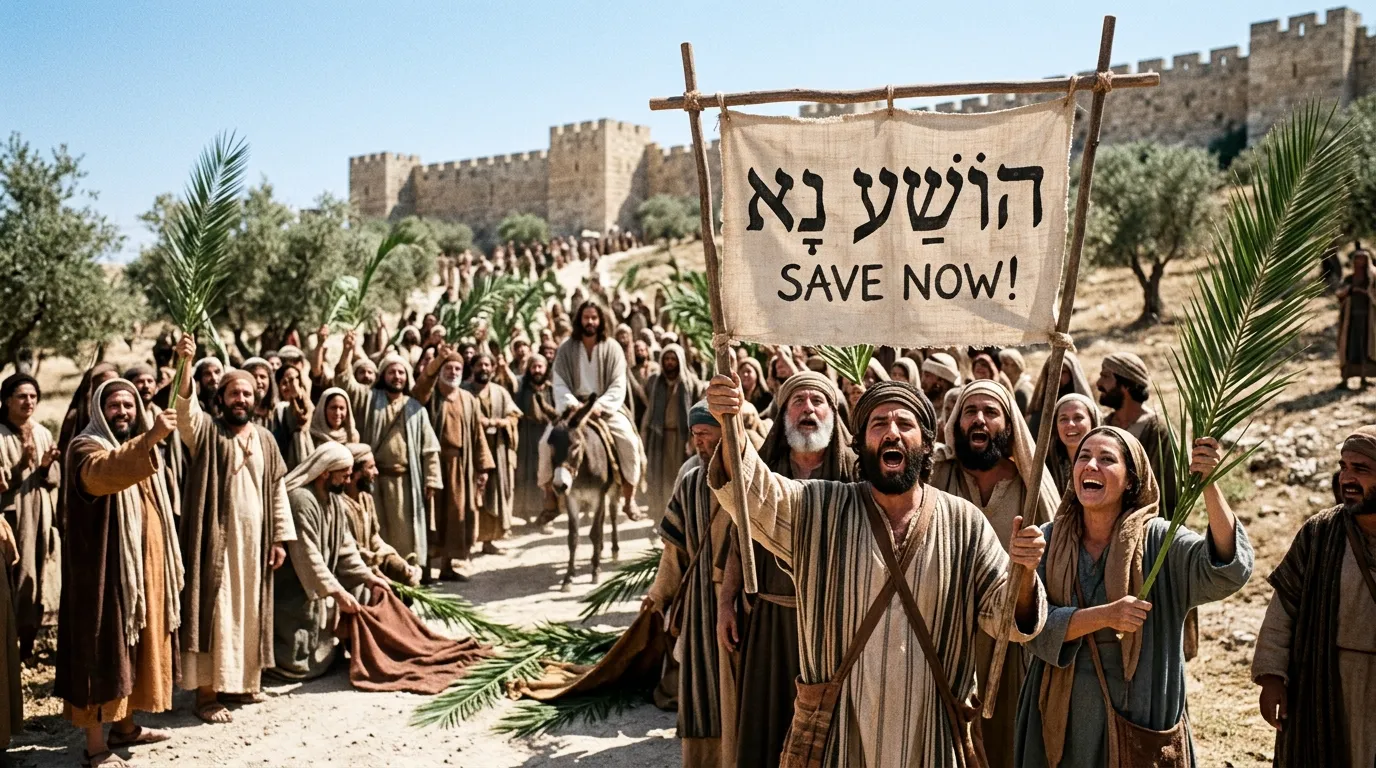
The road into Jerusalem was carpeted with cloaks. Branches cut from the fields lined the path. A crowd pressed around a man riding a donkey, and the air filled with a single word, shouted over and over, in Aramaic and Hebrew and Greek: “Hosanna!” It is the most famous shout in the New Testament, sung in churches every Palm Sunday, woven into worship songs across the world. But most people who sing it have no idea that it started as something else entirely: not a cheer, but a cry for help.
The Cry Underneath the Cheer
Hosanna comes from two Hebrew words pushed together: hoshi’a, meaning “save,” and na, a little particle of urgency meaning “now” or “please.” Put them together and you get something like “Save us, please!” or “Save now!” It is the cry of someone in trouble reaching for a rescuer.
The phrase comes straight from Psalm 118:25: “Lord, save us! Lord, grant us success!” In its original setting, this was a liturgical prayer, sung by pilgrims going up to Jerusalem for the feasts. It was not a celebration of a rescue already accomplished. It was a plea for a rescue still needed. The people sang it because they were not yet saved, and they knew it.
Hold that in mind, because it changes everything about Palm Sunday. When the crowds shouted “Hosanna,” they were not merely applauding Jesus. They were begging Him, urgently and publicly. Beneath the palm branches and the excitement was a desperate prayer: save us, and do it now.
How a Plea Became a Praise
Language drifts, and “hosanna” drifted. By the time of Jesus, the word had been sung in worship for centuries, and like many oft-repeated prayers, it had begun to change color. People still knew it meant “save us,” but they sang it with growing confidence, the way you might sing a song about victory before the battle is over, because the God they sang to had never failed to save before.
By the first century, “Hosanna” functioned almost as an exclamation of praise, a kind of “Hallelujah with an edge.” The plea had not disappeared, but joy had overtaken it. When the crowds shouted it at Jesus, both meanings were alive at once: save us now and praise Him, for He can.
This is worth noticing because it mirrors how faith itself works. We begin by crying out in need, and as we discover God’s faithfulness, the cry turns into a song. Hosanna is the sound of a prayer becoming a praise without ever ceasing to be a prayer. Every believer who has moved from desperation to gratitude has sung their own hosanna.
The Day the Word Found Its Man
Matthew 21 records the triumphal entry in detail, and every detail is deliberate. Jesus sends disciples to fetch a donkey and her colt, fulfilling Zechariah’s prophecy: “See, your king comes to you, righteous and victorious, lowly and riding on a donkey” (Zechariah 9:9). Kings rode horses into battle; this King rode a donkey into peace.
The crowd’s shout is recorded with its full messianic framing: “Hosanna to the Son of David! Blessed is he who comes in the name of the Lord! Hosanna in the highest heaven!” (Matthew 21:9). “Son of David” is a title of the promised Messiah. “Blessed is he who comes” quotes Psalm 118:26, the very next verse after the “save us” cry. The crowd was not improvising. They were declaring, in the language of their Scriptures, that the Messiah had arrived.
And then, in a detail John alone records, Jesus’ response to the whole spectacle was not to bask in it but to weep over the city (Luke 19:41). He knew what the crowd did not: that their hosannas were real but shallow, that within the week the same voices would demand His death. He received their praise and grieved their blindness in the same moment. That is the compassion of Christ in miniature.
The Feast Behind the Branches
The palm branches were not random. Every autumn, Israel celebrated the Feast of Tabernacles, and Leviticus commanded the people to take “branches from luxuriant trees, from palms, willows and other leafy trees” and rejoice before the Lord (Leviticus 23:40). During that feast, worshippers waved these branches while singing the Hallel psalms, Psalms 113 through 118, which include the great “save us” cry of Psalm 118:25.
By Jesus’ day, the seventh day of the feast had a special name: Hosanna Day. The priests would circle the altar with palm branches, the choirs would sing “Hosanna,” and the whole temple courts would ring with the word. It was the most exuberant liturgy in Israel’s calendar, a rehearsal of final salvation.
So when the crowds waved palm branches and shouted “Hosanna” at Jesus, they were borrowing the liturgy of Tabernacles and applying it to Him. They were saying, in effect: the final salvation the feast points to is happening now, in this man. Whether they fully understood it or not, their instincts were right. John confirms it in Revelation, where the great multitude before the throne holds palm branches and cries, “Salvation belongs to our God” (Revelation 7:9-10). The branches of Palm Sunday will wave again at the end of all things.
Why the Shouts Turned: The Messiah They Wanted
The hardest question about Palm Sunday is also the most instructive: how did “Hosanna!” become “Crucify him!” in less than a week? The answer lies in what the crowd meant by “save us.” They wanted saving from Rome. They wanted a king who would drive out the occupiers, restore the throne of David, and make Israel great again.
Jesus was, in fact, the King they needed, but not the king they wanted. He came to save them from a deeper oppression: sin, death, and the devil. When it became clear He would not lead a revolt, the enthusiasm curdled. A Messiah who would not fight Rome was, to them, no Messiah at all.
This is a standing warning to every generation of believers. We all arrive with our own definition of salvation: fix my marriage, heal my body, rescue my nation, end my pain. Jesus hears every hosanna, and He answers every one, but He answers the deeper need first. The crowd wanted a political deliverer; He gave them an eternal one. Blessed are those who let Him define the rescue.
The Prayer Hidden Inside the Praise
There is a devotional secret in “Hosanna” that most worshippers miss. Because the word means “save us now,” every time we sing it we are praying, whether we realize it or not. It is one of the few words in Christian worship that is simultaneously adoration and petition.
This makes it a perfect word for the Christian life, which is itself a blend of gratitude and need. We praise God for what He has done, and in the same breath we cry out for what we still need Him to do. The believer’s song is never pure triumph; it is triumph edged with longing, and longing edged with triumph. “Hosanna” holds both.
So the next time you sing it, sing both meanings. Let the praise be real: He is worthy, He has saved, He reigns. And let the plea be real too: Lord, save us still, save us now, in the places where we are still waiting, the prodigal who has not come home, the body that has not been healed, the nation that has not turned. A hosanna that forgets the plea is shallow; a hosanna that forgets the praise is despair. The word was made to carry both.
Carrying Hosanna Into the Week
Palm Sunday comes once a year, but hosanna is a daily word. It belongs in the hospital waiting room, where “save us now” is the only honest prayer. It belongs at the graveside, where praise and grief stand side by side. It belongs in the quiet of morning devotions, where a believer whispers it over a wayward child, a broken habit, a frightening diagnosis.
The church calendar places Palm Sunday at the start of Holy Week for a reason. The hosannas of Sunday lead to the cross of Friday and the empty tomb of Easter Sunday, and the whole week is one continuous answer to the crowd’s cry. The plea “save us now” was answered, but not in the way anyone expected: not by a sword, but by a cross; not by the death of Rome, but by the death of Death itself. Every hosanna since has been sung in the light of Easter.
So shout it, sing it, pray it. It is the cry of pilgrims who became worshippers, of a crowd that did not understand becoming a church that does. Save us, Lord, we pray. And blessed is He who comes, and has come, and is coming again. For more on the word’s journey from Hebrew liturgy to Christian worship, the Wikipedia article on Hosanna offers a concise overview of its history and usage.










