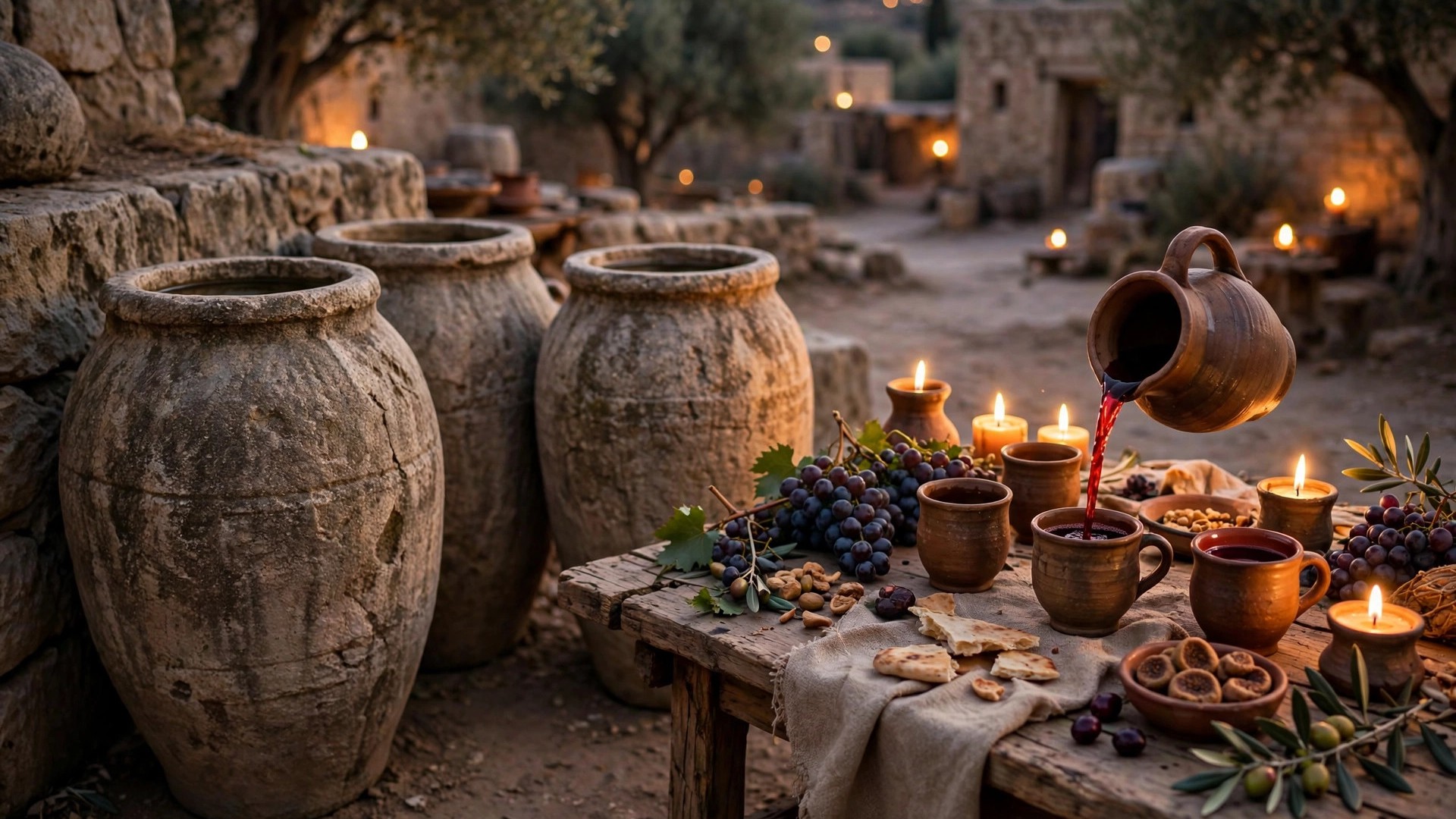
Picture the scene: a village wedding in Cana of Galilee, music playing, guests celebrating — and then the unthinkable happens. The wine runs out. In a culture where wedding feasts lasted for days, this was not a minor embarrassment; it was a social disaster that would shame the family for years.
It was into this very human crisis that Jesus stepped and performed his first miracle. The meaning of Jesus’ first miracle in the Bible is far richer than most people realize. John 2:1-11 tells the story simply, but every detail glows with meaning about who Jesus is and what he came to do. This was not just a kindness to a wedding host. It was a sign — the first public unveiling of the glory of the Son of God.
The Setting: A Wedding in Cana
“On the third day a wedding took place at Cana in Galilee. Jesus’ mother was there, and Jesus and his disciples had also been invited to the wedding” (John 2:1-2). Jesus was not a distant holy man avoiding celebration. He was an honored guest at a party. The God who made joy was happy to be at a joyful occasion.
That matters. Some people picture Jesus as perpetually solemn, as if joy were a distraction from holiness. The first miracle says otherwise. Jesus began his public ministry at a wedding — not in a temple, not in a courtroom, not on a battlefield. He began it in the middle of ordinary human happiness. The God of the Bible is not the enemy of joy. He is its source. “You make known to me the path of life; you will fill me with joy in your presence, with eternal pleasures at your right hand” (Psalm 16:11, in substance).
Weddings in that culture lasted for days — sometimes a full week. The host was responsible for providing food and wine for every guest for the entire celebration. Running out of wine was not a small oversight. It was a public humiliation that would follow the family for years. In a shame-and-honor culture, it was a catastrophe.
The Crisis: “They Have No More Wine”
“When the wine was gone, Jesus’ mother said to him, ‘They have no more wine'” (John 2:3). Mary did not give an order; she stated a need. She knew who her Son was, and she trusted him with the problem. Notice what she did not do: she did not panic, and she did not propose a solution. She simply brought the need to Jesus.
That is a model for prayer. So often we come to God with our proposed solutions attached: “Lord, fix it this way.” Mary came with only the problem: “They have no more wine.” She trusted Jesus to decide the how. Prayer is not dictating terms to God. It is bringing the need and leaving the method to him.
Jesus’ reply sounds sharp in English: “Woman, why do you involve me? My hour has not yet come” (John 2:4). But “Woman” was a respectful term of address in that culture — Jesus used it again tenderly from the cross (John 19:26). He was gently telling Mary that his actions were now governed by the Father’s timetable, not family expectations. Yet he still acted — showing that compassion and divine timing work together.
Mary’s response is one of the wisest sentences in Scripture. She turned to the servants and said, “Do whatever he tells you” (John 2:5). Five words. Mary’s final words in Scripture are an instruction to obey Jesus completely. Whatever your crisis — the wine running out, the money running out, the hope running out — the answer is the same: do whatever he tells you.
The Miracle: Water Into the Best Wine
“Nearby stood six stone water jars, the kind used by the Jews for ceremonial washing, each holding from twenty to thirty gallons” (John 2:6). These were not wine vessels. They were purification jars — used for the ritual washings of Jewish law. Jesus said, “Fill the jars with water”; so they filled them to the brim. Then, “Now draw some out and take it to the master of the banquet” (John 2:7-8).
When the master tasted it, the water had become wine — and not just wine, but the best wine. “Everyone brings out the choice wine first and then the cheaper wine after the guests have had too much to drink; but you have saved the best till now” (John 2:10). The quantity was enormous: six jars of twenty to thirty gallons each — 120 to 180 gallons of wine. This was not a small kindness. It was an overflowing, extravagant, almost reckless generosity. “God is able to do immeasurably more than all we ask or imagine” (Ephesians 3:20).
John’s conclusion tells us what the miracle was for: “What Jesus did here in Cana of Galilee was the first of the signs through which he revealed his glory; and his disciples believed in him” (John 2:11). The miracle was a sign — a pointer. Signs do not exist for themselves. They exist to point beyond themselves, to the One who performed them.
Why Water Into Wine? The Symbolism John Intended
John chose this miracle as the first sign for a reason. Every detail is symbolic.
The water of purification. The jars held water for ritual washing — the old system of cleansing through law and ritual. Jesus turned that water into wine. The message: the old system of external washing is being replaced by something new, something joyful, something that comes from within. The law washed the outside; Jesus transforms the inside.
The wine of joy. Wine in Scripture is a symbol of joy and celebration: “Wine that gladdens human hearts” (Psalm 104:15). It is also a symbol of the kingdom. The prophets pictured the Messianic age as a time of overflowing wine: “New wine will drip from the mountains and flow from all the hills” (Amos 9:13). By turning water into wine, Jesus was announcing that the Messianic age had arrived — the age of joy, abundance, and celebration.
The best saved for last. The master of the banquet was astonished because the best wine came last. That is the pattern of God’s work: the best is always yet to come. The law was good; grace is better. The old covenant was glorious; the new covenant is more glorious. The wine of the old creation runs out; the wine of the new creation never does.
The wedding. The Bible ends with a wedding: “The wedding of the Lamb has come, and his bride has made herself ready” (Revelation 19:7-9, in substance). Jesus’ first sign at a wedding points to the last wedding — the marriage supper of the Lamb, where the wine will never run out and the joy will never end. The wedding at Cana was a preview of the wedding of eternity.
Common Interpretations — and Where to Be Careful
Some readers use this miracle to argue that Jesus endorsed drunkenness. He did not. The Bible consistently warns against drunkenness: “Do not get drunk on wine, which leads to debauchery. Instead, be filled with the Spirit” (Ephesians 5:18). Jesus provided wine for a wedding feast in a culture where wine was a normal part of celebration — but providing wine is not endorsing excess. The miracle is about joy, not intoxication.
Others use the miracle to argue that Jesus was primarily a social worker — that his mission was fixing people’s problems. He did fix this problem, and he cares about our problems. But the miracle was a sign, not just a service. Its purpose was to reveal his glory and produce faith (John 2:11). If we reduce Jesus to a problem-fixer, we miss the sign. He did not come merely to refill the wine. He came to give us himself.
Still others spiritualize the miracle into pure allegory, as if the wedding, the wine, and the jars were never real. They were real. The miracle happened at a real wedding, with real jars, real water, and real wine. The symbolism is layered on top of history, not instead of it. John’s Gospel is history with meaning — and the meaning is richer because the history is true.
What This Miracle Means for Your Life Today
First, it means Jesus cares about your ordinary crises. The wine running out was not a theological problem. It was a social embarrassment. And Jesus cared. No problem is too small for him. He is not only the God of the cross and the resurrection. He is the God of the wedding, the kitchen, the empty cupboard, the embarrassing moment. Bring him your small crises. He is not too busy.
Second, it means Jesus turns the ordinary into the extraordinary. He took plain water — the most common substance on earth — and made it the best wine. He takes ordinary people, ordinary days, ordinary offerings, and transforms them. Your life may feel like water: plain, tasteless, unremarkable. In his hands, it becomes wine.
Third, it means Jesus saves the best for last. If your life feels like the wine has run out — the joy gone, the celebration over, the best days behind you — hear the master of the banquet: “You have saved the best till now.” The best is not behind you. The best is ahead of you. “He who began a good work in you will carry it on to completion” (Philippians 1:6, in substance). The God of Cana is the God of your future.
Finally, it means Jesus turns religion into relationship. The water jars were religion: ritual, washing, law. The wine is relationship: joy, celebration, grace. Jesus did not come to give us better jars. He came to give us himself. “I have come that they may have life, and have it to the full” (John 10:10). The full life is not a better ritual. It is a relationship with the One who turns water into wine.
Questions Readers Often Ask
Was this really Jesus’ first miracle? John calls it “the first of the signs” (John 2:11). The other Gospels do not record miracles before this one. It was the first public demonstration of Jesus’ glory — and John chose it as the opening sign of his Gospel for its rich symbolism.
Why did Jesus call Mary “Woman”? In first-century Greek, “woman” was a respectful, even affectionate form of address — similar to “ma’am.” Jesus used it again from the cross (John 19:26). He was not being rude; he was gently signaling that his mission was now governed by the Father’s timetable.
Did the wine have alcohol? Yes — the Greek word is oinos, ordinary wine, and the master of the banquet’s comment about guests having “had too much to drink” (John 2:10) implies it. The Bible permits wine in moderation and forbids drunkenness. The miracle celebrates God’s gift of joy; it does not license excess.
The God of the Best Wine
The wedding at Cana ended with a miracle, a confession, and a promise. The miracle: water became wine. The confession: the disciples believed in him. The promise: the best is saved for last. That promise is still true. Whatever has run out in your life — joy, hope, strength, love — the God of Cana can refill it, and the refill will be better than the original. Do whatever he tells you. And watch the water become wine. For the historical and artistic background of this famous wedding, the Wikipedia article on the Wedding at Cana offers a helpful overview.










