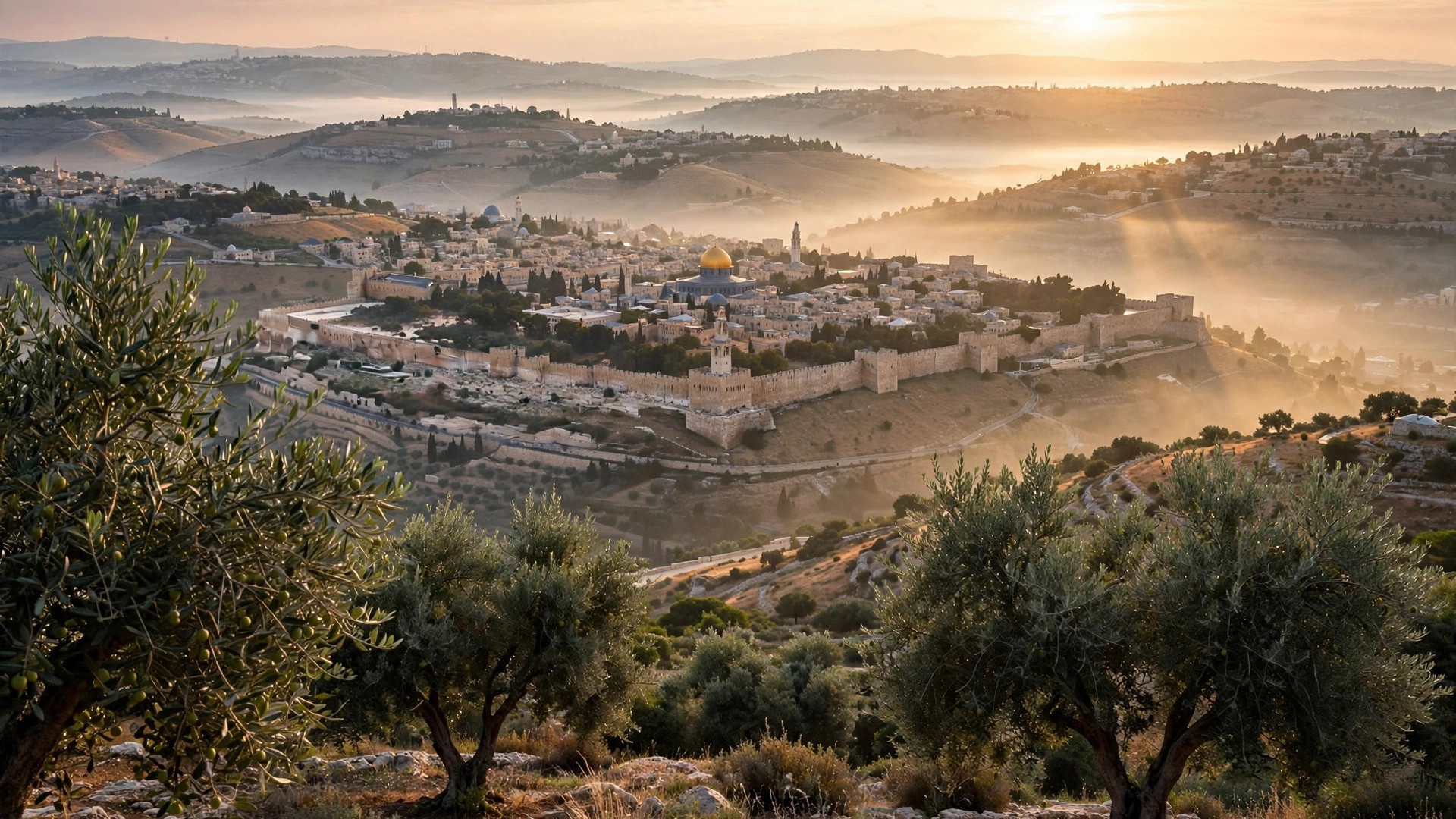
Jerusalem sits on hills — every pilgrim who has climbed its steep streets knows it in their legs. But the seven hills of Jerusalem in the Bible carry significance far beyond geography. These hills shaped the city’s history, hosted its temple, witnessed its tragedies, and point to its glorious future.
What are the seven hills? Does the Bible name them? And why does Scripture so often describe Jerusalem as a city “on the mountains”? Let us climb these ancient heights together — through Scripture, history, and the hope they proclaim.
Jerusalem, City on the Hills
The Bible describes Jerusalem as a city set on high ground. “Great is the Lord, and most worthy of praise, in the city of our God, his holy mountain. Beautiful in its loftiness, the joy of the whole earth, like the heights of Zaphon is Mount Zion, the city of the Great King” (Psalm 48:1-2). “As the mountains surround Jerusalem, so the Lord surrounds his people both now and forevermore” (Psalm 125:2).
Jesus called it “a town built on a hill” that “cannot be hidden” (Matthew 5:14). The image is deliberate: Jerusalem was meant to be visible — a city on the heights, a light to the nations. Its elevation was not just topography. It was theology. God placed his city on high ground so that the world could see it, and so that its people would always look up.
But which seven hills? The Bible does not give a numbered list. The “seven hills of Jerusalem” is a traditional description, drawn from the city’s topography and from later historical sources. Different lists name slightly different hills, because Jerusalem’s ridges and valleys have been built over, leveled, and renamed across three thousand years. The traditional seven are these.
Hill One: Mount Zion — The City of David
Mount Zion is the most famous hill in the Bible — and the most misunderstood. Originally, Zion was the Jebusite fortress David conquered, the southeastern hill of the city (2 Samuel 5:7, in substance). Later, the name expanded to cover the whole city, the temple mount, and eventually the entire people of God. “The Lord loves the gates of Zion more than all the other dwellings of Jacob” (Psalm 87:2).
Zion is the hill of kingship and covenant. David made it his capital. The ark rested there. The prophets used “Zion” as shorthand for God’s people and God’s promises. And the New Testament lifts it higher still: “You have come to Mount Zion, to the city of the living God, the heavenly Jerusalem” (Hebrews 12:22). Zion is the hill that became a hope — the earthly city that points to the heavenly one.
Hill Two: Mount Moriah — Where God Provided
Mount Moriah is the temple mount, the hill where Abraham offered Isaac (Genesis 22:2, 14, in substance) and where Solomon built the temple (2 Chronicles 3:1). It is the hill of sacrifice and provision. Abraham named it “The Lord Will Provide” (Genesis 22:14) — because on that hill, God provided a ram in place of the son.
Centuries later, on the same hill, God would provide a greater substitute: his own Son, sacrificed just outside the city walls. Moriah is the hill where the story of substitution began — and where it was finished. Every sacrifice offered on that hill pointed forward to the one sacrifice that would end all sacrifices: “Behold, the Lamb of God, who takes away the sin of the world” (John 1:29, in substance).
Hill Three: The Mount of Olives — The Hill of the King
East of the city, across the Kidron Valley, rises the Mount of Olives — the hill of Jesus’ most intimate and most agonizing moments. He taught there. He wept over the city there: “As he approached Jerusalem and saw the city, he wept over it” (Luke 19:41). He prayed in Gethsemane, at its foot, the night before the cross (Matthew 26:36). And he ascended to heaven from its slopes: “He was taken up before their very eyes, and a cloud hid him from their sight” (Acts 1:9).
The Mount of Olives is also the hill of return. Zechariah prophesied, “On that day his feet will stand on the Mount of Olives, east of Jerusalem” (Zechariah 14:4). The angels at the ascension promised, “This same Jesus, who has been taken from you into heaven, will come back in the same way you have seen him go into heaven” (Acts 1:11). The hill where he wept and prayed and left is the hill where he will return.
Hill Four: Mount Scopus — The Hill of Watching
North of the Mount of Olives stands Mount Scopus, whose name means “watchtower.” From its summit, the whole city is visible — the temple mount, the walls, the valleys. Roman armies camped there. Pilgrims first glimpsed the city from there. Scopus is the hill of watching: the place where you see the city whole, in all its beauty and vulnerability.
Scopus reminds us that Jerusalem has always been watched — by armies, by pilgrims, by prophets, and by God. “I have posted watchmen on your walls, Jerusalem; they will never be silent day or night” (Isaiah 62:6). The God who watches over Jerusalem watches over his people too: “He who watches over Israel will neither slumber nor sleep” (Psalm 121:4, in substance).
Hill Five: The Hill of Evil Counsel — The Hill of Betrayal
South of the city, near the Valley of Hinnom, stands the hill tradition calls the Hill of Evil Counsel — where, tradition says, the house of Caiaphas the high priest stood, and where the plot to kill Jesus was hatched. Nearby is the Field of Blood, bought with the thirty pieces of silver Judas returned (Matthew 27:3-10, in substance).
This hill is the dark side of Jerusalem’s heights. Not every high place is holy. The same city that hosted the temple also hosted the conspiracy. The same hills that heard the prophets also heard the plotting of priests. Jerusalem’s story is the human story: glory and betrayal on neighboring hills, sometimes on the same day.
Hill Six: Mount Gerizim of the South — The Hill of the Upper City
The western hill of Jerusalem, the Upper City, was the wealthy quarter in Jesus’ day — the neighborhood of priests, aristocrats, and Herod’s palace. It is the hill of power and privilege. Herod’s grand palace stood there, and the Sanhedrin met nearby. The Upper City reminds us that Jerusalem was not only a religious center but a political one — a city of palaces as well as temples, of power as well as prayer.
It was in the Upper City, in an upper room, that Jesus ate his last meal with his disciples (Mark 14:12-16, in substance). The hill of power became the hill of servanthood: “Jesus got up from the meal, took off his outer clothing, and wrapped a towel around his waist” (John 13:4, in substance) — and washed his disciples’ feet. The highest hill in the city’s social order became the place of the lowest service.
Hill Seven: Golgotha — The Hill of the Skull
The seventh hill is not a mountain at all. It is a small, skull-shaped rise outside the city walls called Golgotha — “the place of the Skull” (John 19:17). There, Jesus was crucified. “They came to a place called Golgotha” (Matthew 27:33). The lowest moment in history happened on the lowest hill in Jerusalem’s story.
And that is the point. The God who sits on the heights came down to the lowest hill to die for the world. The King of Zion was crowned with thorns on Golgotha. The glory of Moriah was fulfilled in the shame of the skull hill. The seven hills of Jerusalem tell one story: God comes down to lift us up. The highest hill and the lowest hill meet at the cross.
Why Hills Matter in Scripture
Hills in the Bible are places of revelation. God gave the Law on a mountain. Elijah called down fire on a mountain. Jesus preached his greatest sermon on a mountain (Matthew 5:1, in substance) and was transfigured on a mountain (Matthew 17:1). “I lift up my eyes to the mountains — where does my help come from? My help comes from the Lord, the Maker of heaven and earth” (Psalm 121:1-2).
Hills also represent pride and its fall. “Every valley shall be raised up, every mountain and hill made low” (Isaiah 40:4). The high places of idolatry — where Israel built altars to Baal — were the hills of rebellion. God exalts the humble and humbles the proud. The hills of Jerusalem carry both messages: God is high above us, and God came down to us.
A Necessary Clarification: Jerusalem vs. Rome’s Seven Hills
Revelation mentions a beast with seven heads that are “seven hills on which the woman sits” (Revelation 17:9). Because Rome was famously built on seven hills, many interpreters connect the passage to Rome. That connection is legitimate for Revelation’s context — but it does not mean Jerusalem’s seven hills are the same as Rome’s, or that the two cities are interchangeable. Jerusalem’s hills have their own story, rooted in the Old Testament, the temple, and the life of Jesus. Do not confuse the two. The seven hills of Jerusalem point to God’s covenant city; the seven hills of Revelation point to a different power entirely.
Questions Readers Often Ask
Does the Bible list the seven hills of Jerusalem? No. The Bible describes Jerusalem as a city on hills and mountains, and it names individual hills — Zion, Moriah, Olives — but it never gives a numbered list of seven. The “seven hills” is a traditional description drawn from the city’s topography, not a biblical enumeration.
Why seven? Seven is the biblical number of completeness. Whether or not Jerusalem has exactly seven hills depends on how you count the ridges, but the traditional number reflects the city’s completeness as God’s chosen city — the complete city on the complete hills.
What does “city on a hill” mean for Christians today? Jesus applied the image to his followers: “You are the light of the world. A town built on a hill cannot be hidden” (Matthew 5:14). The church is called to be a visible city — a community on the heights, showing the world what God’s kingdom looks like.
The Mountain That Will Fill the Earth
The seven hills of Jerusalem point beyond themselves. Daniel saw a stone “cut out of a mountain, not by human hands” that “became a huge mountain and filled the whole earth” (Daniel 2:35). Isaiah saw a day when “the mountain of the Lord’s temple will be established as the highest of the mountains… and all nations will stream to it” (Isaiah 2:2). The hills of Jerusalem — Zion, Moriah, Olives, Golgotha — are the foothills of that final mountain. The city on the heights is a preview of the kingdom that will cover the earth. The King who died on the lowest hill will reign from the highest mountain — and “the earth will be filled with the knowledge of the glory of the Lord as the waters cover the sea” (Habakkuk 2:14, in substance). For general background on the city itself, the Wikipedia article on Jerusalem offers a helpful overview.










