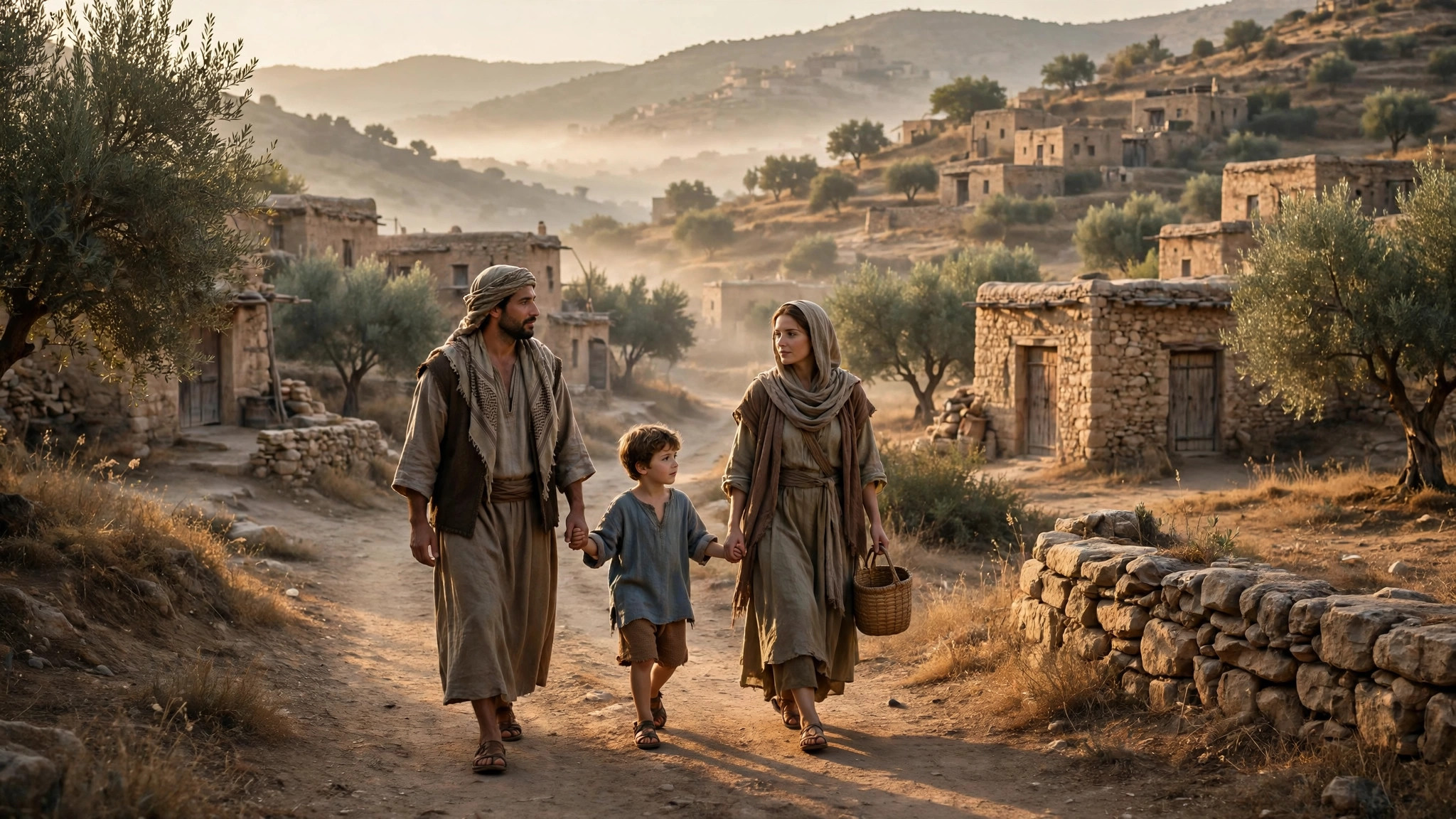
Imagine a workshop in Nazareth, dust in the air, a young man shaping wood beside his father. Nothing about the scene looks like the hinge of history. No crowds, no miracles, no sermons. Yet the Gospels insist that this ordinary-looking life was the life of God Himself, lived out in real time. The meaning of Jesus’ early life in the Bible is found exactly there: the eternal Son did not merely appear as an adult and get to work. He was born, He grew, He waited, and He obeyed — and every quiet year of it matters.
The Name He Carried
Before Jesus ever spoke a word, His name was already preaching. His Hebrew name was Yeshua, a shortened form of Yehoshua (Joshua), meaning “Yahweh saves” or “the Lord is salvation.” The angel told Joseph, “you are to give him the name Jesus, because he will save his people from their sins” (Matthew 1:21). The child’s identity was His mission.
He was known as Jesus of Nazareth, and even the town’s name carried an echo. The Hebrew word netzer means branch or shoot, recalling the prophecy, “A shoot will come up from the stump of Jesse; from his roots a Branch will bear fruit” (Isaiah 11:1). In Greek the Gospels call Him Iēsous, the same saving name carried across languages to the nations. From the first, His story was about rescue.
A Birth in Bethlehem
Jesus’ early life begins with the miracle of the virgin birth. Mary, a young woman engaged to Joseph, learned from the angel Gabriel that she would conceive by the Holy Spirit (Luke 1:26–38). Her response has become the model of surrender for every believer: “I am the Lord’s servant… May your word to me be fulfilled.” Joseph, described as faithful and righteous, chose mercy over public shame when he learned of Mary’s pregnancy, until an angel explained the divine plan to him in a dream (Matthew 1:18–25). Together, this young couple carried heaven’s greatest secret.
Jesus was born in Bethlehem, fulfilling Micah’s prophecy: “But you, Bethlehem Ephrathah… out of you will come for me one who will be ruler over Israel” (Micah 5:2; Matthew 2:5–6). Laid in a manger because there was no room in the inn (Luke 2:7), the King of kings entered the world in poverty — the first sign that His kingdom would not be of this world.
Shepherds, Wise Men, and a Midnight Flight
God announced the birth first to shepherds — poor, night-shift workers in the fields (Luke 2:8–20). Heaven’s choir sang to society’s overlooked, showing from day one that the gospel is for the humble and the lowly. The shepherds hurried to see, then spread the word, becoming the first evangelists.
Wise men from the east followed a star to worship the child, offering gold, frankincense, and myrrh (Matthew 2:1–12). Their costly gifts honored Him as King, God, and the one who would suffer — a remarkable confession from Gentiles at the very start.
But danger came quickly. Warned in a dream, Joseph fled with Mary and Jesus to Egypt, escaping Herod’s murderous rage (Matthew 2:13–15). This fulfilled Hosea’s words, “Out of Egypt I called my son” (Hosea 11:1). Even as a helpless infant, Jesus was already reliving Israel’s story — and already facing the world’s hostility. The shadow of the cross falls across the cradle.
The Hidden Decades in Nazareth
After Herod’s death, the family settled in Nazareth in Galilee (Matthew 2:19–23). Luke summarizes these hidden years in one profound sentence: “And Jesus grew in wisdom and stature, and in favor with God and man” (Luke 2:52). Think about what this means. The Son of God learned to walk, to talk, and to work with wood beside Joseph. He grew — in wisdom, in body, in relationship with God and people. Jesus did not skip human development; He sanctified it. Every stage of human life, including childhood and adolescence, has now been lived by God Himself and filled with dignity.
Scripture is silent about most of these years, and that silence is instructive. God does not need to explain everything. The hidden years teach us that faithfulness in ordinary life — doing chores, learning a trade, honoring parents — is precious to God, even when no one is watching and nothing seems “ministry-like.”
The Boy in the Temple
The one childhood story the Gospels preserve is extraordinary. At twelve, Jesus stayed behind in Jerusalem after Passover, and His frantic parents found Him in the temple courts, “sitting among the teachers, listening to them and asking them questions” (Luke 2:46). Everyone was amazed at His understanding. When Mary scolded Him, Jesus answered, “Didn’t you know I had to be in my Father’s house?” (Luke 2:49). His first recorded words reveal His self-awareness: God was His Father, and His Father’s work was His mission.
Yet Luke adds the tender detail that He then went home to Nazareth and “was obedient to them” (Luke 2:51). Perfect divinity expressed itself in perfect submission to human parents.
Parents often find deep encouragement in Jesus’ early life. If God entrusted His own Son to a young, poor, ordinary couple in a backwater town, then no faithful parent’s work is small or unseen. Your hidden labor of raising children in the Lord echoes Nazareth.
What Scripture Says — and Where It Stays Silent
Scripture explicitly teaches that Jesus was fully God and fully man from conception — conceived by the Holy Spirit, born of the virgin Mary (Matthew 1:20; Luke 1:35). It explicitly teaches that He grew and developed as a real human child (Luke 2:40, 52) and lived without sin (Hebrews 4:15). Scripture is silent about most details of His childhood. Later legends — stories of the boy Jesus performing miracles, found in non-biblical writings like the Infancy Gospel of Thomas — are not Scripture and should not be treated as fact. Where the Bible is silent, we must not invent certainty. The Gospels’ restraint is itself a lesson: God gave us exactly what we need.
What the Quiet Years Teach Us
Every scene of Jesus’ early life carries meaning. The manger shows God’s identification with the poor and humble — salvation comes low, not high. The flight to Egypt shows that God’s plan cannot be stopped by earthly powers, and that Jesus, like Israel, came “out of Egypt” to begin a new exodus — this time from sin. Nazareth — a town of no reputation (“Can anything good come from Nazareth?” John 1:46) — pictures how God chooses the despised things of the world to shame the wise (1 Corinthians 1:27–28). His obedience to Mary and Joseph models the beauty of honoring parents and the sanctity of ordinary family life.
For believers today, the lessons are practical. Embrace hidden seasons: if your life feels unremarkable right now, you are in good company — the Savior spent thirty years in obscurity. Grow intentionally: Jesus “grew in wisdom and stature, and in favor with God and man.” Pursue balanced growth — mental, physical, spiritual, and relational. Honor your family: the sinless Son of God submitted to imperfect parents. Know who your Father is: like the boy Jesus, root your identity in your relationship with God. Trust God’s timing: Jesus waited thirty years before beginning public ministry. Do not rush God’s preparation; the waiting is part of the calling.
Questions People Ask
Did Jesus have brothers and sisters? The Gospels mention Jesus’ brothers — James, Joseph, Simon, and Judas — and His sisters (Matthew 13:55–56). Christians differ on whether these were younger children of Mary and Joseph or close relatives; Scripture simply presents them as His family.
Why is so little recorded about His childhood? The Gospels focus on what reveals His identity and mission. The Holy Spirit inspired exactly the details we need — no more, no less. The silence itself teaches us to trust God’s wisdom in what He reveals and what He withholds.
Was Jesus poor? By worldly standards, yes — born in a stable, raised by a carpenter in Galilee. Yet this poverty was purposeful: “though he was rich, yet for your sake he became poor, so that you through his poverty might become rich” (2 Corinthians 8:9).
Conclusion: The God Who Grew Up
The meaning of Jesus’ early life in the Bible is summed up in its stunning humility: the eternal God became a baby, a boy, a teenager — He lived your life before He died for it. There is no stage of human existence He has not sanctified, no hidden season He does not understand. Whatever quiet, ordinary, unseen place you find yourself today, know that Jesus has been there. He grew in a small town, worked with His hands, and honored His parents — and the Father was well pleased. Your ordinary faithfulness matters eternally. Draw near to Him today in prayer. Thank Him for coming so low to lift you so high. And rest in this hope: the child of Bethlehem is the King of glory, and because He lived, died, and rose, you can live with Him forever. For further historical context on Jesus, the Wikipedia article on Jesus offers a helpful overview.










