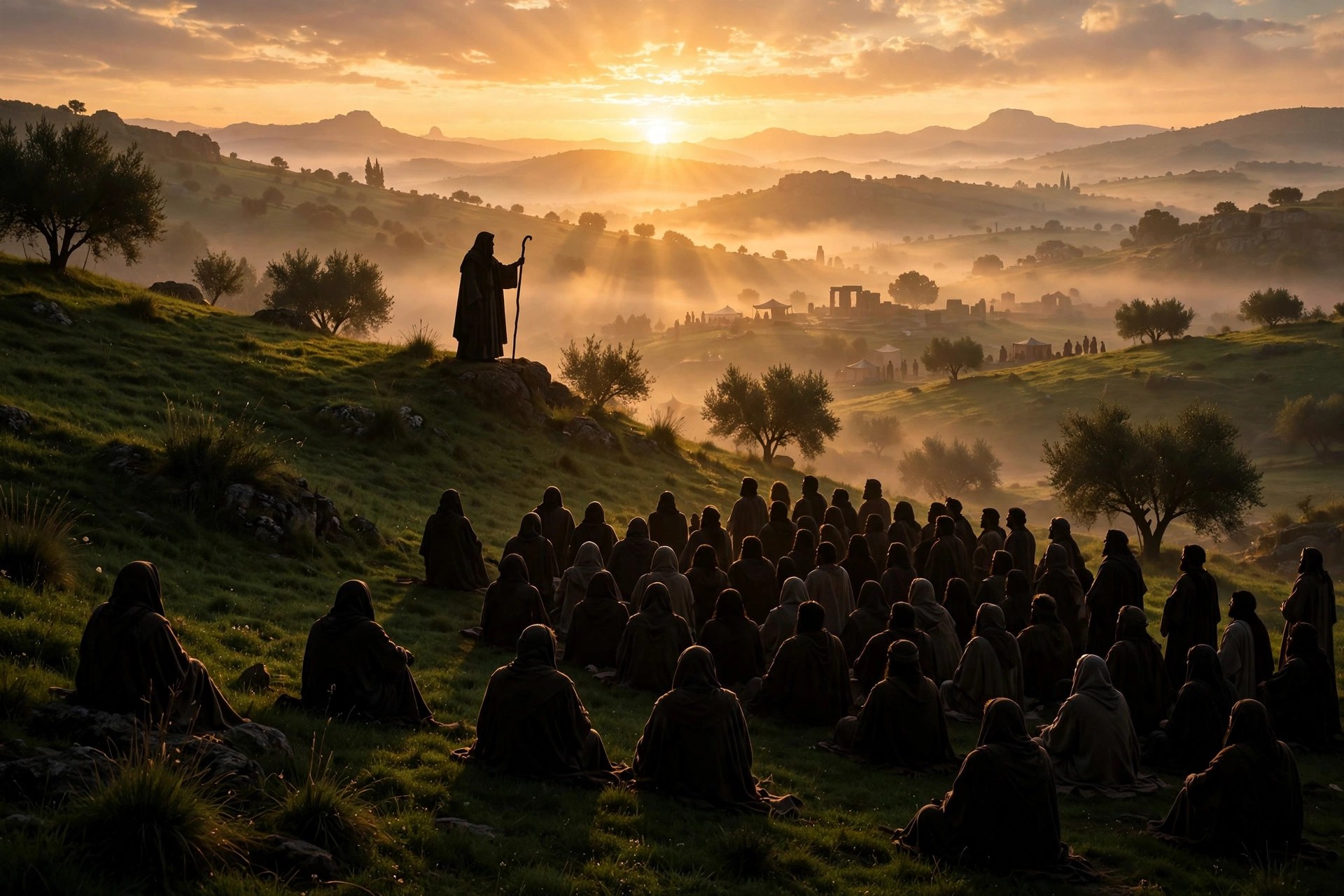
No notes, no pulpit, no sound system — just Jesus, a mountainside, and a crowd of ordinary people hearing words that would reshape the world. The Sermon on the Mount is the most famous sermon ever preached, and its meaning in the Bible is nothing less than Jesus’ own description of what life in God’s kingdom looks like. Two thousand years later, it still confronts, comforts, and transforms everyone who reads it. If you have ever wondered what Jesus actually expects of His followers — not the watered-down version, but the real thing — this sermon is your answer. Let us climb the mountain together.
Setting the Scene: A Manifesto, Not a Seminar
The sermon spans Matthew chapters 5 through 7. Matthew sets the scene: “Now when Jesus saw the crowds, he went up on a mountainside and sat down. His disciples came to him, and he began to teach them” (Matthew 5:1–2). Luke records a similar sermon “on a level place” (Luke 6:17) — likely the same teaching given on more than one occasion, as traveling rabbis repeated their core messages.
The audience matters. Jesus spoke to His disciples, but the crowds listened in — and at the end, “the crowds were amazed at his teaching, because he taught as one who had authority, and not as their teachers of the law” (Matthew 7:28–29). This was not a private seminar; it was a public manifesto of the kingdom.
The sermon’s structure is masterful. It opens with the Beatitudes (Matthew 5:3–12) — the character of kingdom citizens. Then comes their calling: salt and light (5:13–16). Then Jesus explains His relationship to the Old Testament law (5:17–48), teaches on authentic spirituality — giving, praying, fasting (6:1–18) — reorders priorities around money and worry (6:19–34), addresses judgment and discernment (7:1–23), and closes with the wise and foolish builders (7:24–27). Every section builds on the last, forming a complete portrait of kingdom life.
The Beatitudes: Blessing Turned Upside Down
The sermon opens with eight blessings that turn the world’s values upside down. Behind Jesus’ “Blessed are…” stands the Hebrew ashrei, the word that opens the Psalms: “Blessed [ashrei] is the one…” (Psalm 1:1). The Beatitudes are Jesus’ new Psalm 1 — His portrait of the truly blessed life, rooted in Israel’s wisdom tradition.
“Blessed are the poor in spirit, for theirs is the kingdom of heaven” (5:3). The kingdom belongs not to the self-sufficient but to those who know their spiritual bankruptcy. Everything starts with humility. “Blessed are those who mourn, for they will be comforted” (5:4). Those who grieve over sin — their own and the world’s — receive God’s comfort. The world says avoid pain; Jesus says mourning has a promise.
“Blessed are the meek, for they will inherit the earth” (5:5). Meekness is not weakness — it is strength under control, like a tamed warhorse. The gentle, not the ruthless, inherit God’s future. “Blessed are those who hunger and thirst for righteousness, for they will be filled” (5:6). The deepest appetite God promises to satisfy is not for success but for righteousness — for things to be right.
“Blessed are the merciful, for they will be shown mercy” (5:7). “Blessed are the pure in heart, for they will see God” (5:8). “Blessed are the peacemakers, for they will be called children of God” (5:9). “Blessed are those who are persecuted because of righteousness” (5:10). The final beatitude is a warning and a promise: following Jesus will cost you — and heaven’s reward is worth it (5:12).
Salt, Light, and a Covenant of Salt
“You are the salt of the earth” (5:13) echoes salt’s Hebrew significance: salt seasoned sacrifices (Leviticus 2:13) and sealed covenants — a “covenant of salt” (Numbers 18:19) meant an unbreakable promise. To be salt is to be a preserving, covenant-keeping presence in a decaying world. “You are the light of the world” (5:14) recalls Isaiah’s servant: “I will also make you a light for the Gentiles” (Isaiah 42:6). Jesus takes Israel’s calling and gives it to His followers — the church inherits the mission of bringing God’s light to the nations.
The Heart of the Law: A Radical Standard
The sermon’s most challenging section begins with Jesus’ declaration: “Do not think that I have come to abolish the Law or the Prophets; I have not come to abolish them but to fulfill them” (Matthew 5:17). Then He raises the standard higher than anyone imagined. Anger is murder’s root: “You have heard that it was said… ‘You shall not murder.’ But I tell you that anyone who is angry with a brother or sister will be subject to judgment” (5:21–22). Jesus moves from the act to the heart. God judges not just our hands but our hearts. Lust is adultery’s root: “Anyone who looks at a woman lustfully has already committed adultery with her in his heart” (5:28). The battle for purity is won or lost in the mind before the body ever acts.
Then comes the sermon’s summit: “You have heard that it was said, ‘Love your neighbor and hate your enemy.’ But I tell you, love your enemies and pray for those who persecute you” (5:43–44). This is the love that distinguishes God’s children from everyone else (5:45–48). “Be perfect, therefore, as your heavenly Father is perfect” (5:48). The word “perfect” translates the Greek teleios, but its Hebrew counterpart is tamim — meaning whole, complete, undivided. Noah was tamim (Genesis 6:9); sacrifices had to be tamim — without blemish. “Be perfect” means be whole-hearted — undivided in your devotion to God. This impossible standard drives us to grace: we cannot achieve it, which is why we need the Savior preaching it.
The Secret Life: Giving, Praying, Fasting
In chapter 6, Jesus turns to religious practices — and His concern is motive. Three times He repeats the pattern: do not practice righteousness to be seen by others (6:1, 5, 16), but in secret — “then your Father, who sees what is done in secret, will reward you” (6:4, 6, 18). This section contains the Lord’s Prayer (6:9–13) — Jesus’ model for God-centered, kingdom-focused prayer. It also contains the sermon’s teaching on forgiveness: if we refuse to forgive others, we block our own forgiveness (6:14–15).
Then Jesus reorders our relationship with money and worry. “Do not store up for yourselves treasures on earth… But store up for yourselves treasures in heaven” (6:19–20). “You cannot serve both God and money” (6:24). And the beloved antidote to anxiety: “Do not worry about your life… But seek first his kingdom and his righteousness, and all these things will be given to you as well” (6:25, 33). Worry is practical atheism; seeking God’s kingdom first is practical faith.
Judgment, the Narrow Gate, and the Two Builders
Chapter 7 opens with the most quoted — and most misquoted — verse in the sermon: “Do not judge, or you too will be judged” (7:1). Jesus is not forbidding all discernment — He commands it later in the same chapter (7:6, 15–20). He is forbidding hypocritical judgment: “Why do you look at the speck of sawdust in your brother’s eye and pay no attention to the plank in your own eye?” (7:3). Judge yourself first, judge humbly, judge to restore — never to condemn.
Jesus then teaches persistence in prayer — “Ask and it will be given to you; seek and you will find; knock and the door will be opened” (7:7) — grounded in the Father’s goodness: “how much more will your Father in heaven give good gifts to those who ask him!” (7:11). The sermon narrows toward its close: “Enter through the narrow gate. For wide is the gate and broad is the road that leads to destruction” (7:13). Not all paths lead to life. Then the sobering warning: “Not everyone who says to me, ‘Lord, Lord,’ will enter the kingdom of heaven, but only the one who does the will of my Father” (7:21). Words without obedience are empty. The finale is the parable of the builders: “Everyone who hears these words of mine and puts them into practice is like a wise man who built his house on the rock” (7:24). Hearing is not enough. The sermon demands a response — and the storm will reveal what you built on.
The Mountain as God’s Classroom
The mountain is God’s classroom. Moses received the law on Mount Sinai (Exodus 19–20); Jesus gave the kingdom’s charter on a Galilean mountainside. The parallel is deliberate: as Moses delivered the old covenant from a mountain, Jesus delivers the new covenant’s heart from a mountain. But where Sinai came with thunder and terror, this mountain comes with blessing upon blessing. The crowds came with diseases, demons, and desperation (Matthew 4:23–25) — and Jesus gave them the kingdom’s blueprint before He gave them the kingdom’s King on the cross. He taught them how to live before He died to make that life possible. The house on the rock is the tested life. Storms come to every house — the wise builder’s and the fool’s alike. The difference is not the storm but the foundation. Obedience to Jesus’ words is the only foundation that survives the flood.
Living the Sermon This Week
Start with the Beatitudes as a daily examen: each morning, read one and ask, Does this describe me today? Practice secret righteousness — give, pray, or fast this week without telling anyone. Take anger and lust seriously: deal with bitterness or impurity radically (5:29). Love one enemy practically: do something kind for them this week and pray for them daily. Seek first the kingdom in your schedule and budget: reorder one thing this month to put God’s kingdom first. Build on the rock daily: pick one teaching of Jesus each week and practice it. Obedience, repeated, becomes foundation.
Three Questions People Ask
Is the Sermon on the Mount meant to be taken literally? Jesus used vivid hyperbole (gouging out eyes, 5:29) alongside literal commands (love your enemies, 5:44). The principles are absolutely binding; the illustrations use dramatic language to show how seriously to take them. Take the sermon more seriously than you want to — that is the point.
Can anyone actually live up to this standard? Not by willpower — and that is intentional. The sermon crushes self-righteousness and drives us to Christ, who fulfilled it perfectly and gives us His Spirit to transform us. We live it not to earn the kingdom but because we have received it.
What’s the difference between Matthew’s and Luke’s versions? Luke’s “Sermon on the Plain” (Luke 6:17–49) is shorter, with four beatitudes and matching woes. Scholars debate whether they are the same sermon in different settings or similar teachings given at different times. Either way, the message is consistent: kingdom life is radical, gracious, and open to all who come to Christ.
Conclusion: The Invitation of the Mountain
The Sermon on the Mount is ultimately an invitation — from the lips of Jesus Himself — to a life of impossible beauty: humble yet confident, merciful yet holy, persecuted yet rejoicing. It is a life you cannot manufacture and cannot earn. But here is the gospel hidden inside the sermon: the One who preached it lived it. Jesus was poor in spirit, meek, merciful, pure in heart. He loved His enemies — praying for them from the cross. He is the wise builder’s rock, the narrow gate, the fulfillment of every impossible standard. So come to Him. Hear His words. And build — not on your own righteousness, but on His. The storm will come, as storms always do. But the house built on Christ will stand, and on that day you will discover what the crowds on the mountainside began to sense: these are not just wise words. They are the words of life. Readers wanting a broader survey of how this sermon has been read through history can consult the Wikipedia entry on the Sermon on the Mount.










