When David was still a shepherd boy, nobody in his family thought of him as leadership material. Jesse lined up seven sons for Samuel, and David was not among them. He was out with the sheep. Yet God chose the boy in the field, and David went on to lead a nation. The story is a warning against measuring leadership the way the world measures it — by height, polish, volume, or résumé — and an invitation to measure it the way Scripture does: by character formed in hidden places.
Christian leadership, in the Bible, is not a technique for getting people to follow you. It is a calling to serve people the way Christ served them. That definition changes everything, because it means the qualifications are not mostly about skill. Skill matters — David led with “skillful hands” — but Scripture puts character first and competence second. The question is never only “Can this person lead?” It is also “What kind of person is doing the leading?”
The Question Behind the Title
Most leadership failures in Scripture were not failures of talent. Saul had presence. Solomon had wisdom. Judas had proximity to Jesus. What they lacked, at the decisive moment, was the character to carry the weight of their position. That is why the Bible keeps returning to the same test: does this person serve, or does this person use?
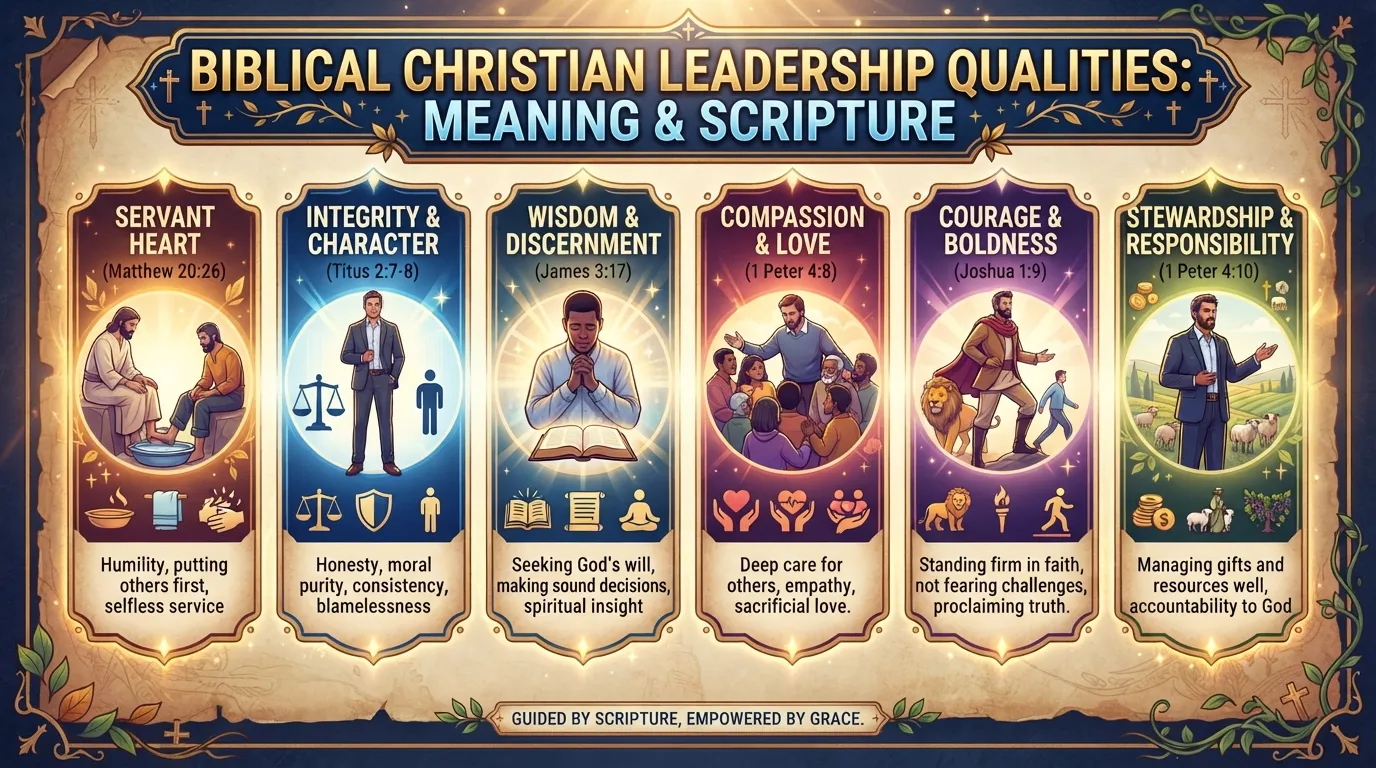
Jesus made the contrast explicit when His disciples argued about greatness. “The rulers of the Gentiles lord it over them,” He said, “but whoever would be great among you must be your servant” (Mark 10:42–45). In the world’s model, leadership is measured by how many people serve you. In Christ’s model, it is measured by how many people you serve. A Christian leader who forgets this has not simply adopted a different style; he has adopted a different kingdom.
This reframes ambition. Wanting to lead is not wrong — Paul says that whoever aspires to oversight desires a noble task (1 Timothy 3:1). But the desire must be purified. A leader who wants the platform more than the people will eventually sacrifice the people to keep the platform. A leader who wants the people more than the platform will lay the platform down when the people need it.
Humility: The Strength to Go Low
Philippians 2:3–4 commands believers to count others more significant than themselves, and then points to Christ, who “emptied himself, by taking the form of a servant” (Philippians 2:7). Biblical humility is not self-hatred. It is self-forgetfulness. The humble leader does not think less of himself; he thinks of himself less, because his attention is on God and on the people entrusted to him.
Moses is the great Old Testament picture of this. Numbers 12:3 calls him “very meek, more than all people who were on the face of the earth.” This is the man who confronted Pharaoh, parted a sea, and carried a nation’s complaints for forty years. His meekness was not weakness; it was strength under control. When his own siblings challenged him, he did not defend himself — God did. The humble leader does not need to win every argument, because his identity is not on the ballot.
In practice, humility looks like admitting mistakes without spin, sharing credit without calculation, receiving correction without defensiveness, and doing unnoticed work without resentment. A humble pastor visits the hospital when no one will post about it. A humble parent apologizes to a child. A humble manager listens to the quietest person in the room.
Wisdom: Asking Before Deciding
Solomon began his reign with a prayer that every leader should memorize: asked what he wanted, he requested “an understanding mind to govern your people, that I may discern between good and evil” (1 Kings 3:9). God was pleased, because Solomon asked for the one thing no org chart can supply. Wisdom is the ability to see a situation as God sees it and to act accordingly.
James 1:5 promises that God gives wisdom generously to those who ask. Proverbs adds that wisdom listens: “The way of a fool is right in his own eyes, but a wise man listens to advice” (Proverbs 12:15). The wise leader therefore builds counsel into decisions. He does not confuse speed with wisdom, or confidence with clarity. He is willing to say, “I don’t know yet,” and to wait, pray, and consult before acting.
Wisdom also knows the difference between a problem to solve and a tension to manage. Not every disagreement needs a ruling; some need patience. Not every delay is disobedience; some delays are protection. The wise leader learns when to act quickly — as Nehemiah did when the wall was threatened — and when to sit still, as David did while Saul hunted him.
Integrity: The Same Person in Every Room
Psalm 78:72 says David shepherded Israel “with upright heart and guided them with his skillful hand.” Heart and hand. Character and competence. The order matters. A leader can have skillful hands and a corrupt heart, and the damage will be proportional to the skill. Integrity means there is no gap between the public leader and the private person.
Integrity shows up in small, unobserved choices: the expense report nobody audits, the promise made when no one wrote it down, the conversation about an absent person, the way power is used when no one can push back. Leaders who cut corners in private eventually cut people in public, because the habit of self-protection spreads.
Scripture is blunt that integrity is tested by money, sex, and power — the three arenas where David himself fell. His adultery with Bathsheba and the murder of Uriah are recorded without varnish, precisely so that no leader can claim immunity. The lesson is not that failure disqualifies a person forever; David repented and was restored. The lesson is that no amount of past faithfulness makes a leader untouchable, and that hidden sin always becomes public damage.
Compassion: People Are Not Projects
Matthew 9:36 says that when Jesus saw the crowds, “he had compassion for them, because they were harassed and helpless, like sheep without a shepherd.” Compassion is what keeps leadership human. Without it, people become numbers, tasks, or obstacles. With it, a leader can make hard decisions — removing someone from a role, confronting sin, closing a program — without dehumanizing anyone in the process.
Compassion does not mean avoiding hard truths. Jesus wept over Jerusalem and then cleansed the temple. A compassionate leader tells the truth, but tells it the way a surgeon holds a scalpel: carefully, precisely, and for healing rather than harm. Compassion also means noticing who is missing. The shepherd in Luke 15 leaves the ninety-nine for the one. The compassionate leader asks who has gone quiet, who stopped coming, who is carrying something alone.
Courage and Faithfulness: Staying When It Costs
Joshua heard the same command four times as he took up Moses’ mantle: “Be strong and courageous” (Joshua 1:6–9). Biblical courage is not the absence of fear; it is obedience in the presence of fear. The courageous leader speaks truth to a powerful person, protects a vulnerable person, admits a costly mistake, and holds a biblical line when the crowd wants it moved.
But courage without faithfulness burns out. Faithfulness is courage repeated daily: showing up, keeping promises, doing the unglamorous work, finishing the assignment. Paul’s summary of a steward is that he be “found faithful” (1 Corinthians 4:2). The faithful leader does not need to be spectacular. He needs to be steady. Churches, families, and teams are rarely destroyed by one dramatic failure; they are far more often eroded by a thousand small unfaithfulnesses — the skipped prayer, the avoided conversation, the deferred decision.
What Leadership Is Not
It is worth naming the counterfeits, because they are common. Leadership is not domination: using fear, guilt, or spiritual pressure to control people. It is not celebrity: building a following around a personality instead of around Christ. It is not performance: measuring success by applause rather than by fruit. And it is not indispensability: a leader who makes everyone dependent on himself has built a monument, not a ministry. The test of godly leadership is what happens when the leader leaves. If the work collapses, the leader built followers of himself. If the work continues, he built followers of Christ.
That is the legacy worth aiming for. Paul told Timothy, “What you have heard from me in the presence of many witnesses entrust to faithful men, who will be able to teach others also” (2 Timothy 2:2). Four generations in one verse. The leader’s job is not to be the whole chain; it is to be one strong link.
So the question returns to the shepherd boy. God is still choosing leaders in fields nobody is watching, forming them through obscurity, correction, and quiet faithfulness before He ever gives them a platform. If you lead anything — a church, a family, a team, a classroom — the path forward is the same: serve before you speak, listen before you decide, stay honest in every room, love the people you would rather manage, and be brave enough to stay faithful when it costs. For a wider look at how this servant pattern has been understood beyond the Bible, the article on servant leadership traces its history and its influence on modern organizations.










