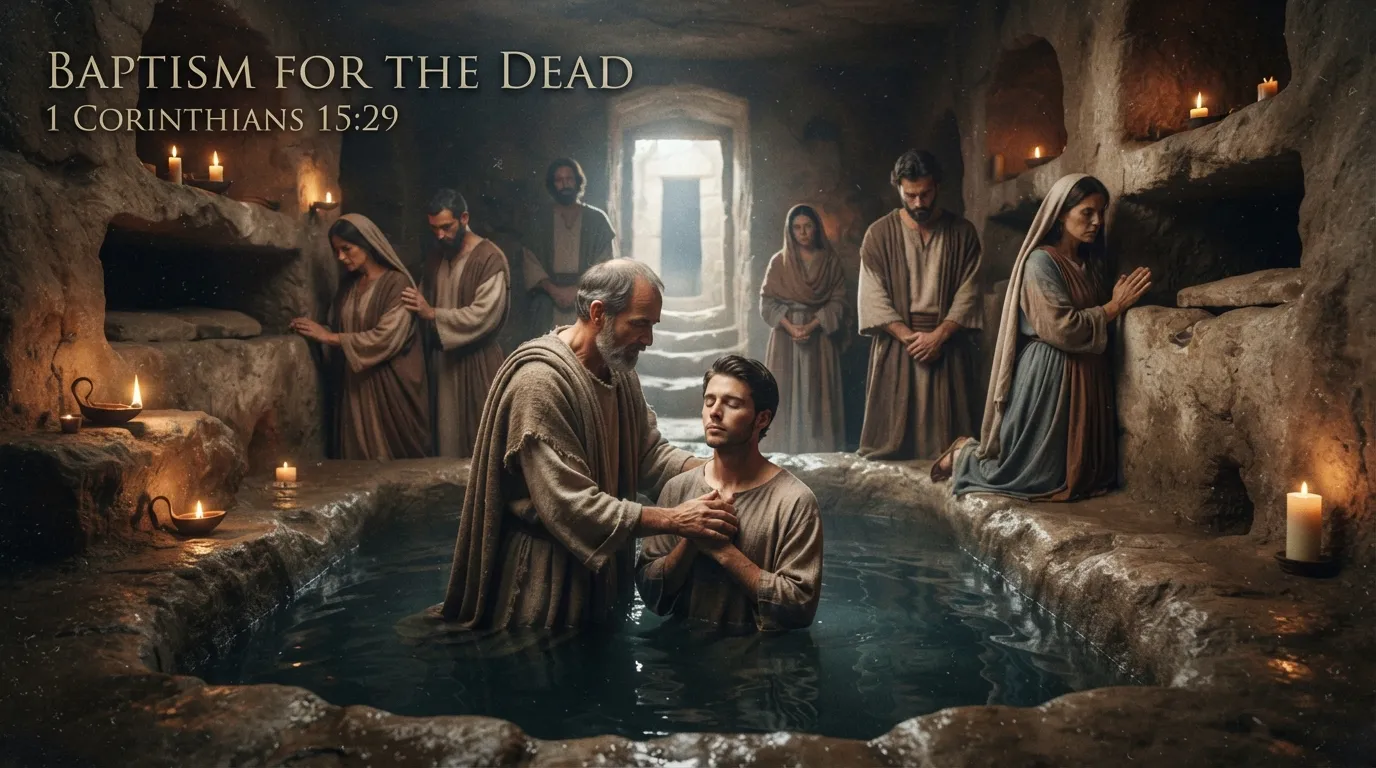
There is one verse in the Bible that has generated more debate, more denominations’ worth of disagreement, and more sincere confusion than almost any other single sentence: “Otherwise, what do people mean by being baptized on behalf of the dead? If the dead are not raised at all, why are people baptized on their behalf?” (1 Corinthians 15:29). One verse. One passing reference. No explanation. No command. No further mention anywhere else in Scripture.
That is the first thing to understand about “baptism for the dead.” It appears exactly once in the Bible, in a passing argument, and Paul never tells his readers to do it. Everything else — every theory, every practice, every controversy — is an attempt to explain a verse that Paul left unexplained. Honest Bible study begins by admitting that: this is one of the most difficult passages in the New Testament, and no interpretation is certain.
The Context: Resurrection, Not Baptism
The key to 1 Corinthians 15:29 is the chapter around it. First Corinthians 15 is not about baptism. It is about the resurrection. It is the longest, most systematic treatment of resurrection in the New Testament, and Paul’s argument builds step by step.
First, Paul establishes the facts: “Christ died for our sins in accordance with the Scriptures, that he was buried, that he was raised on the third day in accordance with the Scriptures” (1 Corinthians 15:3–4). Then he lists the witnesses: Peter, the Twelve, five hundred brothers at once, James, all the apostles, and finally Paul himself. Then he addresses the problem: some in Corinth were saying there is no resurrection of the dead (1 Corinthians 15:12). Paul answers with a chain of consequences: if there is no resurrection, then Christ has not been raised, preaching is in vain, faith is in vain, the apostles are liars, believers are still in their sins, the dead have perished, and Christians are “of all people most to be pitied” (1 Corinthians 15:13–19).
Then comes verse 29 — and it is an argument, not a command. Paul’s logic is: “If the dead are not raised at all, why are people baptized on their behalf?” He is pointing to something his readers were doing (or knew about) and saying: Your own practice contradicts your own theology. If you really believe there is no resurrection, why are you doing something that only makes sense if there is one? The verse is a rhetorical weapon in a debate about resurrection. It is not a teaching about baptism.
Notice also Paul’s pronoun: “What will those people do who are baptized for the dead?” (or “what do people mean by being baptized…”). Paul distances himself. He says “they,” not “we.” He does not say, “This is what we do.” He says, “This is what they do — and even they believe in resurrection.” The grammar suggests Paul is referencing a practice of others — possibly a fringe group in or near Corinth — not endorsing it as apostolic teaching.
The Main Interpretations
Scholars have proposed more than thirty interpretations of this verse. Here are the leading ones, each with its strengths and weaknesses.
1. Proxy baptism for deceased relatives. This is the most straightforward reading: living people were being baptized on behalf of people who had died unbaptized. This is the interpretation adopted by the Church of Jesus Christ of Latter-day Saints, which practices proxy baptism for the dead today, based on this verse. The strength of this view is that it takes the words at face value. The weakness is that it contradicts the rest of Scripture, which consistently teaches that a person’s eternal destiny is settled by their own response to God in this life (Hebrews 9:27; Luke 16:19–31; 2 Corinthians 5:10). No other passage in the Bible suggests that one person can be baptized for another, and Paul never commands or endorses it. If Paul meant to teach proxy baptism, it is strange that he would do so in a single ambiguous sentence and never mention it again.
2. Baptism in the face of death / baptism as a martyr’s act. Some scholars argue that “for the dead” means “in view of death” or “because of the dead” — that is, people were being baptized despite the risk of martyrdom, inspired by the example of believers who had died. The Corinthians were watching fellow Christians die for the faith, and new converts were stepping forward to be baptized in their place, filling the ranks. The strength of this view is that it fits the context: Paul immediately follows with his own sufferings — “Why are we in danger every hour? I die every day!” (1 Corinthians 15:30–31). The argument would be: If there is no resurrection, why would anyone risk death to be baptized? The weakness is that it requires a less common reading of the Greek preposition hyper (“on behalf of”).
3. Baptism for the sake of a dead Christ. Another view is that “the dead” refers to Christ Himself — people were being baptized “for” (in devotion to, in union with) the One who died. The strength is that it fits Paul’s theology of baptism as union with Christ’s death (Romans 6:3–4). The weakness is that the plural “the dead” more naturally refers to dead people in general, not to Christ alone.
4. A Corinthian heretical practice Paul merely cites. Some scholars argue that a fringe group in Corinth — possibly influenced by pagan mystery religions that had rites for the dead — was practicing proxy baptism, and Paul cited it the way a debater cites an opponent’s own behavior: “Even these people, whose practice I do not endorse, act as if resurrection is real.” The strength is that it explains Paul’s distancing language (“those people”). The weakness is that we have no independent evidence of such a group in Corinth.
5. Baptism as identification with the dying. A related view is that new converts were being baptized to take the place of believers who had died — “for the dead” in the sense of “to fill the places of the dead.” This fits the military image of ranks being replenished and the context of persecution.
No interpretation has won universal agreement. What scholars do agree on is that the verse cannot bear the weight of a doctrine. A single ambiguous sentence, in a rhetorical argument, with distancing language, and no corroboration anywhere else in Scripture, is not a foundation for a practice — especially a practice that would contradict the Bible’s clear teaching that salvation is personal, by grace through faith, and settled in this life.
What the Rest of the Bible Says About Baptism
To interpret one unclear verse, the Bible’s own method is to let clear verses interpret unclear ones. And the clear verses about baptism are consistent: baptism is for the living, for those who believe.
“Whoever believes and is baptized will be saved” (Mark 16:16). “Repent and be baptized every one of you in the name of Jesus Christ for the forgiveness of your sins” (Acts 2:38). The Ethiopian eunuch asked, “What prevents me from being baptized?” and Philip answered, “If you believe with all your heart, you may” (Acts 8:36–37). In every case, baptism follows personal faith and repentance. It is the believer’s own confession, not a ritual performed on someone else’s behalf.
The Bible also consistently teaches that death is the deadline for decision. “It is appointed for man to die once, and after that comes judgment” (Hebrews 9:27). The parable of the rich man and Lazarus depicts a fixed gulf after death (Luke 16:26). Paul says, “Now is the day of salvation” (2 Corinthians 6:2). There is no second chance after death, no postmortem baptism, no proxy that can substitute for a person’s own response to God. That is why the gospel is urgent: decisions made in this life echo in eternity.
What to Do with a Difficult Verse
First Corinthians 15:29 is a reminder that the Bible contains passages that are hard to understand — and that is okay. Peter himself admitted that Paul wrote “some things in them that are hard to understand” (2 Peter 3:16). The existence of one difficult verse does not undermine the clarity of the whole. The Bible is clear about the things that matter most: God, sin, Christ, salvation, resurrection, and the Christian life. On the unclear passages, humility is the right posture.
Second, the verse teaches a method: when you encounter a difficult passage, read the context, check the original language, compare with clear passages, and resist building a doctrine on a single ambiguous sentence. The Reformers called this the analogy of faith: Scripture interprets Scripture. The clear passages govern the unclear ones, not the other way around.
Third, the verse’s main point is not in doubt, even if its details are. Paul’s argument is about the resurrection — and the resurrection is certain. Christ rose. The witnesses saw Him. The dead will rise. The gospel stands on that fact, and no ambiguity in one verse can shake it. “For as in Adam all die, so also in Christ shall all be made alive” (1 Corinthians 15:22). That is the truth Paul was defending when he mentioned baptism for the dead — and that truth is the one that matters. For a survey of the scholarly debate and the history of interpretation of this verse, see the Wikipedia article on baptism for the dead.










