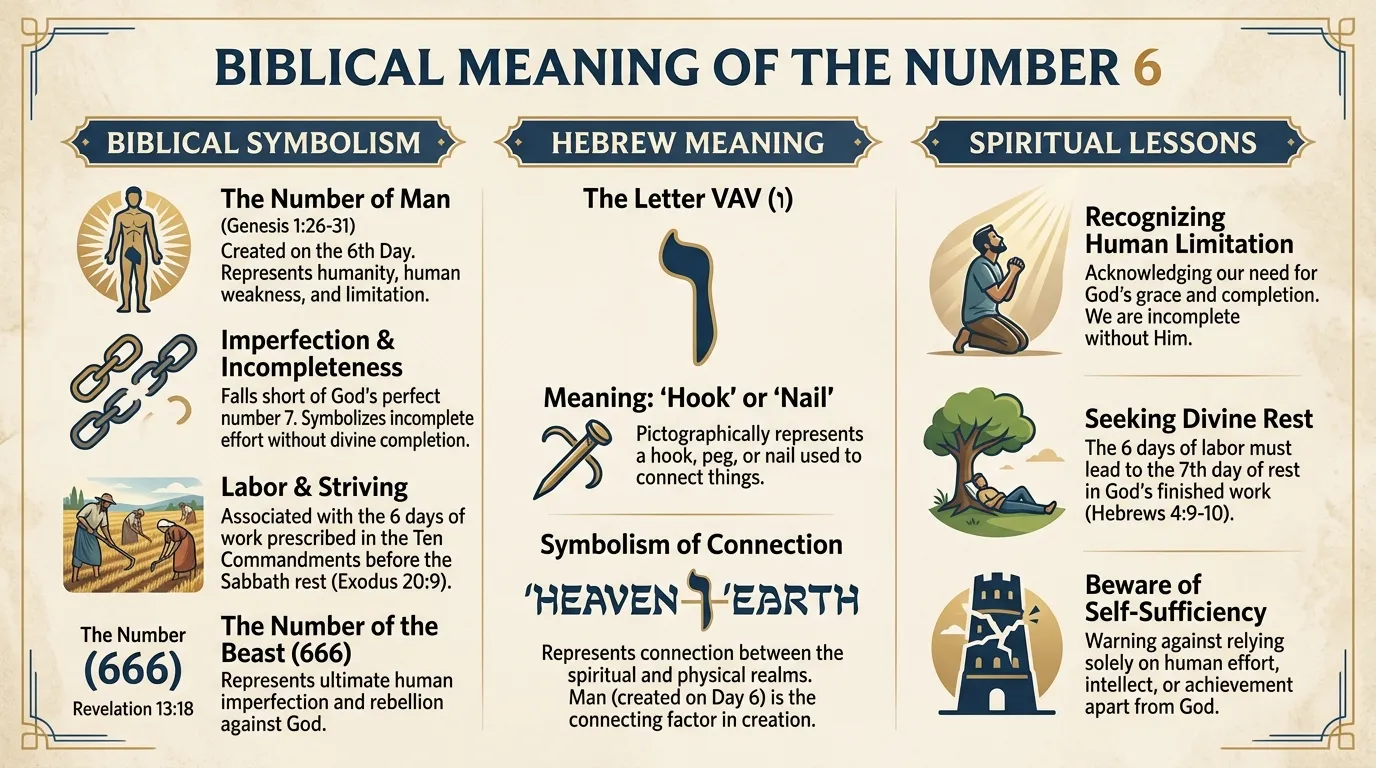
Six is the number of the workweek. Before it is anything else in the Bible — before the beast, before Goliath’s height, before any speculation — six is the number of days God gave humanity to labor. “Six days you shall labor and do all your work, but the seventh day is a Sabbath to the Lord your God.” The rhythm of six-and-one is the oldest pattern in Scripture, established in Genesis 1 before there was sin, before there was Israel, before there was a church. Everything the Bible says about six flows from that first week.
This article follows that flow. We will start with creation, trace six through the law and the narratives, face honestly the most notorious six in Scripture — 666 — and end with the caution the topic requires. The goal is not to decode a mystery but to recover a rhythm.
The Sixth Day: Humanity’s Birthday
On the sixth day, God creates the land animals and then — as the climax of the whole creation account — human beings. “Then God said, ‘Let us make man in our image, after our likeness.'” The sixth day is humanity’s birthday, and its placement is deliberate. Man is not the first thing made but the last, the crown toward which the week has been building. Light, sky, land, lights, sea creatures, land animals — and then the image-bearers, given dominion and blessed.
Because of this, six has always been associated with humanity — with human work, human limits, and human incompleteness. Seven is the number of divine completion; six, falling one short, is the number of the creature: real, dignified, God-imaged — but not God. Man was made on the sixth day, and the sixth day points beyond itself to the seventh, the Sabbath rest that humanity was made to enter. Six says: you are magnificent, and you are not finished. You need the seventh day.
This is why the Sabbath command is framed the way it is. “Six days you shall labor” is not a concession to economics. It is a theological statement: human work is good — God worked six days Himself — but human work is not ultimate. The week is designed to end in rest, in worship, in the acknowledgment that the world does not depend on our labor. Six days of work, one day of rest: the rhythm teaches both the dignity of labor and its limits.
Six in the Life of Israel
The six-and-one rhythm structures Israel’s entire calendar. Six years the land is sown; the seventh year it rests. Six years a Hebrew servant serves; in the seventh he goes free. The pattern scales from days to years to generations: after seven sevens of years comes the Jubilee, the great reset. Six is always the season of work, and the season of work always ends in release.
Sixes appear in the narratives too, often marking human strength at its limits. Goliath’s height is given as “six cubits and a span” — roughly nine feet nine inches. The measurement is not incidental. The narrator wants us to feel the sheer mass of human power arrayed against Israel: six cubits of bronze-age warrior, bristling with armor that is itemized piece by piece. And then a shepherd boy with a sling brings him down. The six-cubit giant is the Bible’s monument to the truth that human might, however impressive, is still only six — one short of seven, one short of God.
At Cana, Jesus finds “six stone water jars” set out for the Jewish rites of purification. Six jars, twenty to thirty gallons each — the vessels of the old order, the containers of ritual washing. Jesus fills them with water and turns the water to wine. The symbolism, whether intended or simply resonant, is rich: the six jars of the law’s purification become the vessels of the gospel’s joy. The old order, complete in its sixness, is transformed by the arrival of the seventh-day reality — the bridegroom, the feast, the new wine.
The Six Days Around Jericho
One more six deserves mention, because it dramatizes the whole theology. At Jericho, God instructs Israel to march around the city once a day for six days, with seven priests bearing seven trumpets. On the seventh day, they circle seven times, the trumpets sound, the people shout — and the walls fall. Six days of obedient, unimpressive marching. One day of breakthrough.
The pattern is unmistakable: six days of faithfulness that looks like nothing is happening, then the seventh day when God acts. The soldiers must have felt foolish on day three, circling silent walls while the defenders jeered. But the six days were not wasted. They were the obedience on which the miracle stood. Much of the Christian life is days one through six around Jericho — praying, serving, enduring, seeing no walls move. The theology of six says: keep marching. The seventh day belongs to God, and it always comes.
Facing 666 Honestly
No discussion of six can avoid the most famous number in the Bible: 666, “the number of the beast” in Revelation 13. “This calls for wisdom: let the one who has understanding calculate the number of the beast, for it is the number of a man, and his number is 666.” Two thousand years of speculation have followed, and honesty requires saying what is known and what is not.
What is known: the number is presented as a riddle for first-century readers with “understanding” — almost certainly involving gematria, the ancient practice of assigning numerical values to letters. The leading scholarly proposal is that 666 encodes “Nero Caesar” in Hebrew letters, pointing to the emperor whose persecution was the beast-like power John’s readers actually faced. The textual variant 616, found in some early manuscripts, strengthens this reading: it corresponds to the Latin form of Nero’s name. A riddle with a contemporary answer, in other words — not a code for distant-future speculation.
What is also widely recognized: 666 as triple six evokes the falling-short-of-seven on a cosmic scale. If seven is completeness and six is humanity, then 666 — six intensified threefold — is humanity’s attempt at ultimate significance without God: the complete number of incompletness, if that paradox can be allowed. The beast parodies the Trinity with its own trinity of dragon, beast, and false prophet, and its number parodies perfection with emphatic imperfection.
What is not known — and what Christians should stop claiming — is whose name 666 encodes in our own time. Every generation produces candidates: popes, presidents, barcodes, microchips. Every generation is wrong. The text calls for wisdom, not for newspaper exegesis. The point of the number is theological, not predictive: human power, however total it appears, is still six. It cannot reach seven. The beast’s number is a confession of its limits disguised as a boast of its power.
The Pastoral Meaning of Six
Strip away the speculation, and six preaches a remarkably practical sermon. It is the number of honest work: God made you to labor six days, to build, to plant, to provide. Work is not a curse — the curse made it painful, but work itself predates the fall. The sixth day’s blessing rests on human industry, and the Christian who works diligently is living inside the creation pattern.
The theology of six also names accepted limits. Six is not seven, and you are not God. The week ends. The land rests. The servant goes free. The rhythm is designed to prevent the two great idolatries of work: the idolatry that makes work ultimate (as if everything depended on us) and the idolatry that despises work (as if matter did not matter). Six days honors labor; the seventh day dethrones it. Both are worship.
And six is the number of waiting for completion. Every week, the six days point forward to the seventh. Every year of labor points to the Sabbath year. The author of Hebrews picks up this thread and runs it to eternity: “There remains a Sabbath rest for the people of God.” The sixes of this life — the work, the striving, the incompleteness — are not the end. They are the prelude. The seventh day is coming, and it will not end.
A Final Caution
The cautions for this number are the same as for all biblical numbers, with one addition. Six has attracted more superstition than most — the fear of the number itself, the seeing of 666 in every barcode, the anxiety about addresses and phone numbers. Christians should have nothing to do with this fear. A number cannot curse you. The beast of Revelation is a theological symbol of persecuting power, not a digit that haunts receipts.
What deserves our attention is not the sighting of sixes but the keeping of the rhythm: work six, rest one; labor diligently, trust completely; recognize your limits, anticipate your completion. That is what the Bible actually teaches about six. It is less exciting than a code, and far more transformative than one.
The number’s broader profile — mathematical, cultural, and historical — is catalogued in the reference article on the number 6; Scripture’s own portrait, from the sixth day to the Sabbath rest, remains the authoritative one.










