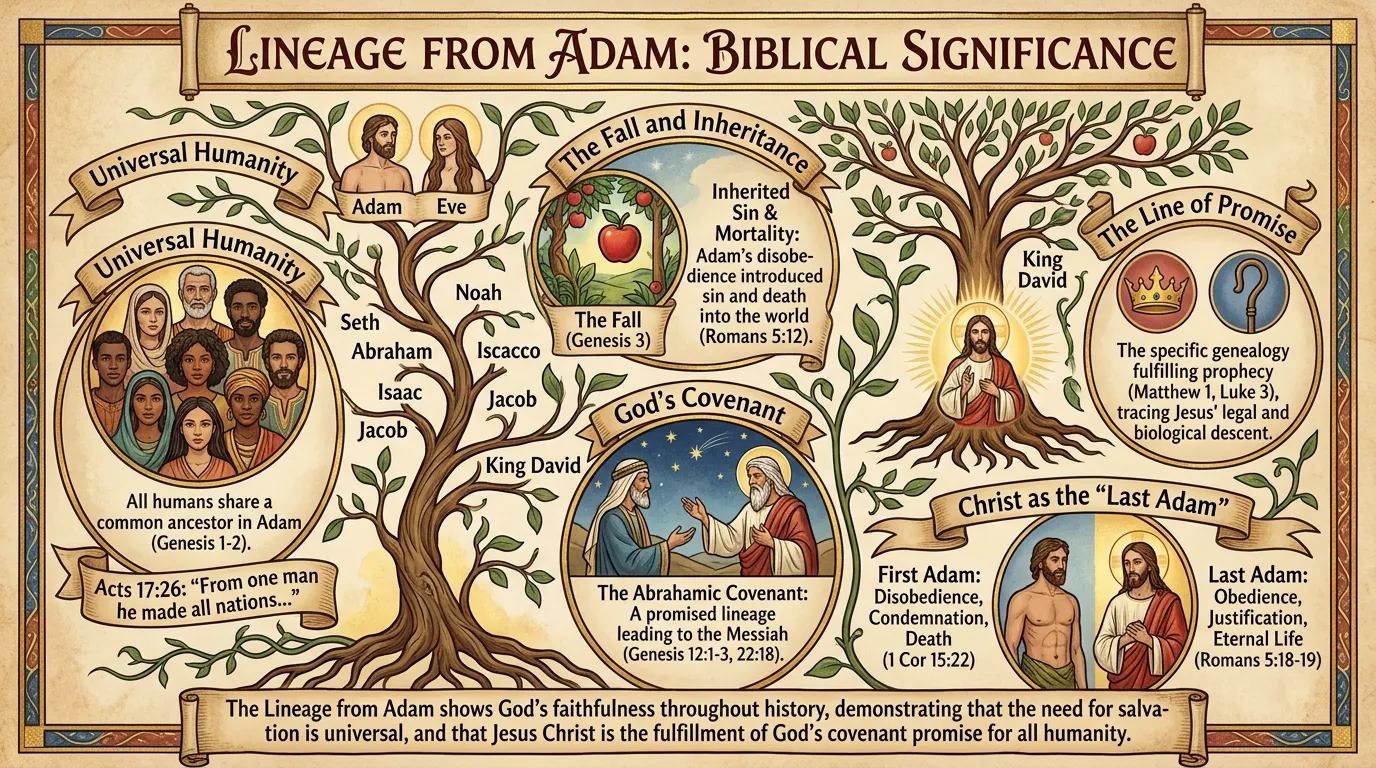
Have you ever looked at a family tree and wondered where it all began? Every family has a story. Names are passed down. Lives connect across many generations. The Bible also gives us a great family story, and it begins with Adam.
The phrase lineage from Adam meaning in the Bible points to the family line that begins with Adam, the first man God created. Scripture follows this line through many generations. It shows births, families, sin, death, faith, judgment, and God’s promise of redemption.
The Bible does not give Adam’s lineage only as a list of names. These names help us see how God worked through human history. They also remind us that every person comes from a human family marked by both God’s image and human sin.
The lineage from Adam also leads us toward an important truth of Christian faith. Humanity needed salvation, and God’s plan of redemption unfolded through history until Jesus Christ came.
So, what is the biblical meaning of lineage from Adam? It is much more than ancestry. It teaches us about our beginning, our fallen condition, God’s faithfulness, and the hope of restoration. Let us look at what Scripture says.
Biblical Meaning of Lineage From Adam
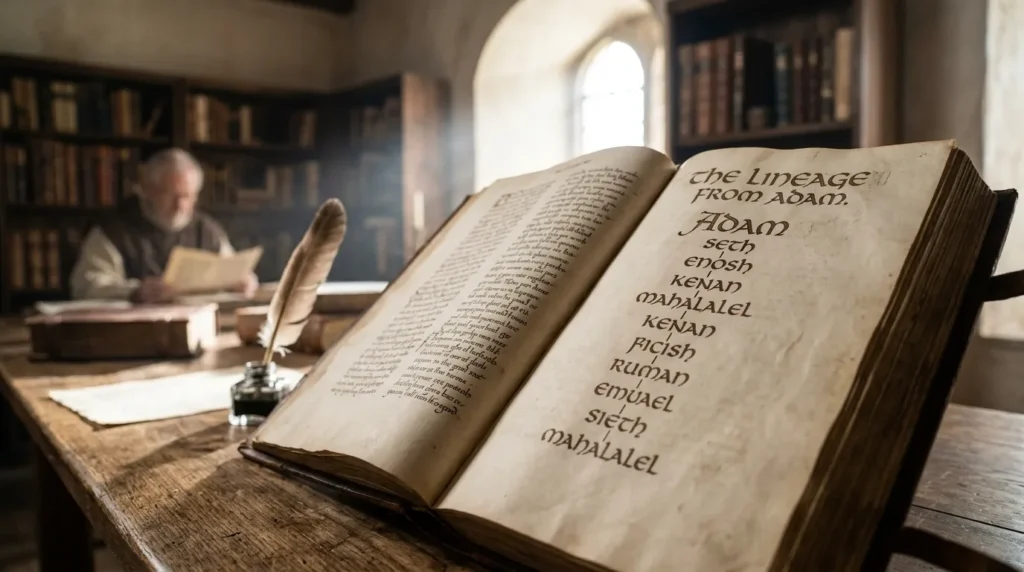
The lineage from Adam in the Bible is the family history that traces humanity from Adam through later generations. One of the clearest records is found in Genesis 5.
Genesis 5 begins with Adam and follows his descendants through Seth, Enosh, Kenan, Mahalalel, Jared, Enoch, Methuselah, Lamech, and Noah.
This genealogy has a deep purpose.
It shows that human life continues from generation to generation, even after sin entered the world.
Genesis 5:1 says that this is the book of the generations of Adam. It also reminds readers that humanity was created in the likeness of God.
This is important. Adam’s story begins with creation and dignity, but it also continues after the Fall.
Adam and the Beginning of Humanity
According to Genesis, Adam was the first man. God created him from the dust of the ground and gave him life.
Genesis 2:7 describes God breathing the breath of life into Adam.
Adam was created in the image of God. This gives every human life great value.
But Adam and Eve disobeyed God. Their sin brought death and brokenness into human experience.
Romans 5:12 explains that sin entered the world through one man, and death came through sin.
This is one reason Adam’s lineage matters spiritually. It reminds us of humanity’s need for God.
Seth and the Continuing Family Line
After Cain killed Abel, Adam and Eve had another son named Seth.
Genesis 4:25 says Eve gave birth to Seth and saw him as another child in place of Abel.
Genesis 5 then follows the line through Seth.
This is significant because the biblical genealogy continues through Seth rather than Cain.
The story shows that God’s purposes continued even after tragedy.
When one family chapter ended in sorrow, God was still working.
This can bring hope to Christians today. A painful season does not mean God has stopped working.
The Lineage Leads to Noah
Adam’s family line eventually reaches Noah.
Genesis 5 records Noah as a descendant of Seth through several generations.
Noah lived during a time when human wickedness had become very great. Yet Noah found favor with God.
Genesis 6:8 says, “Noah found grace in the eyes of the LORD.”
This gives another important lesson from Adam’s lineage.
Human history contains sin, but it also contains faithful people who trust God.
The genealogy therefore connects human weakness with divine grace.
The Lineage and God’s Promise
The biblical family records also prepare the reader for the larger story of salvation.
The Bible moves from Adam to later families and eventually to Abraham, Israel, David, and ultimately Jesus Christ.
Luke 3:23–38 gives a genealogy of Jesus that traces His human ancestry all the way back to Adam.
Luke 3:38 ends with Adam, described as the son of God.
This connection is deeply meaningful for Christian belief.
Adam represents the beginning of fallen humanity. Jesus comes as the One who brings redemption.
Paul makes this comparison clear in Romans 5:18–19. Through Adam came condemnation, while through Christ comes the gift of righteousness and life.
This means the lineage from Adam points not only backward to creation but also forward to redemption through Christ.
Lineage From Adam Hebrew Meaning
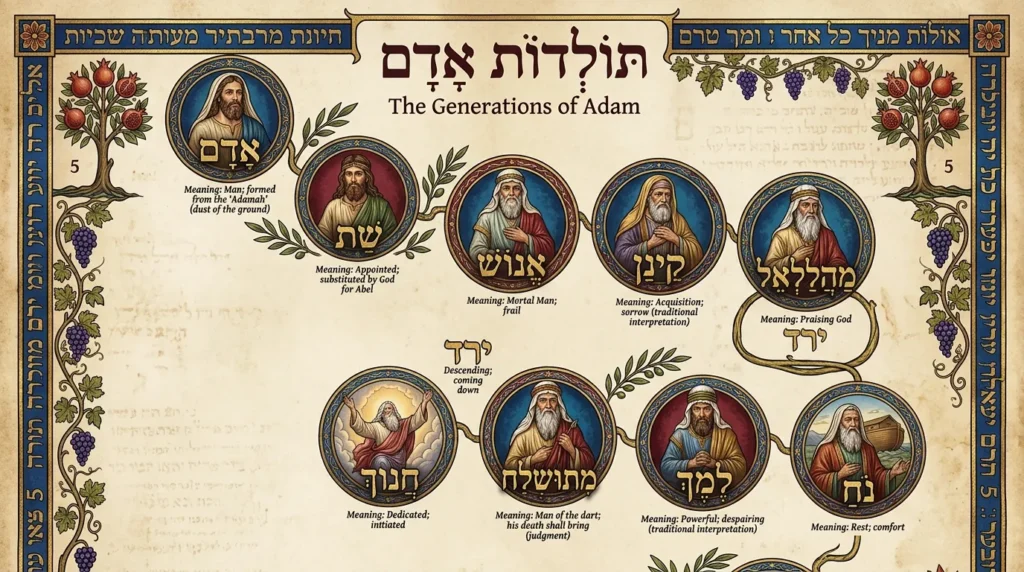
The phrase lineage from Adam is not one special Hebrew expression found as a single phrase in the Old Testament. Instead, it combines ideas found in biblical Hebrew, especially the words connected with Adam, generations, and family descent.
The Hebrew name Adam is written אָדָם (ʾadam).
The word is connected with אָדָמָה (ʾadamah), meaning ground or earth.
This connection is important because Genesis 2:7 says God formed Adam from the dust of the ground.
There is also a Hebrew word often used for family history or generations:
תּוֹלְדוֹת (toledot)
It can mean generations, descendants, family history, or account of what came from someone.
This word is important in Genesis. Genesis 5:1 introduces the record of Adam with the idea of the generations of Adam.
So, when we talk about the lineage from Adam Hebrew meaning, we are dealing with the biblical idea of generations flowing from the first man.
The Hebrew language helps us see something beautiful. A genealogy is not simply a collection of names. It is a record of lives, generations, and God’s work in history.
It also reminds us that human beings came from the ground but received life from God.
Our physical beginning is humble, but our value comes from being created in the image of God.
Spiritual Significance and Symbolism
The spiritual meaning of lineage from Adam can teach several important lessons about faith and Christian life.
It Reminds Us of Our Human Beginning
Adam reminds Christians that humanity was created by God.
We are not accidents. Scripture presents human life as part of God’s creation.
Genesis 1:27 says that God created humanity in His image.
This gives every person dignity and worth.
It Shows the Reality of Sin
Adam’s story also reminds us that sin affects humanity.
The Bible does not hide human failure. It tells the truth about it.
The genealogy in Genesis repeatedly uses the words “and he died.”
This repeated phrase is powerful.
It shows that the warning given after sin became a reality.
Human strength, wealth, knowledge, and success cannot remove death.
We need God.
It Shows God’s Faithfulness
Generations came and went, but God continued His work.
This is one of the strongest lessons in the biblical lineage.
People lived. People died. Families changed. Yet God’s purpose continued.
This can bring hope when your own life feels uncertain.
You may not understand what God is doing today. But Scripture shows that God can work across generations.
It Points Toward Redemption
The family line from Adam eventually connects with the story of Jesus.
Christian faith teaches that Jesus came to deal with the problem that began with human sin.
First Corinthians 15:22 says that “in Adam all die”, while those who belong to Christ will be made alive.
This creates a powerful biblical contrast.
Adam points us to humanity’s fall.
Christ points us to new life.
That is why the lineage from Adam can be seen as part of the larger story of creation, fall, promise, redemption, and restoration.
Biblical Interpretations in Dreams or Real Life
If you see Adam, a family tree, old names, ancestors, or a long lineage in a dream, it can naturally make you wonder about its spiritual meaning.
The Bible does contain dreams and visions, but Scripture does not teach that every modern dream is a divine message.
So dream interpretation should be approached with prayer and wisdom.
A dream about Adam or ancestry may simply reflect thoughts about family, identity, history, or personal relationships.
From a Christian perspective, however, it may encourage reflection on questions such as:
Where did I come from?
What values have I inherited?
What patterns should I leave behind?
How is God leading me today?
If a dream causes you to think about sin, forgiveness, family, or spiritual growth, take those thoughts to God in prayer.
Do not build major beliefs on a dream alone. Test spiritual impressions against Scripture.
God’s written Word should remain the foundation of Christian guidance.
Practical Lessons and Faith Insights
The lineage from Adam gives us simple lessons for daily life.
Remember your identity: You are created in God’s image.
Learn from the past: Family history can teach valuable lessons, but past mistakes do not have to control your future.
Trust God’s timing: Generations passed before many biblical promises were fulfilled.
Seek Christ: The Bible points from humanity’s fall toward God’s plan of salvation through Jesus.
Pray for your family: Ask God to bring faith, wisdom, forgiveness, and peace into your family relationships.
Key Bible Verses About Adam and His Lineage
Several Scriptures help explain the biblical meaning of lineage from Adam.
Genesis 2:7
This verse describes God forming Adam from the dust and giving him the breath of life. It connects Adam with both earth and divine life.
Genesis 5:1–5
This passage begins the genealogy of Adam and records his descendants through Seth.
Genesis 5:24
Enoch is described as walking with God. His story shows that faithfulness can stand out even in a world marked by sin.
Genesis 6:8
“Noah found grace in the eyes of the LORD.”
This verse reminds us that God’s grace can shine during dark times.
Luke 3:38
Luke traces the genealogy of Jesus back to Adam. This connects Christ’s human family line with the beginning of humanity.
Romans 5:12
Paul explains that sin entered the world through one man and that death came through sin.
Romans 5:19
Paul contrasts Adam’s disobedience with Christ’s obedience and shows the hope of righteousness through Christ.
1 Corinthians 15:22
Paul says that those who are “in Christ” will be made alive.
Together, these passages tell one great story: humanity fell, but God did not abandon humanity.
What Does the Lineage From Adam Teach Christians Today?
The lineage from Adam meaning in the Bible is deeply connected to identity, sin, grace, and redemption.
It tells us where the human story begins.
It reminds us that every generation faces the effects of sin.
But it also shows that God continues His work through generations.
Your family history may contain joy and pain. You may come from a family with strong faith, or you may be the first person in your family to seriously seek God.
Whatever your background, the gospel offers hope.
Your past does not have the final word.
For Christians, identity is ultimately found not only in earthly ancestry but in Christ.
Second Corinthians 5:17 teaches that anyone who is in Christ is a new creation.
This is the heart of the message.
Adam reminds us where the story of fallen humanity begins.
Jesus shows us where God’s story of redemption leads.
Conclusion
The lineage from Adam in the Bible represents more than a list of ancestors. It tells the story of humanity’s beginning, sin, death, faith, grace, and God’s continuing purpose. The Hebrew ideas of Adam and toledot help us understand creation and generations. Most importantly, the biblical family line points toward the hope found in Jesus Christ.
If questions about your family, identity, or spiritual journey are weighing on your heart, return to Scripture and prayer. God’s story is still a story of grace, hope, and transformation.