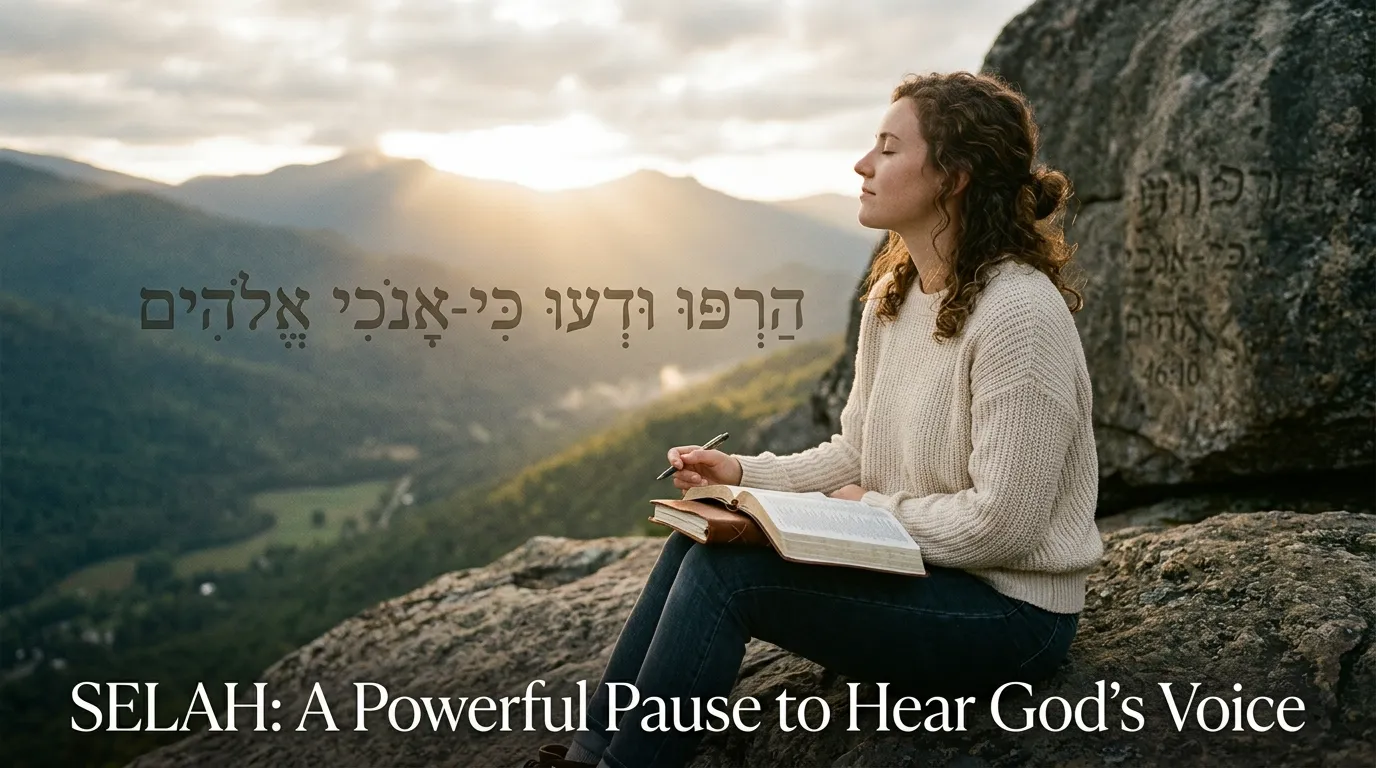
You are reading the Psalms — really reading, the way the ancient church did, out loud — and the poetry is carrying you: “The LORD is my shepherd; I shall not want…” Then, mid-psalm, a single strange word stops you cold: Selah.
It is not translated. It is not explained. It just sits there, seventy-one times in the Psalms and three times in Habakkuk, like a rest in a musical score that nobody taught you to read. Most readers skip it. That is a pity, because Selah — whatever else it is — is an invitation. And the church that learns to accept it discovers one of Scripture’s quietest disciplines.
What We Know (Which Is Less Than You Think)
Intellectual honesty first: nobody knows for certain what Selah means. The ancient translators were already guessing. The Septuagint (the Greek Old Testament) usually renders it diapsalma — roughly “a pause in the psalm,” suggesting a musical interlude. The Jewish Targums treat it as an expression of eternity or emphasis. Later rabbis connected it to the Hebrew root s-l-h, “to lift up” — as in lifting the voice, or lifting the hands.
Modern scholars propose several theories, none conclusive:
- A musical direction. “Pause here; interlude.” The singers stop, the instruments play, the congregation breathes. The placement of Selah — often at the end of a stanza or after a weighty line — supports this.
- “Lift up.” From salal (to lift up): lift up your voice, lift up the music, lift up your heart. A call to heightened response.
- “Pause and reflect.” The most popular devotional reading: stop and think about what you just sang. This may owe more to pious imagination than philology, but it captures something true about how the word functions, whatever it meant.
- A benediction or affirmation. Related to the root’s use in “lifting up” praise — Selah as a kind of musical “amen.”
The responsible conclusion: Selah was a liturgical or musical notation whose precise meaning is lost, but whose placement is inspired. God preserved the pauses. That alone is worth pondering — Scripture cares not only about what we sing but about the silences between.
Where the Pauses Fall
Look at where Selah appears and a pattern emerges: it follows statements too large to rush past.
“Thou, LORD, art a shield for me; my glory, and the lifter up of mine head… Selah.” (Psalm 3:3, 8). David, fleeing Absalom, declares God his shield — then the music stops. Sit with that. The man running for his life has just said God is his glory. Pause.
“Be still, and know that I am God… Selah.” (Psalm 46:10-11). The most quoted verse in the Psalter is followed by a pause — as though the text itself obeys its own command. Be still. Selah. Know that He is God. Selah.
“I cried unto the LORD with my voice, and he heard me out of his holy hill. Selah.” (Psalm 3:4). Testimony, then silence — the pause of someone who has just remembered being heard.
Habakkuk’s three uses are the most dramatic: after “God came from Teman… Selah” (3:3), after the cosmic upheaval of verse 9, and after “thou didst march through the land in indignation… Selah” (3:13). The prophet sees visions of divine judgment and can only punctuate them with pauses. Some truths have no commentary. Only silence will do.
The Lost Art of the Pause
Here is where Selah moves from scholarship to spirituality. Whatever the word meant technically, its effect on the reader is unmistakable: it interrupts. And interruption is precisely what the modern soul resists.
We read the way we scroll — continuously, rapidly, on to the next. We pray the way we talk — filling every silence. We worship the way we consume — song after song, point after point, no gaps. Into this hurry, the Psalter inserts seventy-one speed bumps. Stop. Breathe. Let that land.
The Bible elsewhere commands the same discipline in different words. “Be still, and know that I am God” (Psalm 46:10). “In quietness and in confidence shall be your strength” (Isaiah 30:15). Mary “kept all these things, and pondered them in her heart” (Luke 2:19) — the New Testament’s Selah, a young mother pausing inside the miracle. Even God models it: He rested on the seventh day (Genesis 2:2), and the heavenly worship includes “silence… about the space of half an hour” (Revelation 8:1). Heaven itself keeps Selah.
Practicing Selah: Five Pauses
Pause after a promise. When you read “I will never leave thee, nor forsake thee” (Hebrews 13:5), do not rush to the next verse. Selah. Let the promise do its work. Promises believed in haste are promises half-received.
Pause after a confession. David’s “I have sinned against the LORD” (2 Samuel 12:13) deserved a Selah — a moment to feel the weight and the relief. Confession rushed is repentance unrooted.
Pause in prayer. Most prayers are monologues. Try the psalmist’s rhythm: speak, then Selah — silence, listening, waiting. “My soul, wait thou only upon God” (Psalm 62:5). God speaks in the pauses we actually keep.
Pause in crisis. Jehoshaphat’s choir sang, then stood still to see God’s deliverance (2 Chronicles 20:17-22). When panic urges speed, Selah is an act of faith: I will stop striving long enough for God to act.
Pause in worship. Between songs, after the sermon, before the benediction — resist the urge to fill every gap. The congregation that learns holy silence has learned something the noise never teaches.
A Selah Reading Plan: Five Psalms to Practice On
Theory becomes discipline through practice. Here are five Selah psalms, each with a suggested pause:
Psalm 3 — David fleeing Absalom. Read verses 1-4 slowly; at the Selah after “thou, LORD, art a shield for me,” stop. Picture the shield. Are you letting God be yours today, or are you shielding yourself? Sit in the question before reading on.
Psalm 24 — “Lift up your heads, O ye gates… Selah” (24:6, 10). The King of glory approaches. Pause at each Selah and ask: what gates in my life are still closed to Him? The psalm’s Selahs frame the entrance of the King — let them frame His entrance into your week.
Psalm 46 — “Be still, and know that I am God… Selah” (46:10-11). This is the graduate course. Read the verse, then actually be still — two minutes, no phone, no agenda. The Selah is the assignment: stillness as worship, silence as confession that He is God and you are not.
Psalm 68 — the most Selah-dense psalm (verses 7, 19, 32). Read it as a procession: each Selah marks a stage in God’s triumphal march. Pause at each and join the procession mentally — the God who rides through the wilderness is riding through your circumstances.
Habakkuk 3 — the prophet’s prayer with three Selahs (verses 3, 9, 13). Read the whole chapter aloud, pausing long at each Selah. Notice how the pauses intensify: creation trembles, then judgment marches, then — after the final Selah — the prophet’s resolve: “yet I will rejoice in the LORD” (3:18). The pauses produce the joy. That is Selah’s deepest lesson: silence, kept in God’s presence, becomes song.
Teaching Children Selah
Selah may be the easiest spiritual discipline to teach a child — because children understand pauses instinctively. Try this at bedtime: read a short psalm aloud, and every time you reach “Selah,” stop. Close your eyes together. Count to ten in silence. Then ask: what did you hear in the quiet?
Children raised on constant noise — screens, music, chatter — need the Selah habit most. It teaches them what the church has always known: God is not only in the words but in the spaces between them. “Be still, and know that I am God” (Psalm 46:10) is a verse a six-year-old can practice, one ten-second Selah at a time.
And the habit transfers. The child who learns to pause in the psalm learns to pause before answering in anger, to pause before deciding, to pause in the rush of the day and remember who is God. Selah is not just a liturgical notation; it is a life skill — the discipline of the holy pause, learned young and kept for life.
The Word That Teaches Without Meaning
There is a lovely irony here: the Bible’s most uncertain word may be one of its most instructive. We cannot define Selah, but we can do it — and in the doing, we learn what the definition could never give. The scholars debate the etymology; the saints practice the pause.
So the next time you meet it in the Psalms, do not skip it. Stop. Lift your eyes. Let the last line settle. That is Selah — not a word to understand but a silence to keep. And in a world without pauses, the kept silence may be the most countercultural worship of all. For the scholarly discussion of the term’s possible origins and its liturgical theories, the Wikipedia article on Selah gathers the main views; for the practice, close this article, open a psalm, and at the first Selah — stop.










