In 2001, a new English Bible appeared from an unlikely publisher — not a giant Bible house but Crossway, a nonprofit ministry publisher in Wheaton, Illinois, best known for Christian books. Within two decades it would become one of the most widely used translations in the English-speaking church, the pew Bible of choice across Reformed and evangelical congregations, and the base text of the best-selling study Bible of its generation. Its name: the English Standard Version.
But what is the ESV — where did it come from, how was it made, and what kind of translation is it? Those are factual questions with factual answers, and they are worth getting right, because the ESV’s story illustrates how Bible translation actually works.
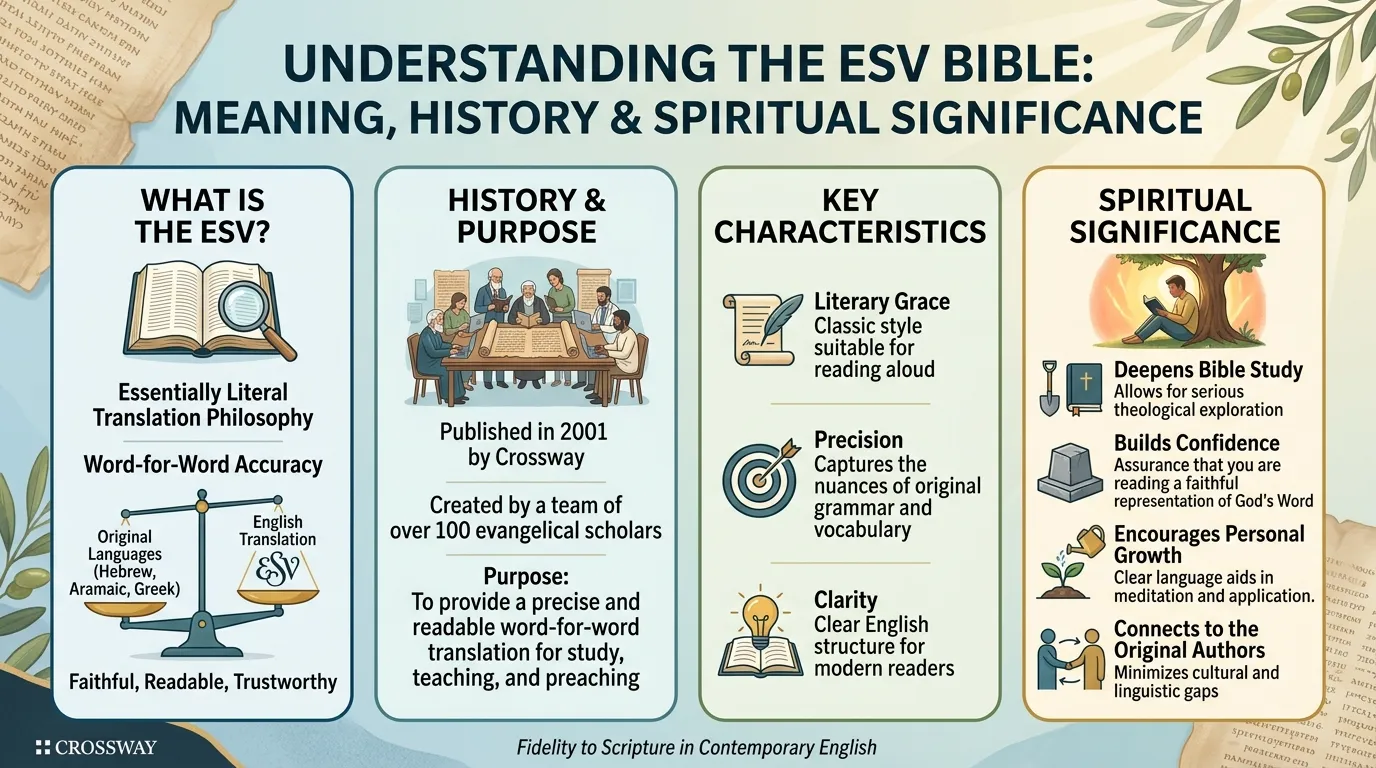
At a glance: first published 2001 by Crossway (Wheaton, Illinois); a revision of the 1971 Revised Standard Version; translation philosophy “essentially literal” (formal equivalence); source texts the Masoretic Hebrew and the standard critical Greek; text editions in 2007, 2011, and 2016; famous companions include the ESV Study Bible (2008). With those facts in hand, the story unfolds as follows.
The Origin: A Revision, Not a Start From Scratch
The ESV did not begin with a blank page. It began with the Revised Standard Version of 1971 — itself a revision of the American Standard Version of 1901, which revised the King James Version of 1611. Bible translation in the “literal” tradition has always worked this way: each generation revises the last, updating language and incorporating better manuscript knowledge, rather than reinventing the wheel.
In the late 1990s, Crossway assembled a team of evangelical scholars — ultimately more than a hundred, from seminaries and churches across denominations — with a specific brief: produce a revision of the RSV that would be essentially literal, theologically conservative, and suitable for public reading, preaching, memorizing, and serious study. The work took several years; the ESV New Testament and complete Bible were published in 2001.
The choice of the RSV as the base was deliberate and, to some, surprising — the RSV had been controversial among evangelicals in the 1950s (notably for translating ‘almah in Isaiah 7:14 as “young woman” rather than “virgin”). The ESV team kept the RSV’s literary excellence and literal structure while revising theologically sensitive renderings back toward traditional evangelical readings. The result was, in effect, the RSV’s grandchild with the family’s conservative values restored.
The Philosophy: “Essentially Literal”
Every translation sits somewhere on a spectrum. On one end is formal equivalence (“word-for-word”): keep the original’s words, word order, and structure as far as English allows. On the other is dynamic equivalence (“thought-for-thought”): render the meaning in natural English, even if the wording differs. Most translations blend the two; the question is the balance.
The ESV plants its flag firmly on the formal side, calling its approach “essentially literal.” In practice this means: translate each word with its most precise English equivalent; preserve the original’s sentence structure where possible; keep metaphors as metaphors rather than explaining them; and let ambiguities in the original remain ambiguous in English rather than resolving them for the reader.
The trade-offs are real and acknowledged. Essentially literal translations can sound wooden where the original is idiomatic, and they sometimes require more effort from the reader. The ESV’s defenders consider this a feature: the reader does more of the interpretive work, and the translator does less of it for them. The translation aims to be transparent to the original — “as literal as possible, as free as necessary” is the working principle.
The Text Behind It
A translation is only as good as its source text, and here the facts are straightforward. For the Old Testament, the ESV uses the Masoretic Text (the traditional Hebrew text, primarily the Leningrad Codex) — the same basis as nearly all modern translations. For the New Testament, it uses the standard critical Greek text (the Nestle-Aland/UBS tradition) — again, the same basis as the NIV, NASB, CSB, and others.
This is worth stating plainly because confusion persists: the ESV, NIV, NASB, CSB, and NLT all translate essentially the same Hebrew and Greek texts. Their differences come from translation philosophy and word choices, not from different Bibles underneath. The textual debates (Textus Receptus vs. critical text) that distinguish the KJV/NKJV family from modern translations do not divide the modern translations from each other.
Editions and the “Permanent Text” Episode
The ESV has gone through several text editions — 2001 (first), 2007 (minor revisions), 2011 (more substantial updates, several hundred changes), and 2016. The 2016 edition is notable for an unusual publishing decision: Crossway initially announced that the 2016 text would be the “permanent text” of the ESV, unchanged for the future.
The announcement drew significant criticism from scholars and pastors, who argued that translation should remain open to correction as scholarship advances. Within weeks, Crossway reversed the decision, clarifying that the text would continue to be refined as needed. The episode is instructive: it showed both the publisher’s desire for stability (churches memorize and print from a fixed text) and the scholarly community’s insistence that no translation is final. Both concerns are legitimate; the ESV now continues under normal periodic review.
The ESV Study Bible and Its Influence
No account of the ESV is complete without the ESV Study Bible (2008) — a publishing landmark. With 20,000 notes, 240 maps and illustrations, 50 articles, and contributions from 95 scholars, it won Christian Book of the Year and became one of the best-selling study Bibles in history. For many readers, “the ESV” means the ESV Study Bible; the notes shaped a generation’s reading of Scripture.
The translation’s influence extends through preaching (it is the pulpit Bible in many evangelical churches), publishing (a vast ecosystem of ESV-based resources), and memorization (its cadence, close to the RSV/KJV tradition, memorizes well). Critics note its occasional archaisms and its complementarian translation choices in debated passages; supporters praise its literary dignity and transparency to the original. Both assessments can be true at once — which is precisely why the translation debate continues, healthily, across the church.
Criticisms and Responses: An Honest Ledger
No translation is above critique, and the ESV has received its share. A fair account notes both sides:
“It retains archaic language.” Critics point to words like propitiation, behold, and thee/thou-free but still formal constructions. The ESV’s response, implicit in its philosophy: some “archaic” words carry theological precision that modern substitutes lose. Propitiation (Romans 3:25) says something expiation does not — and the essentially-literal approach prefers precision to smoothness.
“Its translation choices reflect complementarian theology.” In debated passages (e.g., Romans 16:7 on Junia, 1 Timothy 2:12), the ESV’s renderings align with the conservative evangelical scholars who produced it. Supporters reply that all translations reflect their translators’ convictions — there is no view-from-nowhere Bible — and that the ESV is transparent about its approach. Readers who disagree can compare with the NRSV or CEB, which reflect different convictions.
“It is too literal to read smoothly.” The NLT and NIV read more naturally in places; the ESV can feel stiff. The ESV’s defenders consider this the price of transparency: the translation shows you what the original says, including its rough edges, and trusts the reader (and the preacher) to do the smoothing.
The honest verdict: the ESV is an excellent translation of its kind — formal, conservative, literary — and no translation is the right tool for every job. The church is well served by readers who know the ESV’s strengths, acknowledge its limits, and keep a second translation within reach.
A last practical note: if you preach or teach from the ESV, read it aloud first. Its cadence rewards the speaking voice — many of its renderings were tested in the pulpit before they reached the page — and hearing it will show you both its music and its occasional stiffness better than silent reading ever could.
Choosing a Translation: Practical Counsel
The ESV is one good translation among several. Here is non-polemical guidance for choosing:
- Match the translation to the task. Essentially literal translations (ESV, NASB) excel for close study; dynamic ones (NIV, NLT) excel for initial comprehension. Many serious readers use both.
- Read the preface. Every translation explains its philosophy honestly. The ESV’s preface is a model of transparency about what “essentially literal” means in practice.
- Do not make a translation a test of fellowship. The church has flourished on many translations. “KJV-only” and “ESV-only” polemics mistake a good tool for the gospel itself.
- The best translation is the one you read. The most literal Bible on the shelf helps no one. Choose one you will actually open daily.
The English Standard Version is what it claims to be: a careful, conservative, essentially literal revision in the King James lineage, made by evangelical scholars for the church’s reading, preaching, and study. Its history — from RSV revision to 2001 publication, through the study-Bible phenomenon and the permanent-text debate — is the ordinary, fascinating story of how God’s Word keeps finding fresh English dress. For the full publication timeline and textual details, the Wikipedia article on the English Standard Version documents it thoroughly; for the experience itself, any copy of the text, opened daily, will do the rest.










