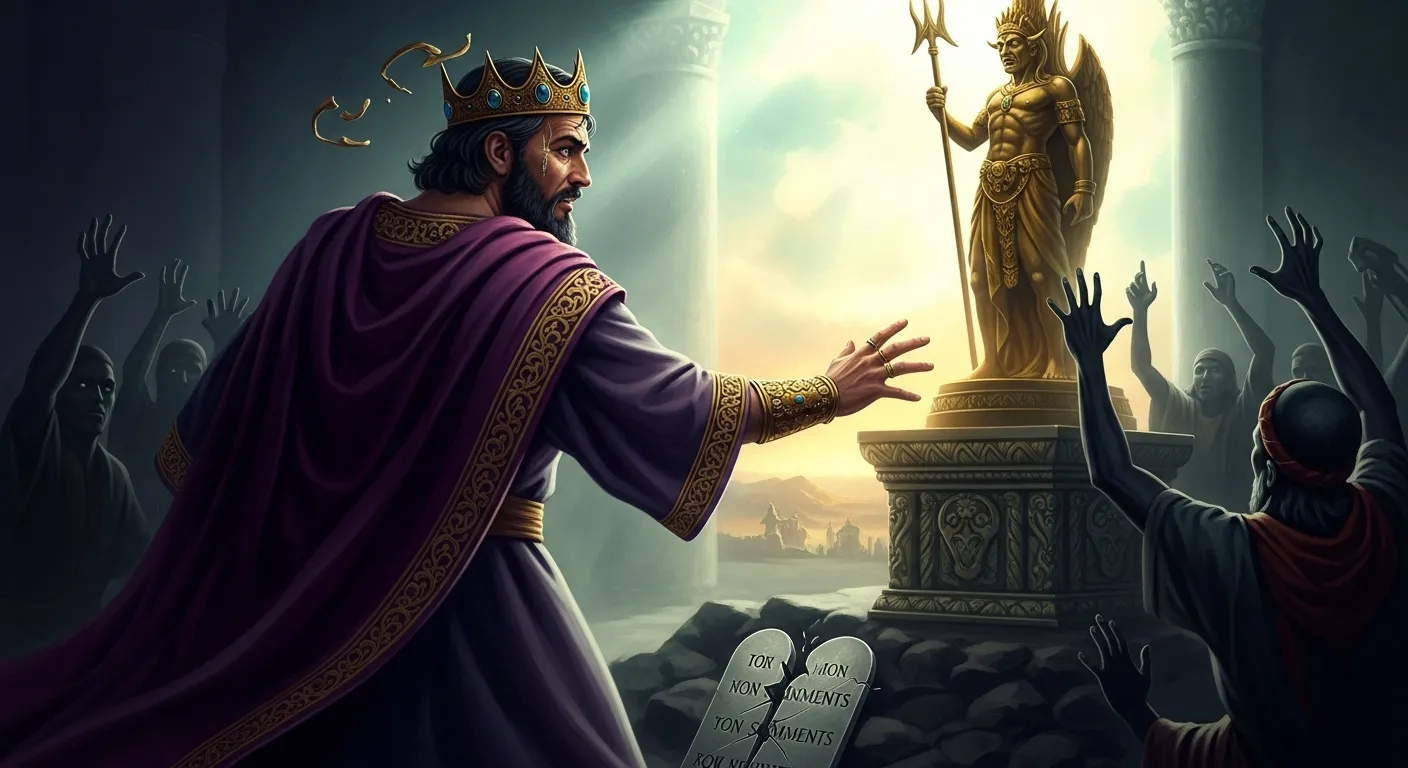
Scripture’s verdict on Ahab is the harshest delivered on any king of Israel: “Ahab son of Omri did more evil in the eyes of the LORD than any of those before him” (1 Kings 16:30). In a dynasty not known for righteousness — Jeroboam, Baasha, Omri himself — that sentence lands like a gavel. Yet Ahab’s story, told across 1 Kings 16–22, is stranger and sadder than a simple villain’s tale. He is not a monster of unusual cruelty. He is something more recognizable and more frightening: a weak man with absolute power, a king who outsourced his conscience and discovered, too late, that borrowed wickedness still bills the borrower.
To understand Ahab is to understand how ordinary compromise becomes historic evil — and how even historic evil meets a God who still sends warnings, still offers mercy, and still tells the truth about consequences.
The Indictment: More Evil Than All Before Him
Ahab’s reign begins with a marriage and a building program. He marries Jezebel, daughter of Ethbaal king of the Sidonians (1 Kings 16:31) — a political alliance that imports a religion. Jezebel brings the worship of Baal and Asherah with her, and Ahab builds them infrastructure: “He set up an altar for Baal in the temple of Baal that he built in Samaria. Ahab also made an Asherah pole” (1 Kings 16:32–33). This is not private unbelief; it is state-sponsored idolatry, the official replacement of Israel’s God with a fertility cult.
The narrator adds a chilling summary: Ahab “did more to arouse the anger of the LORD, the God of Israel, than did all the kings of Israel before him” (1 Kings 16:33). And later, the epitaph: “There was never anyone like Ahab, who sold himself to do evil in the eyes of the LORD, urged on by Jezebel his wife” (1 Kings 21:25). “Sold himself” — the language of slavery. Ahab’s tragedy is not strength misused but agency surrendered. Again and again in his story, someone else proposes the evil and Ahab merely fails to refuse it. That failure, Scripture insists, is damnable in its own right. Weakness is not innocence.
The Showdown: Fire on Carmel
Into this darkness walks Elijah, and the confrontation at Mount Carmel (1 Kings 18) is the most dramatic scene of Ahab’s reign. After three years of drought — Elijah’s announced judgment on Baal-worship — Ahab meets the prophet and snarls, “Is that you, you troubler of Israel?” Elijah’s reply reverses the charge: “I have not made trouble for Israel, but you and your father’s family have. You have abandoned the LORD’s commands and have followed the Baals” (1 Kings 18:17–18).
The contest that follows needs no retelling in detail — the prophets of Baal raving from morning to noon, Elijah’s quiet prayer, and then “the fire of the LORD fell” (1 Kings 18:38), consuming sacrifice, wood, stones, dust, and the water in the trench. The people fall facedown: “The LORD — he is God!” For one blazing afternoon, the nation sees clearly.
And Ahab? He watches the whole thing. He sees fire fall from heaven. He hears the people confess. And he goes home and tells Jezebel — who responds not with awe but with a death threat against Elijah (1 Kings 19:1–2). Ahab witnessed the most unambiguous miracle of his generation and changed nothing. It is the story’s most damning detail: evidence does not convert the unwilling. Ahab had all the proof heaven could offer, and he went home for dinner.
The Vineyard: When the King Wanted a Garden
If Carmel shows Ahab’s spiritual blindness, Naboth’s vineyard (1 Kings 21) shows his moral rot. Ahab wants the vineyard next to his palace for a vegetable garden. Naboth refuses — not from stubbornness but from covenant law: ancestral land cannot be sold (Leviticus 25:23). Ahab’s response is to go home “sullen and angry,” lie on his bed, and refuse to eat — the tantrum of a king who has never been told no.
Enter Jezebel, with the most sinister line in the chapter: “Is this how you act as king over Israel?” (1 Kings 21:7). She arranges Naboth’s judicial murder — false witnesses, a rigged trial, a stoning — and presents the vineyard to her husband as a gift. And Ahab? He “got up and went down to take possession of Naboth’s vineyard” (1 Kings 21:16). He did not order the murder. He did not even ask how it was done. He simply accepted stolen goods from his wife’s crime and walked the rows of his new garden. This is Ahab’s evil in miniature: not the hand that stones, but the hand that pockets the vineyard afterward — and in God’s accounting, there is no meaningful difference.
The Crack in the Armor: Ahab Humbles Himself
Then comes the scene that keeps Ahab’s story from being a simple horror tale. Elijah confronts him in the stolen vineyard — “Have you not murdered a man and seized his property?” (1 Kings 21:19) — and pronounces judgment: disaster on his house, dogs licking his blood where they licked Naboth’s. And Ahab, the man who watched fire fall and felt nothing, tears his clothes, puts on sackcloth, fasts, and goes about meekly (1 Kings 21:27).
God’s response is startling: “Have you noticed how Ahab has humbled himself before me? Because he has humbled himself, I will not bring this disaster in his day” (1 Kings 21:29). The worst king in Israel’s history repents — partially, temporarily, imperfectly — and God notices. Mercy bends toward the humbled, even here. It does not cancel the judgment; it postpones it to his son’s days. But the principle blazes through the darkness of this story: no one is beyond the reach of humbled prayer. If God heard Ahab in sackcloth, he will hear anyone.
The Arrow: Death at Ramoth Gilead
Ahab’s end (1 Kings 22) is thick with irony. He goes to battle against Aram at Ramoth Gilead, despite the prophet Micaiah’s explicit warning of disaster — a warning Ahab hears, understands, and tries to cheat by disguising himself while putting King Jehoshaphat in royal robes. “But someone drew his bow at random and hit the king of Israel between the sections of his armor” (1 Kings 22:34). A random arrow. No archer aimed at the disguised king; heaven did. He bleeds out propped up in his chariot, and dogs lick his blood at the pool of Samaria — “as the word of the LORD had declared” (1 Kings 22:38).
Ahab’s meaning in Scripture is therefore a warning with a strange mercy inside it. The warning: power without character becomes evil without even trying; the man who never says no to wickedness becomes wicked; indifference to God is itself a decision with eternal weight. The mercy: even Ahab’s sackcloth moved the heart of God. The story’s last word is not “too late” but “humble yourself” — and the God who delayed judgment for the worst king of Israel still delays, still warns, still waits for the proud to tear their clothes and come home.
The Prophet He Would Not Hear: Micaiah
Ahab’s end deserves a closer look, because it shows his pattern to the last. Preparing for battle at Ramoth Gilead alongside King Jehoshaphat of Judah, Ahab gathers four hundred court prophets, who unanimously promise victory (1 Kings 22:6). Jehoshaphat, uneasy, asks for a prophet of the LORD — and Ahab’s reply is revealing: “There is still one prophet through whom we can inquire of the LORD, but I hate him because he never prophesies anything good about me, but always bad. He is Micaiah son of Imlah” (1 Kings 22:8).
There it is: Ahab does not dispute Micaiah’s accuracy. He hates the message. This is the terminal stage of his disease — shooting the messenger because the diagnosis is unwelcome. Micaiah, pressed, first mocks the court prophets with sarcastic agreement, then delivers the true vision: Israel scattered “like sheep without a shepherd,” and a heavenly scene in which God permits a lying spirit to entice Ahab to his death (1 Kings 22:17–23). Ahab hears the prophecy of his own doom, understands it perfectly — and goes to battle anyway, disguising himself to cheat it.
The disguise is the final portrait of the man: a king who believes he can outmaneuver God with a costume change. “But someone drew his bow at random and hit the king of Israel between the sections of his armor” (1 Kings 22:34). The Hebrew suggests the archer was not even aiming at him. Heaven needed no marksman. Ahab’s whole reign had been an attempt to dodge the word of the LORD — through Jezebel’s gods, through ignored miracles, through a borrowed vineyard, through a change of clothes — and the word found him anyway. “The word of our God endures forever” (Isaiah 40:8); Ahab is its Exhibit A.
For the historical background of Ahab’s reign — including the famous Kurkh Monolith inscription that mentions him and the archaeology of ninth-century Samaria — the Wikipedia article on Ahab gathers the extrabiblical evidence alongside the biblical narrative.










