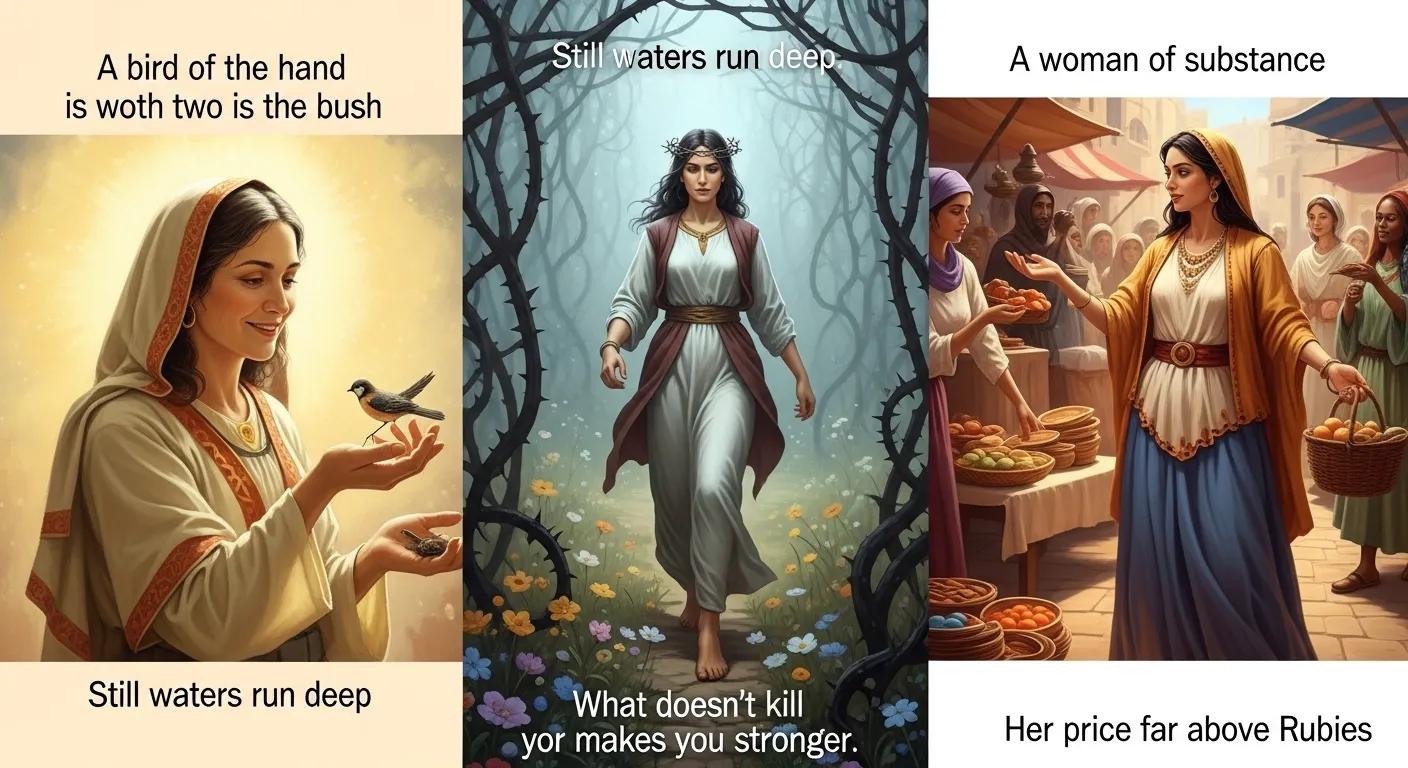
The book of Proverbs is crowded with women — but almost none of them are real people. That is the first thing to understand, and it changes everything. Proverbs does not give us biographies of historical women the way the narratives of Ruth or Esther do. It gives us portraits: four great female figures who are really four ways of life, four invitations, four destinies. Lady Wisdom. The Strange Woman. Lady Folly. The Woman of Valor. To read them as literal women is to miss the book’s artistry; to read them as what they are — personifications of the moral choices every reader faces — is to hear Proverbs’ deepest teaching about the soul.
This matters especially because the book’s language about women has sometimes been misread — either weaponized against real women or dismissed as patriarchal relic. Proverbs itself points the other way: its women are mirrors held up to every reader, male and female alike. The question the book asks is never “what are women like?” It is always “which woman will you follow?”
Lady Wisdom: The Woman Calling in the Streets
She appears first in chapter 1, and her entrance is startling: “Out in the open Wisdom calls aloud, she raises her voice in the public square; on top of the wall she cries out, at the city gate she makes her speech” (Proverbs 1:20–21). In a world where respectable women stayed within the household, Lady Wisdom is shockingly public — shouting at the noisiest intersections of civic life. The point is unmistakable: wisdom is not hidden, esoteric, or reserved for an elite. She is available, vocal, and impossible to miss. If you lack wisdom, it is not because she was silent.
Chapter 8 gives her the book’s greatest speech. She was there before creation — “appointed from eternity, from the beginning, before the world began” (Proverbs 8:23) — present as God’s craftsman at his side, “filled with delight day after day, rejoicing always in his presence” (Proverbs 8:30). The Hebrew is playful, almost dancing. Then her invitation: “Now then, my children, listen to me; blessed are those who keep my ways… whoever finds me finds life” (Proverbs 8:32, 35). Christians have long heard in this passage an echo of Christ himself — the Word who was with God in the beginning (John 1:1), “the wisdom of God” (1 Corinthians 1:24). Whether or not the proverb intends that, its claim stands: to embrace wisdom is to embrace life at its source.
The Strange Woman: Honey That Turns to Wormwood
Her counterpart dominates chapters 5–7, the longest sustained warning in the book. She is called the “strange” or “foreign” woman — ishah zarah — and the “adulterous woman.” The father warns his son about her at length: “the lips of the adulterous woman drip honey, and her speech is smoother than oil; but in the end she is bitter as gall, sharp as a double-edged sword” (Proverbs 5:3–4).
Read her only as a warning against adultery and you read too narrowly — though the book certainly means that too, with devastating realism about how seduction works: the flattery (7:21), the timing (her husband “is not at home,” 7:19), the urgency (“let’s drink deeply of love till morning,” 7:18), and the aftermath (“her house is a highway to the grave,” 7:27). But the “strange woman” is also a figure for every seduction that leads away from God: the lure of quick wealth, of compromise, of any pleasure that promises honey and delivers gall. She is strange not because she is foreign-born but because she is foreign to the covenant — outside the bounds of God’s ways. Every reader, married or single, meets her in some form.
The crucial insight is that her invitation works — that is why the father spends three chapters on her. “With persuasive words she led him astray” (Proverbs 7:21). Folly’s power is not that it looks evil but that it looks delightful. The book respects the reader enough to admit the temptation is real before insisting the price is fatal.
Lady Folly: The Other Banquet
In chapter 9, the strange woman’s wider identity is revealed: she is Folly herself, hosting a rival banquet across the street from Wisdom’s. “Folly is an unruly woman; she is simple and knows nothing… ‘Let all who are simple come to my house!'” (Proverbs 9:13–16). Her menu: “Stolen water is sweet; food eaten in secret is delicious!” (Proverbs 9:17). And the footnote the guests never read: “her guests are deep in the realm of the dead” (Proverbs 9:18).
The pairing of the two hostesses is Proverbs’ masterstroke. Wisdom and Folly issue nearly identical invitations from the same high places of the city. The book’s claim is that moral life rarely presents itself as a choice between obvious good and obvious evil. It presents itself as a choice between two appealing invitations — and the difference is visible only to the discerning. That is why the father begs his son to learn discernment before he needs it. By the time you are seated at Folly’s table, the menu has already been decided.
The Woman of Valor: Wisdom Fully Grown
The book’s final portrait is its most famous and most misunderstood: the “wife of noble character” (Proverbs 31:10–31), the eshet chayil, the woman of valor. Read as a checklist for wives, it crushes. Read as the book intends — as the culmination of everything Proverbs has taught — it sings.
Look at what she actually does: she trades profitably (31:16, 18), manages servants and household (31:15, 27), works with “eager hands” (31:13), speaks “with wisdom” and “faithful instruction” (31:26), cares for the poor (31:20), and plans for the future (31:21, 25). She is Wisdom herself, grown up and moved into the neighborhood — Lady Wisdom from chapter 8, now running a household, a business, and a charity. The poem is alphabetical in Hebrew, an A-to-Z of virtue, suggesting completeness: this is what wisdom looks like from aleph to tav, in a whole life.
And the poem’s closing line gives the book’s final verdict on everything: “Charm is deceptive, and beauty is fleeting; but a woman who fears the LORD is to be praised” (Proverbs 31:30). The book that began with “the fear of the LORD is the beginning of knowledge” (1:7) ends by praising the one who embodies it. The circle closes. The portraits were never about women as a category; they were about wisdom as a way — and the way, walked to its end, looks like this: strong, generous, wise, God-fearing, and unafraid of the days to come (31:25).
So the women of Proverbs ask every reader the same question the father asked his son: which portrait will your life resemble? The one who calls in the streets, or the one whose honey turns to gall? The banquet of life, or the banquet of death? The book’s artistry serves its urgency — choose, and choose soon, for both hostesses are still calling.
Why Women? The Book’s Boldest Literary Choice
It is worth asking why Proverbs personifies its great moral realities as women at all. Part of the answer is literary: in Hebrew, the word for wisdom (hokmah) is grammatically feminine, so “she” is the natural pronoun — the book is following the language’s lead. But Proverbs goes far beyond grammar, giving its figures bodies, voices, houses, and banquets. This is deliberate artistry, and it was daring.
In the ancient Near East, wisdom literature usually spoke in abstractions or in the voice of a male sage. Proverbs instead sends a woman shouting in the public square — claiming the busiest, most male-dominated spaces of the city for her proclamation. Lady Wisdom’s public voice subtly rebukes any notion that wisdom belongs to an educated male elite. She cries “at the city gate” — the place of legal and civic authority — as if to say: wisdom has standing everywhere, and she will not be confined to private rooms.
There is pastoral shrewdness here too. The book’s primary audience is young men facing the specific temptation of sexual seduction (chapters 5–7 are explicit about this). By personifying wisdom itself as a desirable woman — beautiful, available, calling out — the father gives his son a rival affection. The choice is reframed: it is not duty versus pleasure, but one love versus another. Pursue Lady Wisdom, and the strange woman loses her pull. The book fights desire with desire, offering the young man a better beloved. It is one of the most psychologically astute moves in all of Scripture.
Those interested in the history of interpretation around the book’s most famous portrait — including its traditional use in Jewish liturgy and its influence on later ideals of virtue — may appreciate the Wikipedia article on Proverbs 31 as a starting point for further reading.










