Imagine sitting with four friends who witnessed the same important event. Each person remembers certain details, notices different moments, and tells the story from a different angle. Their stories may not use the same words or include the same details, yet they can still tell the truth about what happened.
This helps us understand the differences in the Gospels meaning in the Bible. Matthew, Mark, Luke, and John tell the story of Jesus in different ways. They emphasize different events, teachings, people, and themes. These differences do not automatically mean that the Bible is unreliable. Instead, they invite us to look closely at what each Gospel writer wanted his readers to understand about Jesus.
The four Gospels give us a rich picture of Christ. Together, they proclaim His life, death, resurrection, identity, teachings, mercy, and saving work.
What Are the Differences in the Gospels?
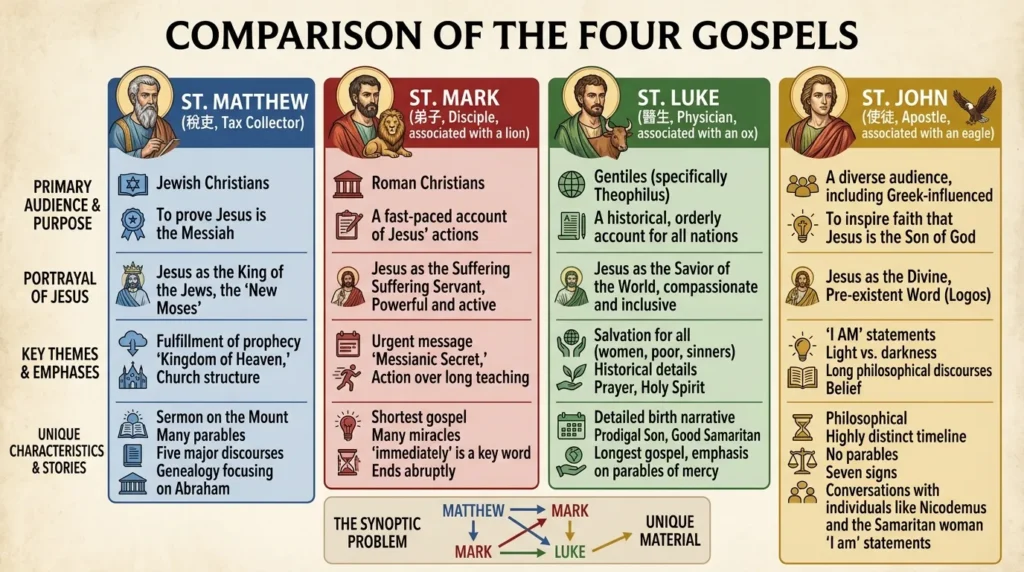
The Gospels are Matthew, Mark, Luke, and John. They all focus on Jesus, but they are not identical copies of one another.
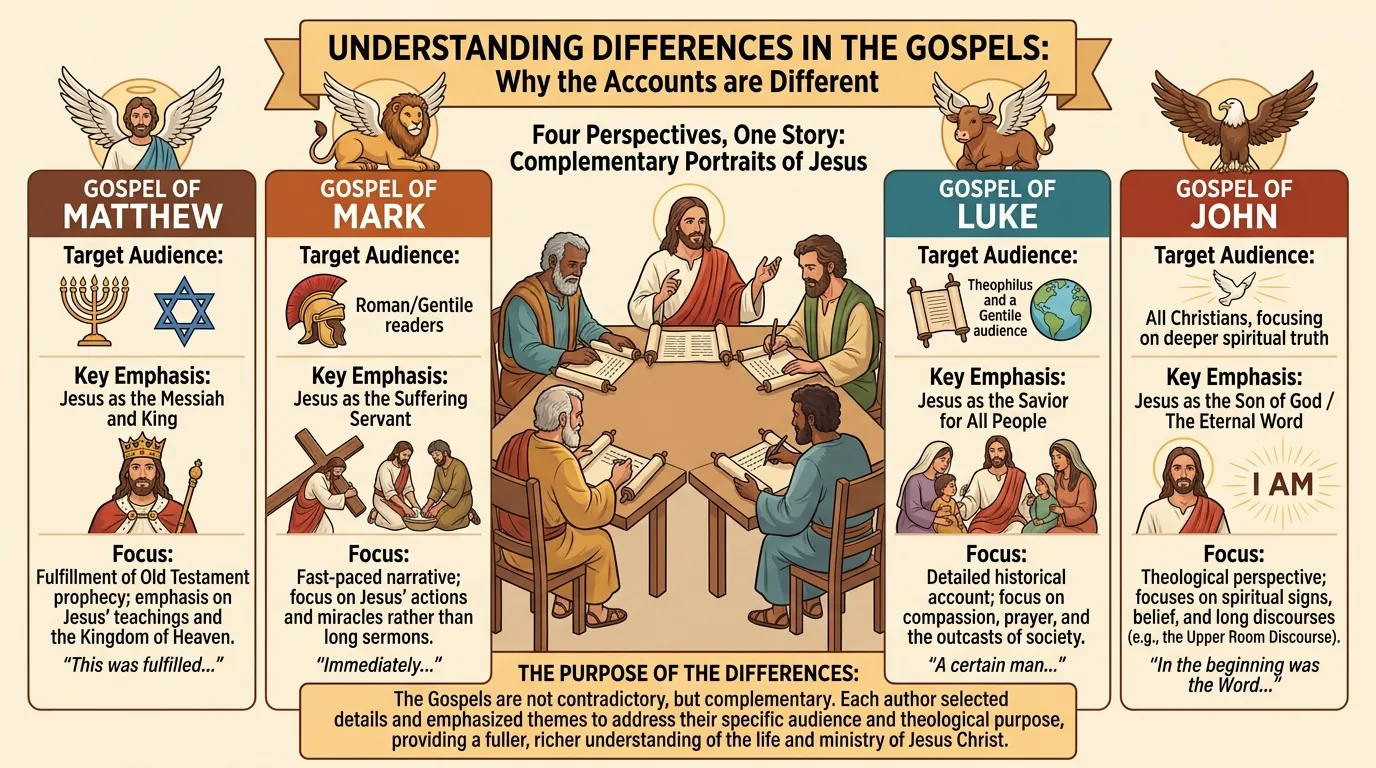
Matthew often highlights Jesus as the promised King and connects His life with Old Testament prophecy. Mark gives a fast moving account that often emphasizes Jesus’ actions and authority. Luke gives special attention to God’s mercy, outsiders, the poverty, prayer, and salvation. John focuses deeply on Jesus’ identity as the Son of God and the source of eternal life.
The Bible itself shows that Gospel writers selected and arranged material for their readers.
Luke begins his Gospel by explaining that he carefully investigated the events surrounding Jesus’ life and wrote an orderly account for Theophilus (Luke 1:1–4). This shows that the Gospel writers had a purpose in how they presented their material.
The Four Gospels Give Four Perspectives
The differences can be seen in several areas:
- Different details: One Gospel may mention something another does not.
- Different order: Events are sometimes arranged differently.
- Different wording: The same teaching may be recorded with different words.
- Different emphasis: Each writer highlights certain themes.
- Different audiences: Each Gospel speaks to readers with particular needs and backgrounds.
- Different portraits of Jesus: Each emphasizes true aspects of Christ’s identity and mission.
These differences can help readers see more of the biblical picture rather than less.
Why Are the Gospels Different?
One major reason is that the Gospel writers had different purposes and audiences.
Matthew repeatedly connects Jesus with the promises of the Old Testament. For example, Matthew 1:22–23 connects Jesus’ birth with Isaiah’s prophecy about Immanuel. Matthew wants readers to see Jesus as the promised Messiah.
Mark moves quickly from one event to another. His Gospel begins with John the Baptist and quickly moves into Jesus’ public ministry. Mark 1:14–15 summarizes Jesus’ message about God’s kingdom and repentance.
Luke emphasizes God’s compassion and His saving work for all kinds of people. In Luke 15, Jesus tells the parables of the lost sheep, lost coin, and lost son. These stories emphasize God’s joy when the lost are found.
John has a different style and emphasis. He records statements such as Jesus saying, “I am the way, and the truth, and the life” (John 14:6). John clearly wants readers to believe that Jesus is the Christ, the Son of God, and to receive life through Him (John 20:31).
The differences in the Gospels can therefore show intentional emphasis rather than contradiction.
Are Differences in the Gospels a Contradiction?
Not every difference is a contradiction.
A contradiction would mean that two accounts make claims that cannot both be true in the same sense. However, different details can exist without denying one another.
For example, two people may describe the same church service. One may remember the pastor’s message, while another remembers a song that was sung. Their accounts are different, but the difference does not prove that either person is lying.
The same principle can help when reading the Gospels.
Matthew may include a detail that Mark leaves out. Luke may provide information that John does not mention. John may record a conversation that the other Gospel writers do not include.
Different information is not automatically conflicting information.
At the same time, Christians should not ignore difficult passages. Some Gospel differences are challenging, especially when accounts appear to vary in timing, wording, or details. Faith does not require pretending that difficult questions do not exist.
Instead, believers can study the context carefully, compare the passages, and remain humble when Scripture does not give enough information to settle every question.
How the Differences Strengthen Our Understanding of Jesus
The four Gospels work together like four windows looking toward the same Savior.
If every Gospel contained exactly the same material in exactly the same order, readers would have less opportunity to see the different themes emphasized by the writers.
Matthew helps us see Jesus in relation to God’s promises.
Mark shows His authority and active ministry.
Luke gives a beautiful picture of God’s compassion and salvation.
John takes readers deeply into the identity of Christ.
Together, they show that Jesus is not merely a teacher or historical figure. He is presented as the promised Messiah, the Son of God, the Savior, and the giver of eternal life.
Differences in the Gospels Meaning in the Bible: What Do They Teach Spiritually?
The Bible does not give a special mystical meaning to every difference between Gospel accounts. However, Christians can draw sound spiritual lessons from the way the four Gospels work together.
God’s Truth Can Be Seen From More Than One Angle
The Gospels remind us that one faithful account can emphasize different aspects of a larger truth.
This can encourage Christians when they face differences in personal experiences.
Two believers may understand the same sermon differently. One may be encouraged by God’s grace, while another may be challenged about obedience.
That does not necessarily mean one person is wrong. We should always compare our understanding with Scripture.
God Gives Us a Rich Picture of Christ
Each Gospel adds something valuable to our understanding of Jesus.
Reading only one Gospel can give us a beautiful view of Christ. Reading all four gives us a broader picture.
This is one reason Christians benefit from reading the whole New Testament rather than relying on isolated verses.
Christians Should Practice Humility
The Gospel differences also remind us that we do not understand everything perfectly.
Deuteronomy 29:29 teaches that some things belong to God. Romans 11:33 praises the depth of God’s wisdom and knowledge.
When we encounter a difficult biblical passage, we can study carefully without becoming proud or fearful.
A difficult question does not have to destroy faith. It can become an invitation to deeper study and trust.
Differences in the Gospels Hebrew Meaning
The phrase “differences in the Gospels” does not have a specific Hebrew word or biblical Hebrew definition. The New Testament Gospels were written in Greek, while the Old Testament was primarily written in Hebrew.
However, understanding a few biblical words can help us understand the idea of Gospel accounts and their message.
The Greek word euangelion means “good news” or “gospel.” It refers to the good news of what God has done through Jesus Christ.
The Hebrew Bible contains the idea of announcing good news as well. For example, Isaiah 52:7 speaks of the messenger who announces good news and says that God reigns.
This connection is important because the Gospel message is not simply information about Jesus. It is good news about God’s saving work.
The four Gospel accounts may differ in presentation, but they all point readers toward the good news of Christ.
What Is the Main Message Shared by All Four Gospels?
Although the Gospels differ in structure and emphasis, their central message is united.
Jesus comes as the Christ.
He teaches about God’s kingdom.
He calls people to repentance and faith.
He demonstrates compassion and authority.
He dies on the cross.
He rises from the dead.
His resurrection becomes central to the Christian message.
Paul summarizes the heart of the Gospel in 1 Corinthians 15:3–4 by teaching that Christ died for sins, was buried, and was raised on the third day according to the Scriptures.
This shared message is more important than every difference in wording or arrangement.
Examples of Differences Between Matthew, Mark, Luke, and John
Understanding specific examples can make this subject easier.
Jesus’ Genealogy
Matthew 1 gives a genealogy beginning with Abraham and moving toward Jesus.
Luke 3 gives a genealogy that moves backward through Jesus’ family line toward Adam.
Christians have offered different explanations for the differences, including different purposes or genealogical perspectives. The text itself does not provide every detail needed to answer every question with certainty.
The important point is that both accounts place Jesus within the biblical story of humanity and God’s saving plan.
The Temptation of Jesus
Matthew 4:1–11 and Luke 4:1–13 both describe Jesus being tempted by Satan.
The temptations are presented in a different order.
This does not necessarily mean that one writer is denying the other. Each Gospel organizes the account according to its literary purpose.
Both teach the important truth that Jesus remained faithful to God when tempted.
The Resurrection Accounts
The resurrection accounts contain different details about the women, angels, disciples, and appearances of Jesus.
Matthew 28, Mark 16, Luke 24, and John 20–21 each present significant details.
Rather than reducing the resurrection story to one short account, these passages give readers several perspectives on the greatest event in Christian history.
At the center of all four accounts is the same powerful truth:
Jesus was raised from the dead.
Why Did Jesus Speak Differently in Different Gospels?
Jesus sometimes appears to express similar teachings using different words in different Gospel accounts.
This can happen because the Gospel writers were communicating Jesus’ teaching to different audiences and in different contexts.
For example, Jesus’ teachings about the kingdom, faith, forgiveness, prayer, and discipleship appear throughout the Gospels.
The Gospel writers did not necessarily intend to create identical transcripts of every conversation.
Their goal was to faithfully communicate the life and message of Jesus.
Luke 1:1–4 is especially helpful because Luke explains his desire to provide a carefully investigated account so that his reader could have confidence in what he had been taught.
Can Gospel Differences Teach Us Anything About Faith?
Yes, when we draw conclusions carefully.
We Should Read the Whole Bible
Instead of building beliefs around one passage, compare Scripture with Scripture.
A Christian who wants to understand Jesus should read Matthew, Mark, Luke, and John together.
We Should Not Fear Honest Questions
Questions about the Bible are not automatically signs of weak faith.
A believer can say, “I do not understand this passage yet,” while still trusting God.
James 1:5 encourages believers to ask God for wisdom. This creates a healthy pattern of prayer, study, humility, and trust.
We Should Keep Christ at the Center
It is possible to become so focused on solving every difficult detail that we forget the central message.
The Gospels call us to know Jesus, believe in Him, follow Him, and live according to His teachings.
What Does This Mean in Everyday Christian Life?
The differences in the Gospels can teach us practical lessons about how we handle differences with other believers.
Suppose two Christians remember a church event differently. One remembers the main sermon, while the other remembers a conversation afterward.
Instead of immediately accusing each other of dishonesty, they can listen carefully.
The same attitude can help in Christian discussions about difficult biblical passages.
We can:
- Listen before judging.
- Study the biblical context.
- Separate clear teaching from personal opinion.
- Admit when we do not know something.
- Avoid unnecessary arguments.
- Keep Jesus at the center.
- Pray for wisdom.
Proverbs 18:13 warns against answering a matter before hearing it fully. This principle is valuable when studying Scripture and talking with other believers.
What If I Dream About Different Gospels or Bible Stories?
Some Christians may dream about reading different Gospels, seeing Bible pages, hearing different accounts of Jesus, or noticing differences between biblical stories.
Such a dream should not automatically be treated as a message from God.
The Bible does contain examples of God speaking through dreams, such as Joseph in Genesis 37 and Daniel in Daniel 2. However, Scripture does not teach that every modern dream has a divine meaning.
If you have such a dream, test it carefully.
Ask:
- Does the idea agree with Scripture?
- Does it lead me toward Christ?
- Does it encourage truth, repentance, love, and wisdom?
- Am I treating a personal dream as more authoritative than the Bible?
- Could the dream simply reflect something I recently read or thought about?
Scripture should remain the standard for Christian faith and doctrine.
A dream should never be used to create a new biblical teaching or override clear Scripture.
What Should Christians Do When a Gospel Passage Is Difficult?
A healthy response is patient study rather than fear.
Start by reading the whole chapter. Then compare the parallel accounts. Look at the surrounding verses and consider what each Gospel writer emphasizes.
You can also consult trusted Bible commentaries, pastors, teachers, and reputable biblical resources.
Most importantly, pray for wisdom.
The goal is not merely to win an argument. The goal is to understand God’s Word faithfully and grow closer to Christ.
Frequently Asked Questions
Why are there four Gospels instead of one?
The New Testament gives us four Gospel accounts: Matthew, Mark, Luke, and John. Each presents Jesus’ life and ministry with its own emphasis, audience, structure, and selection of details.
Together, they provide a fuller picture of Christ.
Do differences in the Gospels prove that the Bible is false?
No. Differences in detail, wording, or emphasis do not automatically prove contradiction. Each passage should be examined carefully in its literary and historical context.
Some passages remain difficult to explain completely, and Christians can acknowledge that honestly without abandoning faith.
Which Gospel is the most accurate?
It is better not to treat one Gospel as “more accurate” simply because it contains different details.
Matthew, Mark, Luke, and John are all received as Gospel accounts within the Christian New Testament. Each contributes important testimony about Jesus.
Why does John look so different from Matthew, Mark, and Luke?
Matthew, Mark, and Luke are often called the Synoptic Gospels because they share many similarities in structure and content.
John has a distinct style and emphasizes Jesus’ identity, signs, conversations, and theological meaning in a different way.
This difference gives Christians another rich perspective on Christ.
Do all four Gospels tell the same story?
They tell the same central story of Jesus, but they do not include exactly the same events or details.
Their shared center is Jesus’ ministry, death, resurrection, and saving mission.
What Is the Spiritual Lesson of the Four Gospels?
One of the most beautiful lessons is that God’s truth deserves careful attention.
The Gospels invite us to slow down and listen.
Matthew may cause us to see God’s promises.
Mark may remind us of Jesus’ authority.
Luke may open our hearts to God’s mercy.
John may lead us to consider deeply who Jesus is.
Together, they call us to faith.
The differences should not become an excuse to ignore Scripture. Instead, they can encourage us to read more carefully, think more deeply, and keep Christ at the center.
Final Thoughts
The differences in the Gospels meaning in the Bible are best understood by looking at the whole biblical witness. Matthew, Mark, Luke, and John present Jesus from different perspectives, with different emphases and details, yet they share the central Christian message of Christ’s life, death, and resurrection.
The Bible does not require us to pretend that every difficult passage is easy. Instead, it invites us to seek wisdom with humility.
When you find something in the Gospels that seems difficult, do not immediately become discouraged. Read the passage carefully, compare it with Scripture, pray for wisdom, and keep your eyes on Jesus.
God is not threatened by sincere questions. His wisdom is greater than ours, and His Word continues to lead believers toward truth, faith, repentance, grace, and hope.
May your study of the four Gospels deepen your love for Christ. And when you encounter something you do not understand, may you respond not with fear, but with prayerful curiosity and trust in the God who knows all things.