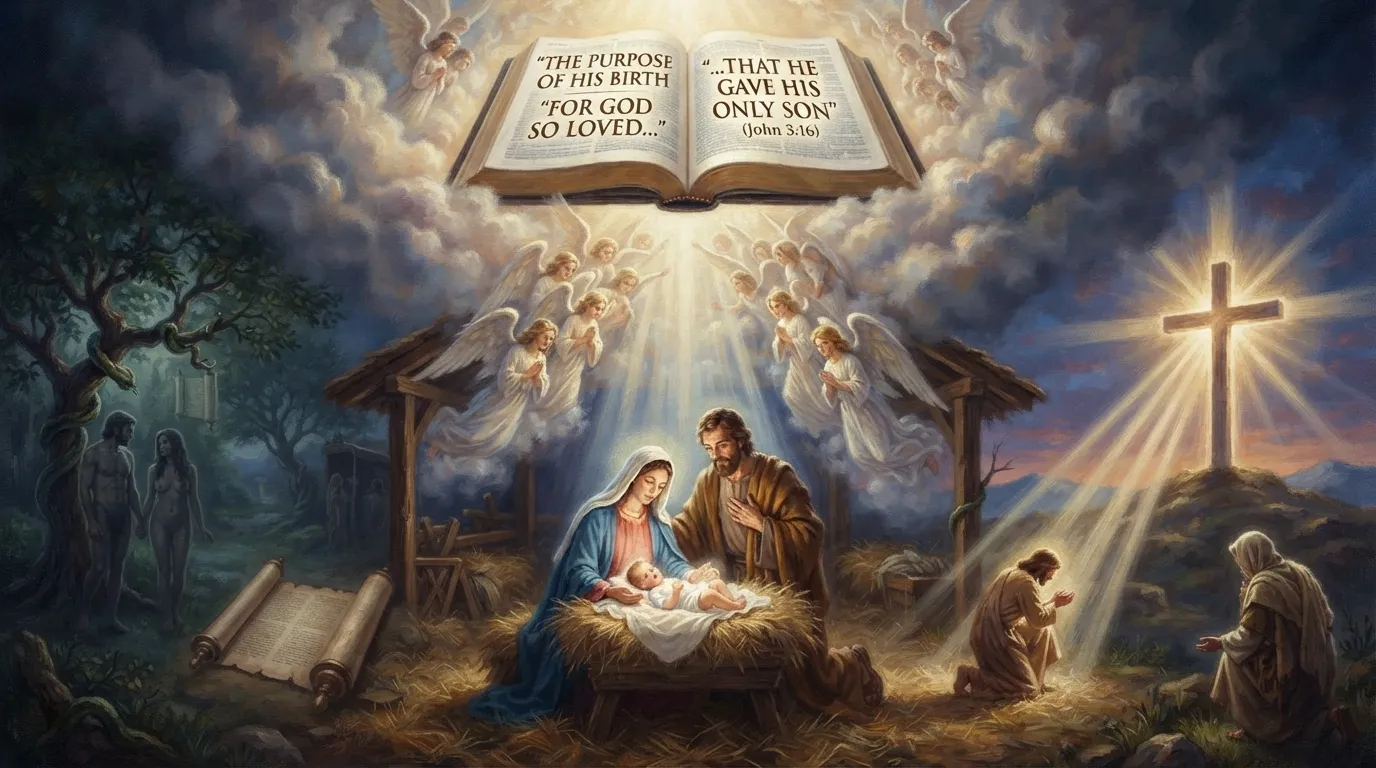
Imagine a quiet night when the world seemed ordinary. People were working, traveling, raising families, and waiting for God to act. Then, in a humble place in Bethlehem, a baby was born. His birth looked simple, but the Bible shows that it carried a purpose far greater than anyone around Him could fully understand. The birth of Jesus purpose meaning in the Bible points to God’s plan to bring salvation, reveal His love, fulfill His promises, and bring people back to Himself. The Christmas story is not only about a baby in a manger. It is about God’s grace entering human history and the beginning of a mission that would lead to the cross and resurrection.
Scene One: A Name Given Before the Birth
Before the manger, before Bethlehem, there was a message. The angel told Joseph that Mary would give birth to a Son and that His name would be Jesus “because he will save his people from their sins” (Matthew 1:21). That sentence is the clearest statement of purpose in the whole birth story. Jesus did not come into the world only to be a good teacher or an example of kindness. Scripture presents His birth as part of God’s great plan of redemption. Sin separates people from God and damages our relationship with Him. Jesus came to deal with the deepest problem of the human heart — and His later death on the cross shows how that saving purpose was fulfilled. His birth and His death cannot be separated. The manger points toward the cross.
The names surrounding His birth carry the whole message in miniature. Jesus comes into English through the Greek Iēsous and ultimately relates to the Hebrew name Yeshua, connected with Yehoshua. The name carries the idea of “Yahweh saves” or “the LORD saves” — which fits Matthew 1:21 exactly. And Immanuel, mentioned in Matthew 1:23, comes from the prophecy in Isaiah 7:14 and means “God with us.” Two central truths, held in two names: Jesus — God saves. Immanuel — God with us. The Bible does not teach that the Hebrew meaning of a name works like a magical formula. Instead, the meaning helps us understand the biblical message surrounding Jesus.
Scene Two: Bethlehem, the Small Town
Jesus’ birth did not appear suddenly without a biblical background. The Gospel writers connect His arrival with promises found throughout the Old Testament. Isaiah 7:14 speaks of a child called Immanuel, and Matthew 1:22–23 applies this passage to Jesus. Micah 5:2 identifies Bethlehem as the place associated with the coming ruler of Israel, and Matthew 2:1 records Jesus being born in Bethlehem.
Bethlehem was not the most powerful city in the ancient world. Yet God chose this humble place for the birth of the Messiah. That choice teaches a powerful spiritual lesson: God does not measure importance the way people often do. Jesus was not born in a palace surrounded by political power. He was born into humble circumstances. God’s greatest work may begin in places that look small, ordinary, or unnoticed — an encouragement to anyone who feels overlooked today. Your value before God is not determined by wealth, position, or public attention.
For centuries, God’s people had waited for the fulfillment of His promises. When Jesus was born, God’s plan began unfolding in a way many people did not expect. That is an important biblical theme: God keeps His promises even when His timing is difficult for people to understand.
Scene Three: The Manger
Luke 2:7 says Mary laid Him in a manger because there was no proper guest room available to them. A manger was a feeding trough. The Bible does not give a formal symbolic explanation of every detail of the scene, but the biblical story allows Christians to reflect on several meaningful truths. The promised King entered the world without earthly luxury. The contrast is striking — and Philippians 2:6–8 later describes Christ’s humility, showing that Jesus willingly humbled Himself and became obedient even to death on a cross. While Christians may use the manger as a symbol of humility, the central biblical truth is clear: Jesus entered human life in humility rather than worldly power.
There is another truth in the manger scene that is easy to miss. John 1:14 says that the Word became flesh and lived among us. Christian faith understands this as the incarnation: God the Son taking on human nature and entering the world as Jesus Christ. God did not remain distant from human suffering. In Jesus, people could see God’s character expressed through a human life filled with truth, grace, compassion, holiness, and love. The manger is where the incarnation became visible — God with us, in the humblest possible form.
Scene Four: Shepherds in the Night
Luke 2:8–20 tells us that shepherds were watching their flocks when an angel announced Jesus’ birth. The announcement is significant because the angel did not go first to a palace or a political leader. Ordinary shepherds received the news. The angel said that the Savior had been born and that this was good news of great joy for all people (Luke 2:10). God’s invitation is not limited to the wealthy, powerful, or socially important.
The shepherds responded by going to see Jesus. Then they returned glorifying and praising God. Their response gives a simple pattern for Christian faith: hear God’s truth, seek Christ, respond with worship. Luke 2:17 says they made known what they had been told about the child. The shepherds did not keep the news to themselves — and Christians can also share the hope of Christ through both words and actions.
Why He Was Born: Seven Purposes, One Mission
The New Testament gives several reasons for Jesus coming into the world. He was born to save sinners from their sins. To fulfill God’s promises made through Scripture. To reveal God’s character to humanity. To bring people into reconciliation with God. To become the promised Messiah. To bring light and hope to people living in darkness. To establish God’s kingdom through His ministry and saving work. To give eternal life to those who believe in Him. These purposes become clearer as we read the Gospels together rather than looking at the birth story alone.
His birth shows God keeping His promises, coming near to humanity, bringing salvation, and offering hope to a world affected by sin. Luke 2:10–11 records the angel’s announcement: the news was “good news of great joy,” and a Savior had been born. It was good news because humanity needed more than temporary comfort. People needed reconciliation with God.
What the Birth Means on an Ordinary Day
The meaning of Jesus’ birth is not limited to Christmas celebrations. It speaks directly to everyday Christian life.
First, God keeps His promises. Israel waited for God’s promises to unfold, and Jesus’ arrival demonstrates the importance of trusting God even during seasons of waiting. You may be praying about something today without seeing an answer. The Christmas story reminds you that God’s timing is not always the same as human timing.
Second, God comes near to the broken. Jesus’ life shows God’s compassion toward hurting people. He welcomed children, touched people who were rejected, forgave sinners, cared for the poor, and showed mercy to those who came to Him. His birth reminds Christians that God is not indifferent to human pain.
Third, salvation is more than self-improvement. The message of Jesus is not simply, “Try harder to become a better person.” Christian salvation depends on God’s grace and Christ’s saving work. Ephesians 2:8–9 emphasizes that salvation is by grace through faith, not something people earn through their own achievements. That gives hope to people who feel they have failed too many times.
Consider a Christian who has lost a job and feels uncertain about the future. The birth of Jesus does not promise a new job will appear tomorrow. But it reminds that person that God is faithful and that their worth is not measured by income. Consider someone who feels guilty about past mistakes. The message of Jesus points toward forgiveness and redemption rather than hopelessness. Consider someone who feels alone. The name Immanuel, “God with us,” reminds Christians of God’s presence and care. These are not promises that every problem will disappear immediately. They are reminders of biblical truths that can strengthen faith in difficult seasons.
Lessons From the Manger
The birth of Jesus provides practical lessons for ordinary Christian life. Trust God during waiting: Mary and Joseph faced uncertainty, but they continued to respond to God in faith. Waiting does not mean God has forgotten you. Choose humility: Jesus entered the world in humble circumstances, and Christians are called to follow His example rather than living only for status or recognition. Make room for Christ: the Christmas story can encourage believers to examine daily priorities — are you making time for prayer, Scripture, worship, service, and love? Faith is not only something we talk about. It shapes how we live. Share good news with others: the shepherds made known what they had been told, and Christians can do the same.
The greatest hope in the birth of Jesus is that God has acted to save. The world Jesus entered was not perfect. People still experienced grief, poverty, injustice, fear, sickness, and death. Jesus did not promise His followers would never experience suffering. Instead, He brought the promise of God’s kingdom, forgiveness, resurrection, and eternal life. John 3:16 summarizes God’s love: God gave His Son so that those who believe in Him may have eternal life. Christian hope is not based on having an easy life. It is based on knowing that God has not abandoned humanity and that Christ has accomplished the work of salvation.
The central purpose of Jesus’ birth was connected to God’s saving plan for humanity. Matthew 1:21 makes this especially clear: Jesus came to save His people from their sins. His birth also fulfilled God’s promises, revealed God’s presence among humanity, and began the earthly life of the Messiah whose mission would lead to His death and resurrection. So the Christmas story should not end with the manger. The manger points to the cross, and the cross points to the resurrection. Together, they tell the story of God’s redemptive work through Jesus Christ. If you are walking through uncertainty today, remember the hope at the heart of the Christmas message: God has not forgotten His promises. Take time to pray, read the Gospel accounts, and reflect on what Jesus’ birth means for your own faith. Let the story move you beyond celebration into deeper trust. The child in Bethlehem became the Savior on the cross and the risen Lord who offers hope and life. For a fuller account of the birth narratives, their historical setting, and how Christians have commemorated them, the Wikipedia article on the Nativity of Jesus brings the Gospel accounts and their background together.










