Imagine sitting with someone from a different culture, speaking a different language, and looking different from you. Yet when you both pray, you can call on the same God. You can both need grace, forgiveness, love, and hope. This raises an important question: Where did the different races and peoples of the world come from according to the Bible?
The origin of races meaning in the Bible points first to one powerful truth: all human beings come from God and share a common human origin. Scripture does not teach that God created separate kinds of human beings with different levels of worth. Instead, the Bible presents humanity as one family created in God’s image.
The story includes Adam and Eve, Noah’s family, the nations at Babel, and God’s plan to bring people from every nation to Himself through Jesus Christ. Understanding these passages can help Christians view race, culture, and human differences through the lens of Scripture rather than fear, pride, or prejudice.
What Does the Bible Say About the Origin of Races?
The Bible begins with one human family.
Genesis 1:26–27 says that God created human beings in His image. Both male and female were created by Him. This means every person has God-given dignity and value.
Genesis 3 then describes the fall of humanity into sin. The Bible does not divide humanity into separate creations after the fall. Instead, everyone shares the same human problem: sin and the need for God’s redemption.
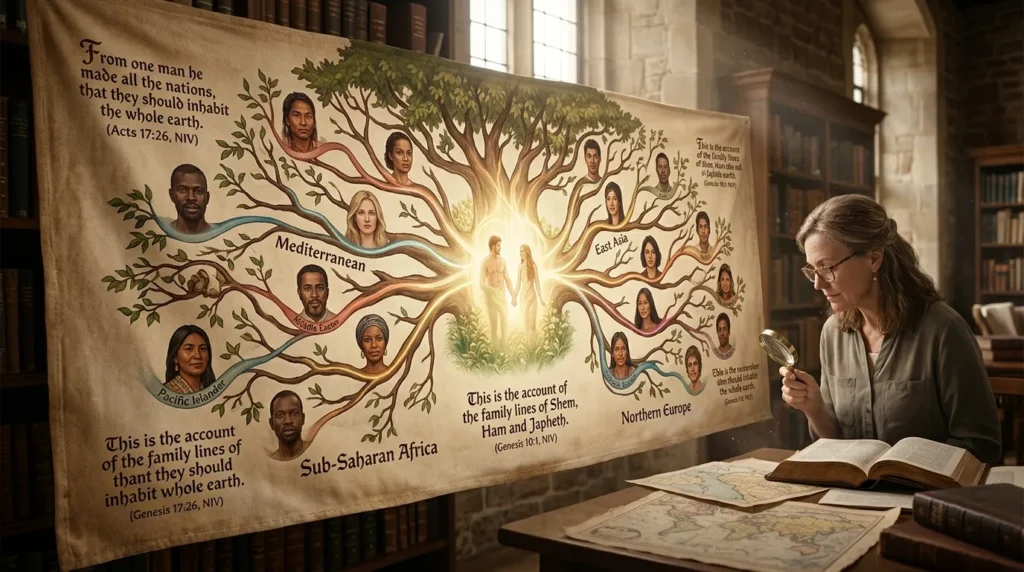
Acts 17:26 gives an especially clear statement. Paul teaches that God made every nation from one human origin and determined their appointed times and places.
So, from a biblical viewpoint, racial and ethnic differences do not mean that humanity has different origins. Humanity has one Creator and one shared human family.
Why Are There Different Peoples and Nations?
The Bible explains the development of different peoples through several important events.
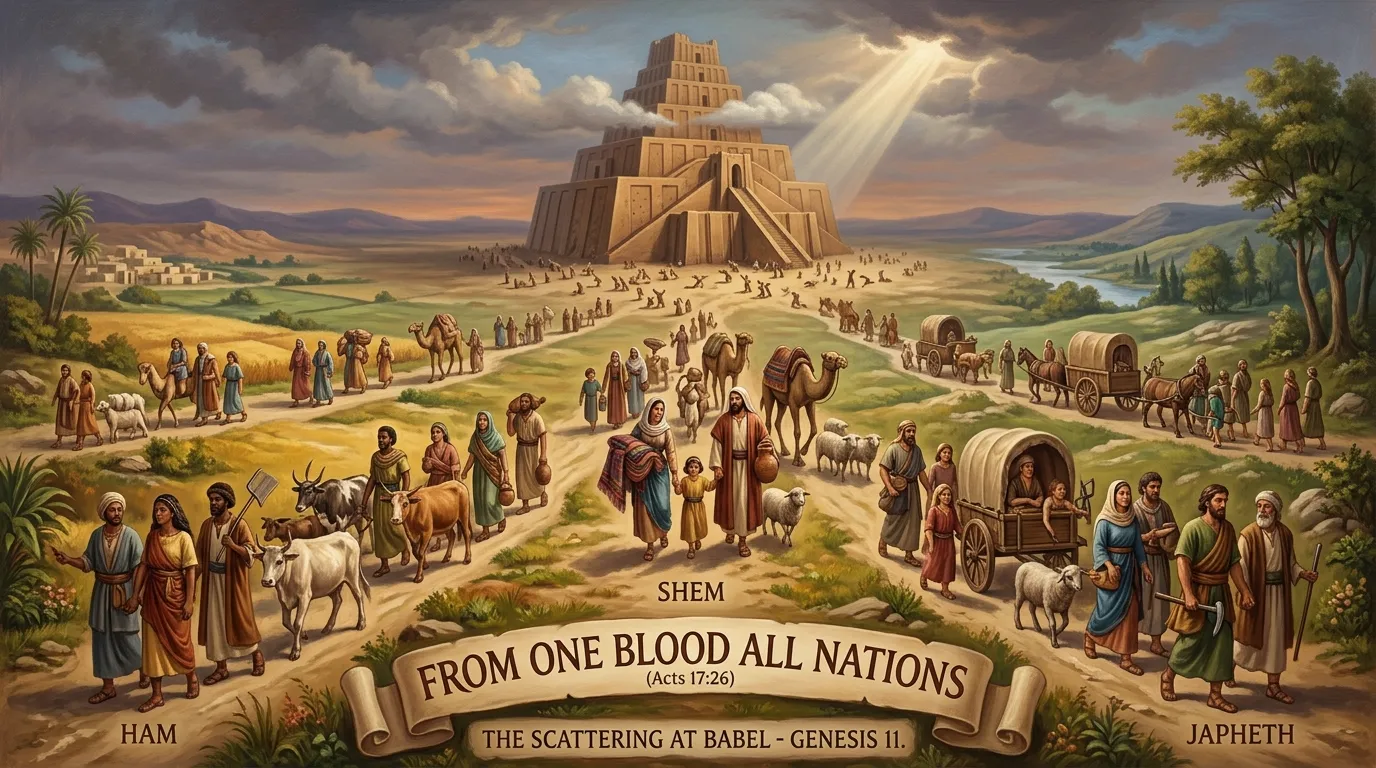
After the flood, Noah and his family became the human family from which later generations came. Genesis 9–10 describes Noah’s sons—Shem, Ham, and Japheth—and the families and nations that came from them.
Genesis 10 is sometimes called the Table of Nations. It describes the spread of many families and peoples after the flood.
This chapter is important because it shows that the Bible recognizes real differences among nations, languages, territories, and family groups. However, these differences do not cancel the shared dignity of humanity.
Different nations do not mean different human value.
The Tower of Babel and the Division of Languages
Genesis 11 gives another important part of the story.
The people of the earth gathered together and began building the Tower of Babel. Their goal reflected human pride and a desire to make a name for themselves apart from God’s will.
God confused their language, and the people scattered across the earth (Genesis 11:1–9).
Christians often connect this event with the development of different language groups and the spread of nations. Scripture clearly says that God confused their language and scattered them. However, the Bible does not give a detailed scientific explanation of modern racial categories.
That distinction matters.
Genesis 11 explains the division and scattering of peoples, but it should not be used to claim that modern racial categories are directly and perfectly mapped onto the biblical nations.
Modern ideas of race are much more complex than the categories described in Genesis.
Origin of Races Meaning in the Bible Hebrew Meaning
The phrase “origin of races” does not appear as a single Hebrew phrase in the Bible. Therefore, it is better to look at important Hebrew words connected with humanity, nations, families, and peoples.
One important Hebrew word is ’adam (אָדָם), connected with “man” or “humanity.” It is also associated with Adam, the first man in Genesis.
Another important word is goy (גּוֹי), which commonly refers to a nation or people. The plural form, goyim, is often translated as “nations.”
The Hebrew word mishpachah (מִשְׁפָּחָה) means family, clan, or family group. This idea is important in Genesis because Scripture often describes people according to families and clans.
These words help us see an important biblical pattern: Scripture speaks about humanity as one created family while also recognizing many nations, families, and peoples.
The Hebrew language itself does not support the idea that some human groups were created with greater worth than others.
Does the Bible Say There Are Different Human Races?
The Bible recognizes different nations, peoples, tribes, languages, and families. But it does not present modern racial categories in the same way people commonly use the word “race” today.
This is an important point for Christians.
The Bible’s main concern is not dividing people by skin color. Its larger story is about creation, sin, nations, covenant, redemption, and God’s kingdom.
Acts 17:26 points believers back to a common human beginning. Genesis 1:27 points to the shared image of God. And Revelation 7:9 looks forward to people from every nation, tribe, people, and language worshiping God together.
Together, these passages give a beautiful picture:
One Creator. One human family. Many peoples. One need for salvation. One Savior.
Does Skin Color Have a Biblical Meaning?
The Bible does not teach that skin color determines a person’s spiritual value, intelligence, morality, or closeness to God.
Human physical differences can be understood as part of the wonderful diversity found among people. Scripture, however, does not give a spiritual ranking system based on skin color.
The Christian message is much deeper.
A wealthy person and a poor person both need God’s grace. A person from one nation and a person from another nation can both belong to Christ. A person with one skin color and a person with another skin color are equally made in God’s image.
James 2:1–9 warns Christians against showing favoritism based on outward status.
God looks beyond the outward appearance and calls His people to love others with humility and fairness.
The Spiritual Meaning of Racial and Cultural Diversity
While the Bible does not assign secret spiritual meanings to every physical difference, it does give believers a powerful way to understand human diversity.
Diversity can remind us of God’s creativity and the broad reach of His kingdom.
Revelation 7:9 describes a great multitude from every nation, tribe, people, and language standing before God’s throne. They worship together because salvation belongs to God and to the Lamb.
This gives Christians a hopeful picture of eternity.
God’s kingdom is not limited to one culture, language, or ethnic group.
The gospel is for every people.
What Does Race Teach Us About God’s Character?
The biblical story of humanity reveals several important truths about God.
God Is the Creator of Every Person
Genesis 1 teaches that human life comes from God. Therefore, every person deserves dignity.
A Christian should never use racial differences as an excuse for hatred or cruelty.
God Is Not Limited to One Nation
From the Old Testament through the New Testament, God works among different peoples.
Israel had a special role in God’s covenant story, but God’s ultimate plan was always larger than one ethnic group. Through Abraham’s family, God promised blessing to the nations (Genesis 12:1–3).
God Desires Redemption for All Peoples
John 3:16 says God loved the world and gave His Son so that whoever believes in Him may have eternal life.
The word “world” points to the wide reach of God’s love.
No ethnicity is outside the invitation of the gospel.
What Does Jesus Teach About Race and People?
Jesus repeatedly crossed social and ethnic boundaries.
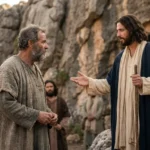
One powerful example is His conversation with the Samaritan woman in John 4. Jews and Samaritans had a long history of tension, yet Jesus spoke with her, treated her with dignity, and revealed important truth to her.
Jesus also told the story of the Good Samaritan in Luke 10:25–37.
The story challenged people to think differently about who their neighbor was. Jesus used a Samaritan as an example of compassionate love.
The lesson remains powerful today.
A Christian’s neighbor is not simply someone who looks like them, speaks like them, or comes from the same background.
Love crosses cultural and social boundaries.
The Bible’s Answer to Racism
The Bible does not use modern terms such as “systemic racism,” but it clearly condemns hatred, partiality, oppression, pride, and treating people as less valuable.
James 2 warns against favoritism. Jesus commands His followers to love their neighbors. Matthew 5:44 even calls believers to love their enemies and pray for those who persecute them.
Galatians 3:28 teaches that those who belong to Christ share a new spiritual identity in Him.
This does not mean Christians stop having different cultures or ethnic backgrounds. Rather, Christ becomes the deepest identity of the believer.
What Does “All Nations” Mean in the Bible?
The phrase “all nations” appears throughout Scripture.
God told Abraham that all families of the earth would be blessed through him (Genesis 12:3). The prophets looked forward to nations turning toward God. Jesus commanded His disciples to make disciples of all nations in Matthew 28:19.
Then Revelation gives the final picture of God’s people gathered from every nation.
This creates a powerful biblical storyline:
Creation → nations → promise → Christ → gospel to the nations → eternal worship.
The story is not about humanity becoming identical. It is about people from many backgrounds being brought together in God’s kingdom.
What Does the Origin of Races Mean in a Dream?
Some Christians may dream about different races, nations, skin colors, or groups of people and wonder whether the dream has a spiritual meaning.
The Bible does contain dreams that God used in specific situations. Joseph received dreams in Genesis. Daniel interpreted dreams. Joseph, the husband of Mary, was also warned through dreams in Matthew 1–2.
However, Christians should be careful.
Not every dream is a message from God.
Ecclesiastes 5:3 connects dreams with the concerns and activities of life. Dreams can also reflect emotions, memories, fears, and daily experiences.
If you dream about race or different peoples, it may simply reflect something you have recently seen, thought about, or experienced.
A believer can pray about the dream, but should always test spiritual impressions against Scripture, wisdom, prayer, and the character of God.
Never use a dream to create a doctrine that the Bible does not teach.
What If You See Different Races in a Spiritual Experience?
If an experience causes you to think about different peoples or cultures, Scripture gives you a healthy foundation for reflection.
Ask:
- Does this experience lead me toward love and humility?
- Does it agree with what Scripture teaches?
- Am I becoming more compassionate toward others?
- Am I making assumptions that the Bible does not make?
- Does this encourage me to pray for people from different nations?
- Is Christ becoming more central in my thinking?
These questions are more helpful than searching for secret meanings in every detail.
God’s Word should remain the foundation for Christian understanding.
Practical Christian Lessons About Race and Culture
The biblical teaching about humanity should affect everyday life.
Treat Every Person With Dignity
At work, school, church, or online, remember that every person is made in God’s image.
You do not have to agree with everyone to treat them with dignity.
Learn From Other Cultures
Christians can appreciate different languages, foods, traditions, music, and histories while keeping Christ at the center.
Cultural curiosity can become an opportunity to practice humility.
Reject Racial Pride
There is nothing wrong with appreciating your family or cultural heritage. The problem begins when pride becomes a reason to look down on others.
Christian identity is rooted in Christ, not superiority.
Pray for the Nations
Prayer can expand your heart.
You might pray for missionaries, persecuted Christians, unreached communities, immigrants, international students, or people from cultures you do not understand well.
This reflects God’s heart for the nations.
Common Questions
Did all races come from Adam and Eve?
Yes. The biblical story presents all humanity as coming from the first human family. Acts 17:26 also teaches that God made every nation from one human origin.
Did all races come from Noah?
According to the Genesis account, Noah’s family survived the flood, and Genesis 10 describes nations and peoples developing through Noah’s descendants.
Did the Tower of Babel create different races?
Genesis 11 clearly says God confused human language and scattered the people. However, Scripture does not explicitly say that Babel created modern racial groups or skin colors.
Does the Bible say one race is superior to another?
No. Scripture teaches that humanity is created in God’s image and that believers from every nation can belong to God’s family.
Is race more important than faith?
For Christians, faith in Christ becomes the central spiritual identity. Ethnic and cultural backgrounds remain meaningful, but they do not determine a person’s worth before God.
Does God love every nation?
Yes. Scripture repeatedly shows God’s concern for the nations, and Revelation 7:9 pictures people from every nation, tribe, people, and language worshiping Him.
Can dreams about race have spiritual meaning?
They can be personally meaningful, but Christians should not automatically treat them as divine messages. Dreams must be tested against Scripture and handled with wisdom.
What Christians Can Learn From the Biblical Story
The origin of races and nations points to several lasting truths.
First, God created humanity. Our existence is not accidental.
Second, every person carries human dignity. Genesis 1 gives this dignity to humanity as a whole.
Third, sin affects every people group. No nation or ethnicity is morally perfect.
Fourth, God’s grace reaches every nation. The gospel does not belong to one culture.
Fifth, Christians are called to love across human boundaries. Jesus made this clear through His teaching and example.
Finally, God’s future kingdom includes people from every nation. Revelation shows diversity gathered in worship rather than diversity used as a reason for division.
Conclusion
The origin of races meaning in the Bible is best understood through the larger story of Scripture. The Bible points to one Creator, one human family, many nations and peoples, and one great need for redemption.
Scripture does not support racial superiority. Instead, it teaches that every person is made in God’s image and that God’s saving purpose reaches people from every nation.
When questions about race, culture, dreams, or human differences arise, Christians do not need to chase hidden meanings or unsupported theories. We can return to God’s Word.
God created humanity. Christ came for the world. The gospel reaches every nation. And God’s people will one day worship Him together.
If this topic makes you think about your own attitudes toward people from different backgrounds, take a quiet moment to pray. Ask God to remove prejudice, pride, fear, or misunderstanding from your heart and replace them with love.
The Bible’s message is ultimately one of hope: different peoples can become one family in Christ.
Trust God’s Word, walk in humility, love your neighbor, and remember that God’s kingdom is far bigger than any one culture or nation.