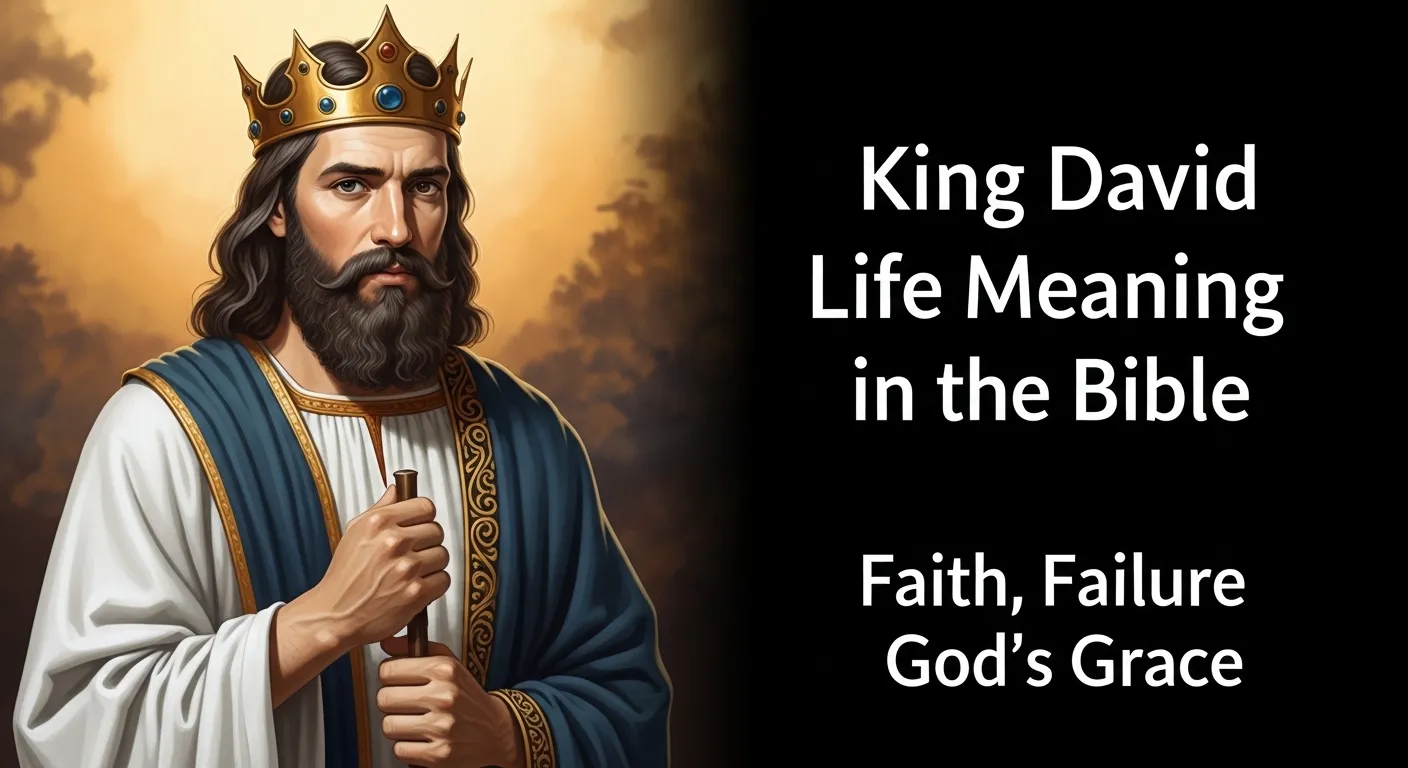
God’s own description of David is the most remarkable character reference in Scripture: “a man after my own heart” (1 Samuel 13:14; Acts 13:22). It was spoken about a man who committed adultery and murder, who numbered Israel in pride, who fled his own son’s rebellion, and who wrote psalms of despair as well as psalms of triumph. The life of King David in the Bible refuses to be either a hero story or a cautionary tale. It is both at once — and that is precisely its meaning. David is Scripture’s proof that God does not choose the qualified, He qualifies the chosen; and that the worst failures are not final for the heart that keeps turning back.
No Old Testament figure gets more space than David — his story runs from 1 Samuel 16 through 1 Kings 2, plus the Psalms, most of which tradition ascribes to him. The New Testament mentions him nearly sixty times. Jesus is called the Son of David more than any other title. To understand David is to understand the raw material of grace: what God does with an ordinary, gifted, deeply flawed human being who keeps coming home.
The Shepherd Nobody Noticed
David enters the story as an afterthought. When Samuel comes to anoint a new king from Jesse’s sons, Jesse parades seven of them and forgets the eighth — the youngest, out with the sheep. “Are these all the sons you have?” Samuel has to ask (1 Samuel 16:11). David is so far from anyone’s idea of a king that his own father does not think to call him.
But God had been watching the fields. “People look at the outward appearance, but the Lord looks at the heart” (1 Samuel 16:7) — the verse that governs David’s entire story. In the pasture, David had learned the two skills that would define his kingship: courage (he killed a lion and a bear defending the flock, 1 Samuel 17:34–36) and worship (the shepherd’s harp that would become the Psalms). Obscurity was his seminary. Before David led a nation, he led sheep; before he faced Goliath, he faced lions; before he wrote Scripture, he sang to no audience but God and the stars.
The meaning for the reader is direct: God prepares His servants in hidden places. The years that feel wasted — the night shifts, the unnoticed faithfulness, the work nobody applauds — are often the years God is doing His deepest work. David’s anointing came to a shepherd, not because shepherding was impressive, but because the heart formed in the fields was ready for the throne.
Goliath: The Battle That Made the Pattern
The valley of Elah is the most famous battlefield in Scripture, and David’s victory there established the pattern of his life: impossible odds, unconventional weapons, and absolute confidence in God rather than in himself. Goliath was over nine feet tall, armored head to foot, undefeated. David was a boy with a sling. But David’s pre-battle speech reveals where the real contest was fought: “You come against me with sword and spear and javelin, but I come against you in the name of the Lord Almighty” (1 Samuel 17:45).
Notice what David refuses: Saul’s armor. He tries it on and takes it off — “I cannot go in these, because I am not used to them” (1 Samuel 17:39). The detail is a parable. David would spend his life refusing to fight God’s battles with the world’s weapons, and his greatest failures would come when he forgot this lesson. The five smooth stones were not the point; the point was a boy who had learned, alone with God and the sheep, that “the battle is the Lord’s” (1 Samuel 17:47).
Victory made David famous — and fame nearly destroyed him. Saul’s jealousy drove him into years of fugitive life, hiding in caves, feigning madness among Philistines, gathering a band of misfits who became his mighty men. Twice he held Saul’s life in his hands — once cutting off a corner of his robe in a cave, once taking his spear while he slept — and twice he refused to strike “the Lord’s anointed” (1 Samuel 24:6; 26:9). The fugitive years were David’s second seminary: he learned mercy toward enemies, dependence in desperation, and the worship that poured out as psalms written in caves. “How long, Lord?” (Psalm 13:1) — the cries of the hunted shepherd-king became the prayer book of the church.
Bathsheba: The Fall and the Return
Then came the spring when “kings go off to war” and David stayed home (2 Samuel 11:1) — the most ominous sentence in his story. Idle, powerful, unaccountable, he saw Bathsheba, took her, and when she became pregnant, arranged the death of her husband Uriah — one of his own mighty men — to cover it. The progression is textbook: idleness, lust, adultery, deception, murder. The man after God’s own heart became, for a season, a man after his own appetites.
Nathan’s confrontation is the bravest sermon in the Old Testament. He tells a story about a rich man stealing a poor man’s lamb; David burns with anger — “the man who did this must die!” — and Nathan delivers the four words that split David’s life in two: “You are the man!” (2 Samuel 12:7). What happens next is why David is still called a man after God’s own heart: he does not spin, blame, or execute the prophet. He says, “I have sinned against the Lord” (2 Samuel 12:13). Five words. No excuses.
Psalm 51 is the anatomy of that repentance, and it remains the church’s deepest text on the subject: “Create in me a pure heart, O God” (Psalm 51:10). David asks not for the consequences to be removed — they were not; the child died, the sword never left his house — but for the relationship to be restored. “Against you, you only, have I sinned” (Psalm 51:4): David understood that every sin is ultimately against God, which is why only God can forgive it. The consequences taught him; the forgiveness restored him. Both were grace.
This is the meaning David’s failure holds for every reader who has failed badly: repentance is not the absence of consequences, and consequences are not the absence of forgiveness. God forgave David fully and disciplined him really. The same God does both today. The only unforgivable posture is the unrepentant one — and David, confronted, repented immediately.
The King Who Sang
David’s final decades were a mixture of triumph and sorrow: the kingdom united, Jerusalem taken, the ark brought home with dancing (2 Samuel 6:14); then Amnon and Tamar, Absalom’s rebellion, the flight from Jerusalem barefoot and weeping (2 Samuel 15:30). He died having secured the throne for Solomon and having prepared everything for the temple he was not permitted to build.
But his enduring legacy is not the kingdom. It is the Psalms. The shepherd’s harp became Israel’s hymnbook and the church’s prayer book — 150 psalms of praise, lament, confession, and hope, most of them his. David gave God’s people language for every human emotion brought before God: “My God, my God, why have you forsaken me?” (Psalm 22:1) — the cry Jesus would make His own on the cross. “The Lord is my shepherd” (Psalm 23:1) — the comfort of billions.
What makes the Psalms extraordinary is their emotional honesty. David does not edit his feelings for public consumption. “How long, Lord? Will you forget me forever?” (Psalm 13:1). “Why, Lord, do you stand far off?” (Psalm 10:1). “I am worn out from my groaning” (Psalm 6:6). And then, almost always, the turn — the moment lament becomes trust: “But I trust in your unfailing love; my heart rejoices in your salvation” (Psalm 13:5). David’s greatness was not that he never fell or never despaired; it was that he turned every falling, every fear, and every rising into worship. He shows believers that doubt brought to God is faith, while doubt nursed away from God is despair.
His final acts were preparation, not self-preservation. Forbidden to build the temple himself, David gathered “iron… bronze… cedar logs” in abundance (1 Chronicles 22:3–4), charged Solomon publicly — “Be strong and courageous… do not be afraid or discouraged, for the Lord God, my God, is with you” (1 Chronicles 28:20) — and prayed the prayer of 1 Chronicles 29, ascribing everything to God: “Yours, Lord, is the greatness and the power and the glory.” The king who had taken so much ended by giving everything away. “He died at a good old age, having enjoyed long life, wealth and honor” (1 Chronicles 29:28) — Scripture’s quiet verdict on a turbulent, grace-soaked life.
And the story’s final meaning is christological. God’s promise to David — “your house and your kingdom will endure forever” (2 Samuel 7:16) — outgrew David entirely and found its fulfillment in Jesus, the Son of David, whose kingdom truly has no end (Luke 1:32–33). Every flawed, repentant, worshiping step of David’s life was preparing the world for a perfect King from his line. The man after God’s own heart pointed, through all his stumbling, to the Man who was God’s own heart. For the historical dimensions of his reign beyond the biblical narrative, the Wikipedia article on David surveys the archaeology, the chronology debates, and his legacy across three faiths.










