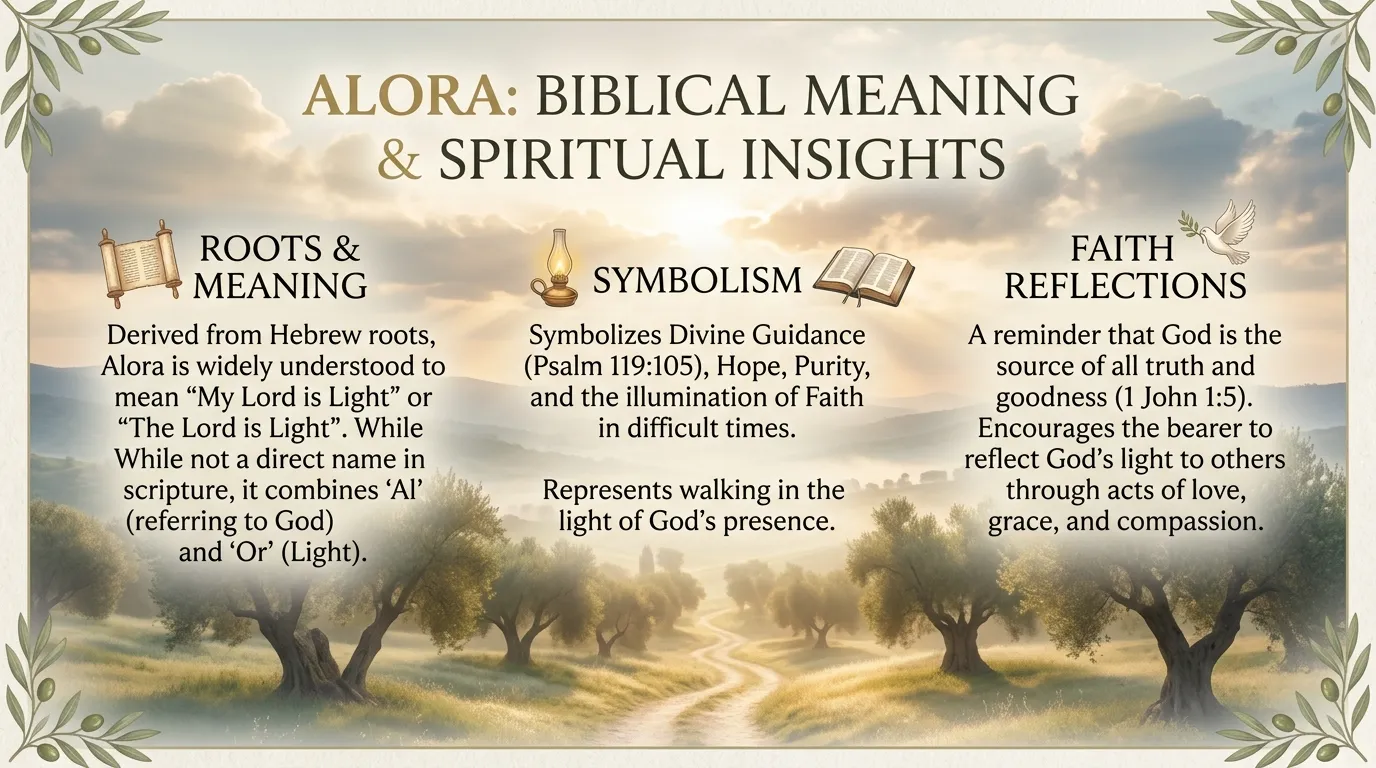
Alora is a name that sounds like morning. Say it aloud and it carries light in it — which is fitting, because the meanings most often attached to it involve light, dreams, and divine exaltation. But Alora does not appear in the Bible, and its precise origin is genuinely uncertain: some sources call it a variant of Elora, others link it to the Spanish town of Álora, others parse it from Hebrew elements meaning “my light” or “God is my light.”
Rather than pretending that uncertainty does not exist, this article will do something more useful: take the meanings people sense in the name — light, dream, divine nearness — and trace each one through Scripture. Whether or not Alora was coined from Hebrew, the Bible has profound things to say about everything the name evokes. And the question of how divine names are built — the theophoric tradition — turns out to be one of the most beautiful windows into how God’s people have always named their children.
The Light the Name Suggests
The association of Alora with light may come from the Latin alba (dawn, white) via Elora, or from a Hebrew parsing as “my light.” Either way, light is the Bible’s master metaphor for God’s presence and God’s people. “God is light, and in him is no darkness at all.” Jesus says, “I am the light of the world.” The new Jerusalem will need no sun, “for the glory of God gives it light.”
But the most personal light verse in Scripture may be the one David sings: “The Lord is my light and my salvation; whom shall I fear?” If Alora means “my light,” then the name is a first-person confession disguised as a noun. It does not say God is light in general. It says He is my light — the lamp for my path, the dawn after my night. That possessive pronoun is the whole difference between theology and faith.
Light in Scripture also carries a commission. Jesus tells His followers, “You are the light of the world,” and warns against hiding it under a basket. A name associated with light suggests a calling: to be visible, to be clarifying, to make things seen as they are. Light does not argue with darkness. It simply arrives, and the darkness leaves. That is a pattern for a life.
The Dream the Name Suggests
Another proposed meaning of Alora is “my dream.” If that is the resonance a family hears, Scripture’s teaching on dreams is worth knowing — because the Bible treats dreams with both seriousness and caution, a balance worth preserving.
God genuinely speaks through dreams in Scripture. Joseph’s dreams chart his rise. Pharaoh’s dreams warn of famine. Daniel interprets the dreams of kings. Joseph, the husband of Mary, is guided by dreams at every critical turn — to take Mary as his wife, to flee to Egypt, to return. The Bible never treats these as mere psychology. They are one of God’s communication channels.
But Scripture also warns that not every dream is from God. Jeremiah condemns prophets who claim “I have dreamed, I have dreamed” while speaking from their own imaginations. Ecclesiastes says that “a dream comes with much business.” The biblical rule is discernment: weigh the dream against God’s revealed word, test its fruit, and never let a nighttime impression override clear Scripture. A name meaning “my dream” can thus carry a gentle reminder — cherish God’s guidance, but test everything, and anchor the soul in the word that never changes.
How God’s People Build Names: The Theophoric Tradition
The most biblically grounded thing about Alora may be its shape. If the name does contain a divine element — the El of “God is my light” or the -ora of exaltation — then it belongs to the Bible’s great tradition of theophoric names: names that embed the name of God. Daniel, Emmanuel, Elijah, Elizabeth, Nathaniel, Gabriella — Scripture is crowded with names that are miniature theologies, carrying God inside the syllables.
The theophoric habit reveals something about how God’s people think. They do not merely believe in God as an idea. They weave Him into the most intimate parts of life — into what they call their children. Every time a parent calls “Daniel!” across a playground, they are unknowingly preaching “God is my judge.” Names become confessions, repeated daily, worn smooth by use. If Alora belongs to this tradition, even loosely, it continues the practice: a God-word carried in an ordinary name through ordinary days.
There is a New Testament echo of this instinct. Jesus gives Simon the name Peter — Rock — as a prophecy of what grace will make him. He nicknames James and John “Sons of Thunder,” with what sounds like affectionate humor. The early church keeps the habit: Barnabas is renamed “son of encouragement.” God’s people have always used names as tools of formation, speaking identity over one another until the identity takes root.
Uncertainty as an Invitation
It is worth pausing on the fact that Alora’s origin is uncertain — because the uncertainty itself teaches something. The modern name-meaning industry hates uncertainty; it prefers every name to have one crisp definition and one inspiring verse. But real etymology is often messy, and honesty about the mess is a Christian virtue. We do not need to manufacture a Hebrew pedigree for a name to find spiritual meaning in it. The meaning we find can be aspirational rather than historical: not “this is what the name meant in 1200 BC,” but “this is what we pray the name will mean in this child’s life.”
That shift — from archaeology to aspiration — frees parents from superstition. You do not need Alora to have been spoken by an ancient Hebrew mother for it to be a good name. You need only the intention to raise a child who knows the God of light, who listens for God’s voice, and whose life makes the divine nearness the name suggests into a lived reality. The name is a prayer, not a pedigree.
Morning Mercies: The Dawn Thread
If Alora carries the sound of dawn — through the Latin alba and its cousins — then Scripture’s dawn imagery belongs in this portrait. The Bible treats morning as the time of God’s renewed mercy. “Weeping may tarry for the night, but joy comes with the morning.” “His mercies are new every morning.” Hosea promises that God’s “going out is sure as the dawn.” The resurrection itself happens at dawn: the women come to the tomb “early, while it was still dark,” and the darkness does not survive the sunrise.
Dawn in Scripture is never just a time of day. It is a theological statement: no night is final. Every twenty-four hours, God preaches the resurrection to the whole planet — the light returns, the shadows retreat, and what was buried in darkness is revealed again. A name that sounds like morning carries that sermon in miniature. It says to its bearer and to everyone who speaks it: the night you are in is not the end of the story. Morning is coming, because morning always comes, because the God of morning cannot be stopped by any darkness.
This is why Christians have always loved to name and sing about dawn. The Benedictus calls Jesus “the dayspring from on high.” Hymns speak of “morning by morning new mercies I see.” To be named for the dawn is to be named for hope with a daily reminder built in — every sunrise a fresh preaching of the name’s promise.
A Blessing for the Name
Names in the Bible are frequently accompanied by blessings — spoken words that shape the future. Isaac blesses Jacob. Jacob blesses his sons. Jesus blesses the children brought to Him. If Alora is the name, here is a blessing in the biblical pattern, drawing on everything the name evokes:
May the Lord be your light and your salvation, so that you need not fear. May He guide you as He guided Joseph — through dreams tested by wisdom and confirmed by His word. May your name’s suggestion of divine nearness become true in experience: the God who is near, the God who answers, the God whose light no darkness overcomes. And may you, in turn, be light for others — a dawn in someone’s night, a lamp on someone’s path, a small reflection of the uncreated Light from whom all light comes.
That is more than a name can promise. But it is exactly what a name can pray. And prayer, as Hannah and a thousand psalmists discovered, is where all the best meanings begin.
The ancient habit of weaving God’s name into personal names — the tradition Alora’s shape echoes — is described in the study of theophoric names, which shows how cultures across the ancient world embedded the divine in the names of their children.










