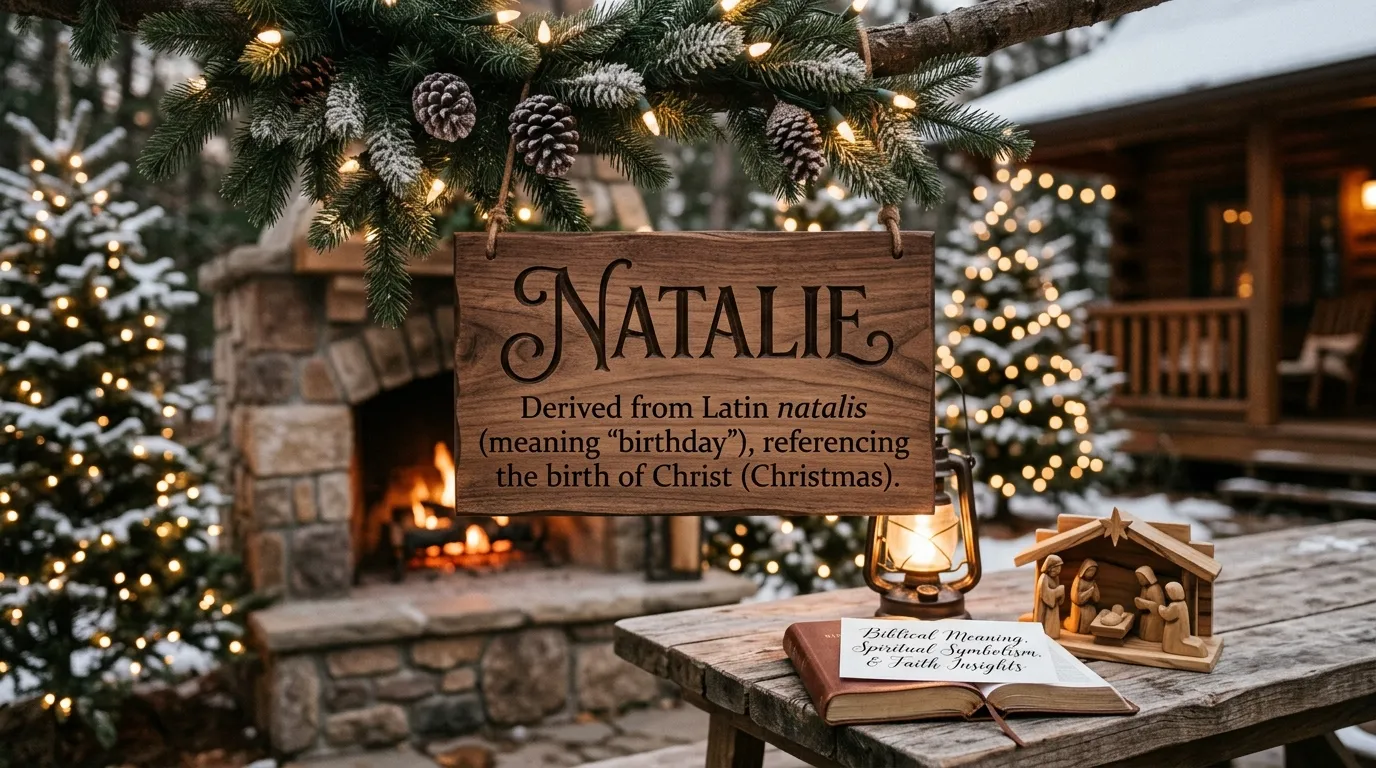
Natalie comes from the Latin natalis, meaning “birthday” — and in the early church, it meant one birthday in particular: the birthday of Christ. The name was traditionally given to girls born on Christmas Day, a living memorial of the Nativity. So while Natalie never appears in the Bible as a person’s name, it is one of the few modern names whose meaning points directly at the central event of the Christian faith. To be named Natalie is to be named after Christmas.
That connection shapes this whole article. Rather than hunting for a Hebrew root that does not exist, we will do something better: walk through the Christmas story itself and ask what it means to carry a name that commemorates it. The Nativity is not just a holiday. It is a theology — about who God is, who we are, and what He has done. A name that means “birthday of the Lord” deserves nothing less than the full story.
A Name Born on Christmas
The practice is ancient. In the early centuries of the church, children born on December 25 were sometimes named Natalie (or Natalia, Natasha — its Slavic cousin) as a permanent celebration of the day. The name was a calendar in miniature: every time it was spoken, it recalled the feast. In an age before printed calendars and anniversary reminders, a name could function as a memorial stone, keeping the community’s memory anchored to its founding event.
The church has always understood the power of such memorials. Israel stacked stones by the Jordan. The Passover meal retold the exodus annually. The Lord’s Supper proclaims Christ’s death “until he comes.” Naming a child Natalie belongs to this instinct — the refusal to let the central story fade. The name says: we will not forget what happened in Bethlehem. We will speak it every day, in the checkout line and the classroom, until the world asks what it means and we get to tell them.
The Night the Name Remembers
What exactly does the name commemorate? Luke’s account is spare and luminous. A decree goes out from Caesar Augustus. A young couple travels to Bethlehem. There is no room in the inn. The baby is born and laid in a manger — a feeding trough — because there is nowhere else. The first witnesses are shepherds, summoned by angels, who find “a baby wrapped in swaddling cloths and lying in a manger.”
Matthew adds the Magi, the star, and the flight to Egypt. John adds the theology: “The Word became flesh and dwelt among us.” But Luke’s details are the ones the name carries: the humility of the setting, the ordinariness of the parents, the glory breaking in from outside. Christmas, as the name remembers it, is not a celebration of human achievement. It is the celebration of divine arrival — God coming down, uninvited by our merit, into the mess.
Notice who is present at the first Christmas: an unwed mother, a confused fiancé, shepherds with a bad reputation, foreign astrologers, and a murderous king. The guest list is not respectable. That is the point. The birthday the name celebrates is God’s announcement that He comes for the unlikely, the overlooked, and the far-off. Every Natalie carries that guest list in her name.
Simeon and Anna: The Waiters
Two figures in the Christmas story deserve special attention from anyone named Natalie, because they show what it means to live in light of the Nativity. Simeon is described as “righteous and devout, waiting for the consolation of Israel.” The Spirit has promised he will not die before seeing the Lord’s Christ. When Mary and Joseph bring the infant Jesus to the temple, Simeon takes the child in his arms and sings the Nunc Dimittis: “Lord, now you are letting your servant depart in peace, according to your word; for my eyes have seen your salvation.”
Anna, the prophetess, is eighty-four, widowed after seven years of marriage, and has spent decades in the temple “worshiping with fasting and prayer night and day.” When she sees the child, she gives thanks and speaks of Him “to all who were waiting for the redemption of Jerusalem.” Two old saints, a lifetime of waiting, one baby — and it is enough. Their whole lives were a prolonged Advent, and Christmas, when it came, made every year of waiting worthwhile.
To bear a name meaning “birthday of the Lord” is to join their company: the waiters, the watchers, the ones who live oriented toward God’s arrival. Simeon and Anna did not merely celebrate Christmas once. They structured their lives around the expectation of it. The name invites its bearer to do the same — to live as someone for whom Christ’s coming, past and future, is the organizing fact of existence.
The Saint and the Name Day
The name also has a martyr’s pedigree. Saint Natalia of Nicomedia, honored in both Eastern and Western traditions, was the wife of Saint Adrian, a Roman officer martyred for his Christian faith in the early fourth century. Natalia stood by her husband through his imprisonment and execution, tending to the martyrs and encouraging them — and she is venerated as a saint in her own right. Her feast is kept on September 8 in some calendars and December 26 in others, the day after Christmas, as if the church could not quite separate her from the Nativity.
In Orthodox and Catholic cultures, a “name day” — the feast of the saint whose name one bears — is celebrated much like a birthday. For a Natalie, the name day is a second annual reminder of the name’s meaning: not only the birthday of the Lord, but the witness of those who found that birthday worth dying for. Natalia’s story adds steel to the name’s sweetness. Christmas is not only angels and candlelight. It is also the beginning of a story that leads, by way of the cross, through martyrdom and into glory. The name can carry both the cradle and the courage.
What “Birthday of the Lord” Means as a Vocation
A name that commemorates an event carries a subtle commission: embody what you memorialize. What would it mean to live as a small, walking Christmas? The Nativity suggests several answers.
First, humility. The Lord of the universe was born in a stable and laid in a feeding trough. There is no version of the Christian life that outgrows that humility. Whatever success, recognition, or comfort comes, the manger stands at the beginning as a permanent corrective: God does His greatest work in the lowest places.
Second, welcome. The Christmas story is about God making room — for shepherds, for Gentiles, for sinners. A life named after that story should be a life that makes room: for the awkward, the outsider, the inconvenient. Hospitality is not a personality trait. It is a Nativity-shaped virtue.
Third, joy. The angel’s announcement is “good news of great joy that will be for all the people.” Joy is not the absence of trouble — Mary would learn that soon enough — but the presence of a promise that trouble cannot cancel. The name Natalie is, at bottom, a joy-name. It commemorates the day heaven’s joy broke into earth’s sorrow and never left.
The Other Birthday: Being Born Again
There is one more birthday the name can point to, and Jesus Himself supplies it. Speaking to Nicodemus, He says, “You must be born again.” The new birth — regeneration, the Spirit’s work of making dead hearts alive — is the second nativity every Christian experiences. And it is, in a sense, what the first nativity makes possible: Christ was born so that we could be reborn.
This gives the name a double meaning worth treasuring. Natalie commemorates Christ’s birthday, and it can also commemorate the bearer’s own spiritual birthday — the day she passed from death to life. Many Natalies can point to such a day, and the name becomes a quiet testimony to it: I am named for a birth, and I have experienced one. The name on the birth certificate points to the name written in the Lamb’s book of life.
And the story is not finished. The same Jesus whose birthday the name celebrates has promised to return. The church’s calendar moves from Advent to Christmas to Epiphany, but history itself is moving toward a final Advent — the day the Lord comes again, not in a manger but in glory. To be named Natalie is to live between two birthdays of the Lord: the one in Bethlehem, already accomplished, and the one at the end of history, still to come. The name is a reminder that Christmas was the first arrival, not the last.
The events the name commemorates are recounted in the historical and theological account of the Nativity of Jesus, which traces how the birth narratives have shaped two millennia of Christian faith and celebration.










