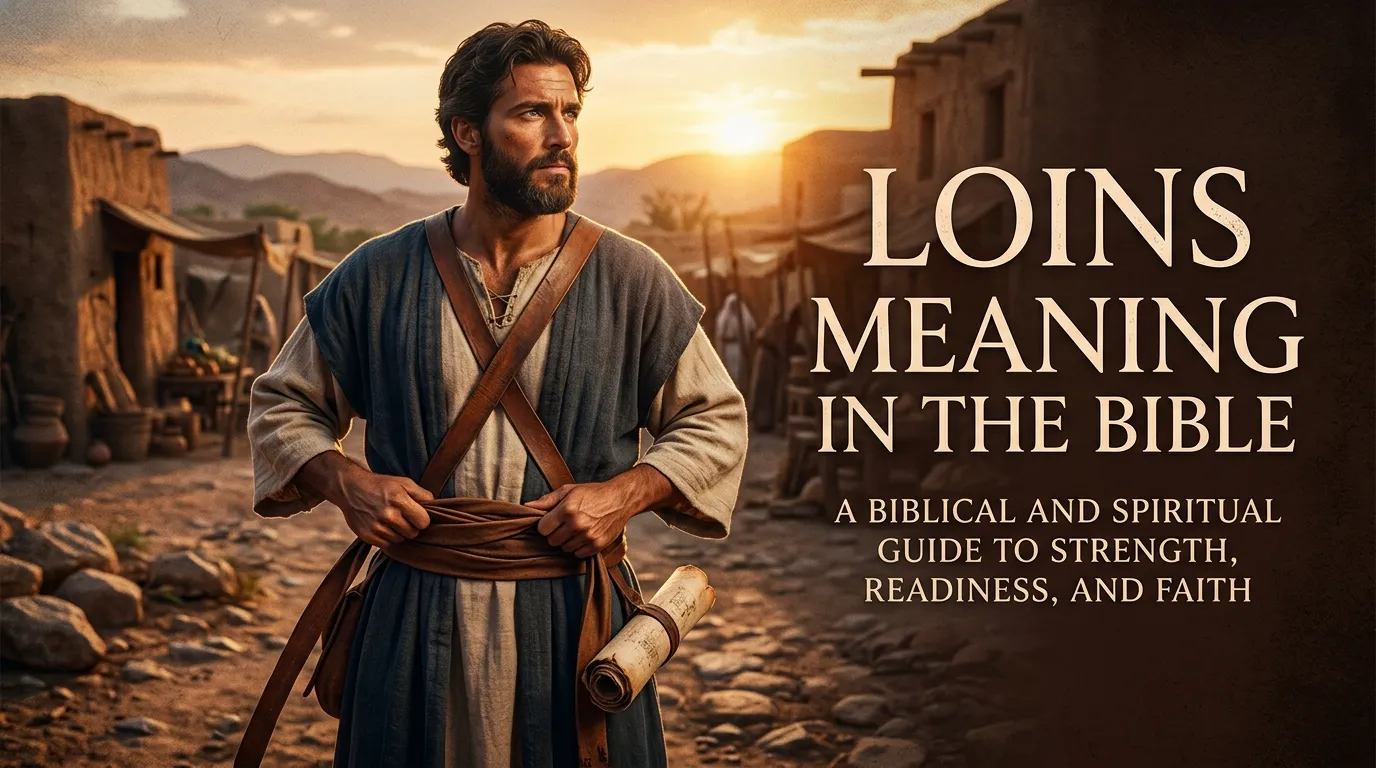
“Gird up your loins.” “He girded his loins.” Modern readers trip over this phrase the way they’d trip over the long hem it describes — because to understand it, you have to see the clothing. In the biblical world, both men and women wore a long, tunic-like robe. For everyday life it was comfortable; for work, running, or battle it was a hazard. The solution was simple and universal: gather the flowing fabric, tuck it into the belt at the waist, and free the legs. That action — girding up the loins — became one of Scripture’s richest pictures of readiness, strength, and resolve.
The Wardrobe Behind the Metaphor
The “loins” are the hips and lower back — the body’s center of strength, the place where power gathers for lifting, running, and fighting. The belt (girdle) cinched the robe at exactly that point. So “gird up your loins” meant: prepare for action. It was what you did before a journey, before labor, before battle. The opposite — letting the robe hang loose — meant leisure, rest, or unreadiness.
Once you see the clothing, the passages come alive. At the first Passover, Israel ate with “your belts fastened, your sandals on your feet, and your staff in your hand. And you shall eat it in haste” (Exodus 12:11). They were dressed for departure — dinner as a departure lounge. The girded loins said: we are ready to move the moment God says go. Four centuries of slavery ended with a people already dressed for freedom.
Elijah Outruns a Chariot
One of the most vivid girdings in Scripture is also one of the strangest: after the showdown on Mount Carmel, “the hand of the LORD was on Elijah, and he gathered up his garment and ran before Ahab to the entrance of Jezreel” (1 Kings 18:46). Ahab was in a chariot. Elijah was on foot. And the old prophet outran the king’s horses through the rain.
The text pointedly notes the sequence: the hand of the LORD was on Elijah — then he girded up — then he ran. Human preparation plus divine empowering. Elijah did not wait for a supernatural wind to carry him; he tucked his robe and ran, and God’s hand made the running miraculous. This is the Bible’s pattern for strength: God’s power flows through prepared people, not passive ones. Girding the loins is our part; the hand of the LORD is His. The loins passage quietly rebukes both presumption (expecting God to act while we lounge) and self-reliance (running without His hand).
The Belt as Honor: Gifts, Prophets, and Priests
The girdle was more than workwear — it could be a gift of honor. When Jonathan made covenant with David, “Jonathan stripped himself of the robe that was on him and gave it to David, and his armor, and even his sword and his bow and his belt” (1 Samuel 18:4). The prince’s belt on the shepherd’s waist: a transfer of status, a pledge of loyalty, almost a sharing of identity. To give your belt was to give your strength — and Jonathan gave his to the friend he loved as himself.
Prophets were marked by their belts. Elijah was identified to the king by a single detail: “He wore a garment of hair, with a belt of leather about his waist” (2 Kings 1:8) — and the king knew instantly, “It is Elijah the Tishbite.” John the Baptist deliberately dressed the same way: “a garment of camel’s hair and a leather belt around his waist” (Matthew 3:4). The leather belt became prophetic uniform: simplicity, readiness, wilderness austerity. When you saw the belt, you knew the man — and you knew his message would not flatter.
Priests, too, were girded — but with splendor, not leather. The high priest’s sash, woven of “gold, blue and purple and scarlet yarns, and fine twined linen” (Exodus 28:8), girded the ephod at the waist. Same action — cinching at the loins — utterly different meaning: not the laborer’s readiness but the mediator’s glory. The belt said: this one is prepared to stand between God and the people. From the field hand’s rope to the high priest’s gold, the girdle gathered every calling at the same place: the loins, the seat of strength, offered up and bound for service.
And in the final vision, the risen Christ appears to John “clothed with a long robe and with a golden sash around his chest” (Revelation 1:13) — the girdle ascended from waist to chest, from work to reign. The One who girded Himself with a towel to wash feet (John 13:4-5) now wears gold. Every girding in Scripture was pointing here: strength bound in service, service crowned in glory.
When God Says It to Job
The phrase takes a startling turn in the book of Job. After thirty-seven chapters of human debate about suffering, God speaks from the whirlwind: “Dress for action like a man; I will question you, and you make it known to me” (Job 38:3). Literally: gird up your loins like a man. The Almighty tells the sufferer to get ready — not for battle against enemies, but for an encounter with Mystery itself.
The irony is deliberate and tender. Job had demanded answers; God invites him to stand ready to receive them — and the “answers” turn out to be a tour of creation’s wonders that silences every question by overwhelming it with glory. Girding the loins before God means preparing not to argue but to listen: tightening the belt of the mind for revelation rather than debate. Sometimes readiness means bracing for wonder.
Loins as the Seat of Strength — and of Promise
Beyond readiness, “loins” carried two deeper associations. First, strength: “He gives power to the faint… ” no — more precisely, Isaiah pictures God’s own might at the waist: “Righteousness shall be the belt of his waist, and faithfulness the belt of his loins” (Isaiah 11:5). The Messiah’s strength is moral — righteousness and faithfulness are what gird Him. True power, Scripture insists, is character under pressure.
Second, fruitfulness and lineage: children were said to come “from the loins” — God promised Jacob that “kings shall come from your own body [loins]” (Genesis 35:11). The loins were the fountain of the future, the place of generative power. This is why the phrase can carry such weight: it touches both what you do (strength for action) and what you leave behind (a legacy).
The New Testament Carries It Forward
Peter takes the old idiom and aims it at the mind: “Therefore, preparing your minds for action [girding up the loins of your mind], and being sober-minded, set your hope fully on the grace that will be brought to you” (1 Peter 1:13). Mental girding — gathering the loose, flapping thoughts, tucking in distractions, getting the mind ready to run the race of hope. In an age of scattered attention, this is a daily discipline: gird the mind each morning before the world ungirds it.
And Paul arms the believer at the waist: “Stand therefore, having fastened on the belt of truth” (Ephesians 6:14). In the armor of God, the belt comes first — everything hangs from it. Truth is what holds the Christian’s life together; without it, every other piece of armor slips. The girdle that once held a robe now holds reality itself.
What does “gird up your loins” mean for me today?
It means intentional readiness: spiritually (a mind prepared by Scripture, not surprised by trials), practically (a life ordered so you can respond when God calls), and morally (character tightened against compromise). Ask each morning: what needs tucking in — what distraction, what loose end — so I can move when God says move?
Why does the Bible use such a strange phrase?
Because it was not strange to them — it was as ordinary as “roll up your sleeves.” Biblical metaphors draw from daily life precisely so that truth sticks to memory. The strangeness we feel is just distance; the meaning is as current as ever: get ready, stay ready, run ready.
From Passover haste to Elijah’s rain-soaked sprint to the armor of God, the girded loins preach one sermon: the prepared are the used. Tuck in the robe, tighten the belt of truth, and be ready to move when heaven says go.
And here is the final encouragement for the tired: girding is a grace before it is a duty. Before God ever told us to gird our loins, He girded Himself for our rescue. Isaiah pictures the LORD putting on “righteousness as a breastplate, and a helmet of salvation on his head… he put on zeal as a cloak” (Isaiah 59:17) — God, girding for battle for us. And Jesus, on the night He was betrayed, “rose from supper… and girded himself with a towel” to wash His disciples’ feet (John 13:4). The Almighty girds to fight for you; the Master girds to serve you. Every command to gird ourselves is carried by the prior reality of a God who girded Himself for us. So tighten the belt — not in your own strength, but in the strength of the One who was girded first.
For the garment itself, see the article on the girdle.










