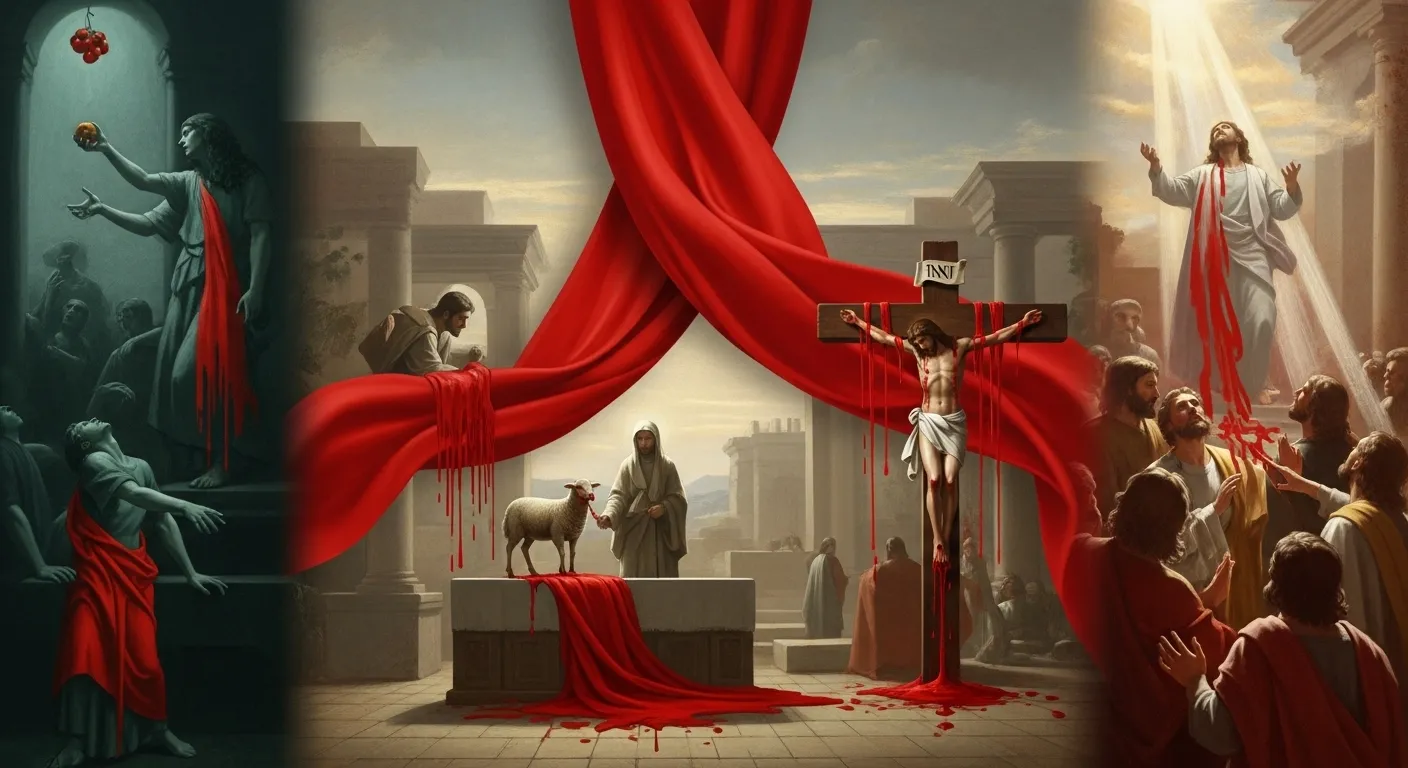
Tie a scarlet cord in your window, the spies told Rahab, and when the city falls your household will live (Joshua 2:18). It is one of the most memorable reds in Scripture — a thread of dyed wool hanging from a window in a doomed city, marking the one house death would pass over. But Rahab’s cord is not an isolated image. It is the first visible link in a scarlet thread that runs the entire length of the Bible: through the tabernacle curtains, the cleansing rituals, the prophets’ promises, the cross, and even the wardrobe of the apocalypse’s villain. Follow the thread. It tells the whole story.
A Cord in a Window
Start where the thread first appears. Rahab was a Canaanite prostitute in a city under divine sentence — by every measure, on the wrong side of everything. Yet she hid the spies, professed faith in Israel’s God (“the Lord your God, he is God in the heavens above and on the earth beneath,” Joshua 2:11), and received her instructions: gather your family into your house, and hang the scarlet cord where we can see it.
When Jericho’s walls fell, “Joshua saved alive” Rahab and her household (Joshua 6:25), and the New Testament remembers her twice — for faith (Hebrews 11:31) and for works (James 2:25). The scarlet cord functioned exactly like the Passover blood: a red sign, visibly displayed, marking a household for mercy. And the mercy overflowed every boundary — Rahab married into Israel and became an ancestor of Christ (Matthew 1:5). The scarlet thread’s first lesson: God’s red-marked mercy finds whoever hangs the sign, regardless of pedigree. Scarlet is the color of the outsider welcomed in.
Scarlet in the Cleansing Rites
The thread next appears in the rituals for the unclean. When a leper was pronounced clean, the priest took “cedarwood and hyssop and scarlet yarn” (Leviticus 14:4) for the ceremony of restoration — the scarlet dipped in blood and water, sprinkled toward the healed person. The red heifer ritual likewise burned “cedarwood and hyssop and scarlet yarn” with the ashes used for purification from contact with death (Numbers 19:6).
Scarlet in these rites is the color of re-entry: the leper restored to community, the defiled restored to worship. It always appears with blood and water — the two agents of cleansing — as if the color itself were part of the medicine. The sermon is quiet but persistent: uncleanness is real, restoration is possible, and the color of the cure is red. Every scarlet strand in the ritual whispered what the cross would one day shout.
Woven Into Worship
Scarlet also clothed God’s house. The tabernacle curtains were woven with “blue and purple and scarlet yarns” (Exodus 26:1), and the high priest’s ephod and breastpiece carried the same three colors (Exodus 28:5–6). Worship in Israel was a scarlet-accented affair — not because God likes red aesthetically, but because every approach to Him ran through atonement, and atonement’s color is blood’s color.
There is a domestic echo too, often missed: the virtuous woman of Proverbs 31 has her household “clothed in scarlet” (Proverbs 31:21) — in context, warm, doubled garments against the snow, the sign of a household provided for and protected. Scarlet as care. The same dye that marked the leper’s cleansing and the priest’s garment also marked a well-kept home. The thread keeps turning up wherever God — or God’s people — are taking care of someone.
Snow From Scarlet
Then the prophets take the thread and tie it into the gospel’s bow. “Though your sins are like scarlet, they shall be as white as snow; though they are red like crimson, they shall become like wool” (Isaiah 1:18). Scarlet and crimson were the ancient world’s permanent dyes — the colors that never washed out. God deliberately chooses the unwashable as His image of guilt, then promises the impossible: the permanent will be reversed, the stain will become snow.
The verse is the scarlet thread’s theological center. All the ritual scarlets — the cord, the yarn, the curtains — were pointing here: to a cleansing so complete it reverses the irreversible. The thread that marked Rahab’s house, that restored the leper, that dressed the priest, now becomes a promise spoken to every stained conscience: what scarlet describes, grace can undo.
The Counterfeit Scarlet
But the thread has a shadow twin, and honesty requires facing it. Revelation’s great harlot — the symbol of seductive, persecuting world power — is “arrayed in purple and scarlet” (Revelation 17:4). The same dye. The opposite meaning. Here scarlet is not mercy but seduction, not cleansing but corruption — the color of a system drunk on power and “the blood of the saints” (Revelation 17:6).
The counterfeit works because it borrows the real thing’s wardrobe. Scarlet means glory, and glory can be holy (the tabernacle) or hellish (the harlot) — the color does not adjudicate; the wearer does. This is why Scripture never lets any symbol, even a God-given one, become a mechanical code. The scarlet of Rahab saves; the scarlet of Babylon damns. Same thread, opposite ends. Discernment — not color-matching — tells them apart.
The soldiers’ scarlet robe on Christ belongs in this gallery too: “they stripped him and put a scarlet robe on him” in mockery (Matthew 27:28). The counterfeit kingship draped on the true King — and the true King wore it to the cross, where His own scarlet, His blood, would accomplish what all the ritual scarlets had rehearsed.
The counterfeit has one more appearance, and it is the beast itself. John sees “a woman sitting on a scarlet beast that was full of blasphemous names” (Revelation 17:3) — not merely dressed in scarlet but riding it. The system of seduction is mounted on the power of persecution; the harlot’s luxury and the beast’s violence are one machine. Scarlet here is the color of the whole anti-kingdom: its wealth, its war, its worship of self. Against it stands the rider on the white horse (Revelation 19:11) — and the color contrast is the moral contrast. Two riders, two colors, two eternities. The scarlet beast goes to “destruction” (Revelation 17:8); the white horse goes to a wedding supper (Revelation 19:9). The thread that began in Rahab’s window ends at the fork every soul must take: ride the scarlet beast, or follow the white horse.
Lips Like a Scarlet Ribbon
The thread ends, beautifully, in the Song of Songs: “Your lips are like a scarlet thread” (Song of Solomon 4:3). After judgment and cleansing and counterfeit, scarlet becomes a love poem — the color of beauty, delight, and intimate joy. It is a fitting final appearance. The scarlet that began as a prostitute’s lifeline in a doomed city ends as a bridegroom’s praise of his bride’s beauty. From rescue to romance: that is the trajectory of grace.
Scarlet and the Bride
The scarlet thread’s final contrast is a tale of two wardrobes. Revelation dresses two women: the harlot, “arrayed in purple and scarlet” (Revelation 17:4), and the bride, granted “fine linen, bright and pure” — “for the fine linen is the righteous deeds of the saints” (Revelation 19:8). The harlot’s scarlet is seduction and power, bought with “the blood of the saints” (Revelation 17:6). The bride’s white is righteousness, given by grace. Same book, opposite colors, opposite destinies.
The contrast is the thread’s last sermon on discernment. Scarlet looks glorious — that is why the counterfeit works. The harlot’s wardrobe is genuinely splendid; Babylon’s scarlet is real dye, real wealth, real splendor. Its damnation is not in its color but in its source: glory seized rather than received, beauty in service of corruption. The bride, meanwhile, wears white she did not earn — “it was granted her to clothe herself” (Revelation 19:8). Granted. Given. The difference between the two wardrobes is the difference between the two gospels: one says take, the other says receive.
And here the thread ties its final knot. The scarlet that began with Rahab — a prostitute marked for mercy — ends with a prostitute-city marked for judgment, while the true bride wears the white that scarlet-sinners were promised in Isaiah 1:18. Rahab’s scarlet led to the wedding; Babylon’s scarlet leads to the fire. The thread never lied. It always pointed to the same fork in the road: mercy received, or mercy refused.
Follow the scarlet thread through Scripture and you have walked the whole gospel: mercy for the outsider (Rahab), cleansing for the unclean (Leviticus), worship woven with atonement (the tabernacle), the impossible promise (Isaiah), the counterfeit exposed (Revelation), the King in the robe of mockery (Matthew), and love’s final poetry (the Song). One dye, one thread, one story — the story of a God who marks houses for mercy and keeps every promise the color ever made. The history of scarlet dye and its cultural meanings — from ancient textiles to cardinals’ robes — shows how enduring this color’s association with both glory and guilt has been; Scripture got there first, and tied it into a cord of grace.










