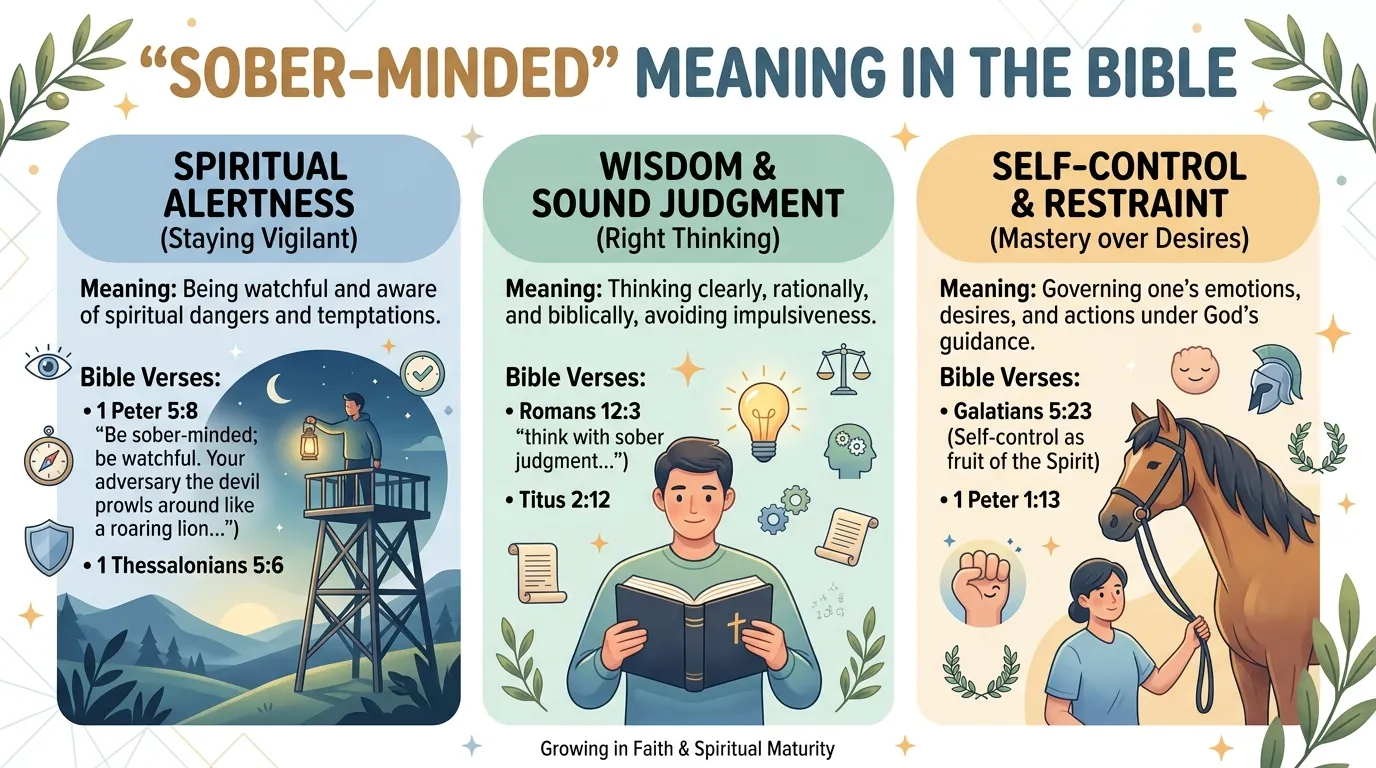
The New Testament has a word for the opposite of the distracted, reactive, foggy-headed life so many of us live. It is usually translated “sober-minded” — and it has almost nothing to do with alcohol. The Greek verb is nepho, which literally means to be free from intoxicants, but the apostles use it metaphorically: to be mentally clear, spiritually alert, and morally steady. In a world engineered to keep you outraged, entertained, and numb by turns, sober-mindedness is one of the most countercultural virtues Scripture commands.
The Watchman’s Word: Why Peter Reaches for It
Peter uses sober-mindedness in the most urgent contexts. “Be sober-minded; be watchful. Your adversary the devil prowls around like a roaring lion, seeking someone to devour” (1 Peter 5:8). The image is a night watchman, not a casual observer. A drowsy sentry gets the camp killed. Peter’s logic is sobering in itself: spiritual danger is real, it is predatory, and it hunts the inattentive. Sober-mindedness is not a personality trait for the naturally disciplined; it is combat readiness for everyone.
Peter pairs the command with its anchor: “Humble yourselves, therefore, under the mighty hand of God… casting all your anxieties on him, because he cares for you” (1 Peter 5:6-7). This is crucial. Anxiety is one of the great intoxicants — it clouds judgment exactly like wine does. Peter’s prescription for alertness is not white-knuckled effort but transferred weight: hand the anxieties to God, and the mind clears. You cannot be sober-minded while clutching worries; you become sober-minded by casting them.
Earlier in the same letter, Peter had already made it a foundational discipline: “Therefore, preparing your minds for action, and being sober-minded, set your hope fully on the grace that will be brought to you at the revelation of Jesus Christ” (1 Peter 1:13). The phrase “preparing your minds for action” translates a vivid idiom — literally, “gird up the loins of your mind.” Alertness is something you do, like a runner tying shoes before the race. And its object is hope: sober-mindedness is not grim vigilance but hopeful vigilance, eyes fixed on grace.
Paul and the Thessalonians: Sober in the Night
Paul uses the same word for the church’s posture toward Christ’s return: “So then let us not sleep, as others do, but let us keep awake and be sober. For those who sleep, sleep at night, and those who get drunk, are drunk at night. But since we belong to the day, let us be sober” (1 Thessalonians 5:6-8). The contrast is day versus night — clarity versus stupor. The world sleeps through spiritual reality; the church stays awake to it.
Paul then tells us what sober-minded people wear: “having put on the breastplate of faith and love, and for a helmet the hope of salvation.” Sober-mindedness is not bare alertness; it is alertness armored by faith, love, and hope. The sober mind is protected at the heart (faith and love guard the motives) and at the head (hope guards the thoughts). This is deeply practical: you cannot think clearly about your life if your heart is unguarded by trust and your mind is unguarded by hope.
To Timothy, Paul ties sober-mindedness to courage: “God gave us a spirit not of fear but of power and love and self-control [sober-mindedness]” (2 Timothy 1:7). Timothy was timid, facing hardship and opposition. Paul’s answer was not “try harder” but “remember what Spirit you received.” Sober-mindedness is a gift before it is a task — the Spirit Himself steadies the mind.
Titus and the Generations: Sober-Mindedness at Every Age
Paul’s letter to Titus makes sober-mindedness an all-generations virtue. Older men are to be “sober-minded, dignified, self-controlled, sound in faith, in love, and in steadfastness” (Titus 2:2). Young men are to be urged likewise to be self-controlled (Titus 2:6) — the same Greek root. Older women and younger women receive their own parallel instructions. The point: no age outgrows the need for clarity. The young need it against impulsiveness; the old need it against cynicism and drift.
This democratization matters. Sober-mindedness is not for pastors, monks, or the temperamentally calm. It is the ordinary Christian’s operating system — the mental posture in which faith, love, and hope actually function. A church of sober-minded people is a church that cannot be stampeded by panic, seduced by novelty, or numbed by comfort.
The Sober Leader: Why Elders Must Be Clear-Headed
When Paul lists qualifications for church leadership, sober-mindedness appears with striking prominence. An overseer must be “sober-minded, self-controlled, respectable” (1 Timothy 3:2); older men in the congregation likewise (Titus 2:2). Deacons, too, must be “dignified, not double-tongued, not addicted to much wine” (1 Timothy 3:8) — the literal and metaphorical sobriety side by side. Why does leadership require this virtue so explicitly?
Because unclear leaders create unsafe churches. A leader intoxicated by flattery makes decisions to please rather than to serve. A leader drunk on authority confuses control with shepherding. A leader numbed by comfort avoids the hard conversations holiness requires. A leader swept by every new trend (“tossed to and fro by the waves,” Ephesians 4:14) leads the flock onto the rocks. The qualifications assume what experience confirms: the leader’s inner state becomes the congregation’s atmosphere. Sober-minded shepherds produce steady sheep; intoxicated shepherds scatter them.
There’s a personal application beyond office-holders: everyone leads someone — children, friends, coworkers, younger believers watching your life. The sober-mindedness required of elders is the sober-mindedness required of every influencer, which in the age of social media means nearly everyone. Before you post, before you advise, before you react: is the mind clear? The qualification for the pulpit is the qualification for the platform, the kitchen table, and the group chat.
What Intoxicates the Mind (Besides Alcohol)
Scripture’s metaphor invites an honest inventory. What clouds your judgment the way wine clouds a drunkard’s? For many today, the intoxicants are digital and emotional: outrage — the constant drip of anger that makes measured thought impossible; entertainment — the endless scroll that keeps the mind stimulated but never still enough to pray; anxiety — rehearsing catastrophes until faith feels naive; busyness — motion mistaken for purpose; flattery and success — which intoxicate as surely as failure depresses.
Proverbs saw it long ago: “Wine is a mocker, strong drink a brawler, and whoever is led astray by it is not wise” (Proverbs 20:1). The principle generalizes: whatever leads you astray from wisdom is your wine. Sober-mindedness begins with naming your intoxicants honestly. You cannot abstain from a drug you refuse to identify.
Practices of a Sober Mind
How does one become sober-minded? Scripture suggests practices, not just willpower:
1. Begin with the Word before the world. The mind takes the shape of its first inputs. “The fear of the LORD is the beginning of wisdom” (Proverbs 9:10) — start the day with Scripture and prayer, and the day’s noise meets a mind already anchored.
2. Practice the pause. “Be quick to hear, slow to speak, slow to anger” (James 1:19) is sober-mindedness in one sentence. Build delays between stimulus and response — in arguments, in purchases, in posts. The sober mind is the unhurried mind.
3. Cast anxieties daily, specifically. Peter’s command is present-tense and continuous: keep casting. Name the worries, hand them over, refuse to take them back. Journaling prayers makes this concrete.
4. Keep company with the alert. “Whoever walks with the wise becomes wise” (Proverbs 13:20). Sober-mindedness is contagious — and so is stupor. Choose voices that clarify rather than inflame.
5. Remember the return. Paul anchors sobriety in eschatology: we belong to the day because the Day is coming. Living toward Christ’s return orders every smaller decision. The sober-minded live with the end in view.
6. Confess the fog quickly. The sober mind is not the mind that never clouds — it’s the mind that notices the cloud and brings it to God immediately. “If we confess our sins, he is faithful and just to forgive us” (1 John 1:9) applies to mental drift too: the wandering attention, the entertained resentment, the nursed anxiety. Short accounts keep the mind clear; unconfessed fog accumulates into stupor. The watchman who admits “I’m getting drowsy” can be relieved — the one who denies it falls asleep on duty.
Is sober-mindedness the same as being serious all the time?
No. Jesus was sober-minded and also the guest who made the best wine at a wedding and was accused of being a glutton for enjoying meals with sinners. Sober-mindedness is clarity, not gloom — it actually protects joy, because the intoxicated mind cannot sustain it. The sober mind laughs freely because it is not laughing to escape.
What if my mind feels anything but clear?
Start where Peter starts: humility and casting. Tell God the fog is real, hand Him the specific anxieties feeding it, and take one small step of obedience. Clarity often follows obedience rather than preceding it. And if mental fog persists, seek help — counselors, doctors, pastors — without shame; God works through means.
In an age of manufactured outrage and endless distraction, the sober-minded Christian is a quiet miracle: clear-headed, steady-hearted, unafraid — awake while the world sleeps, armored in faith, love, and hope. For the broader concept across traditions, see sobriety.










