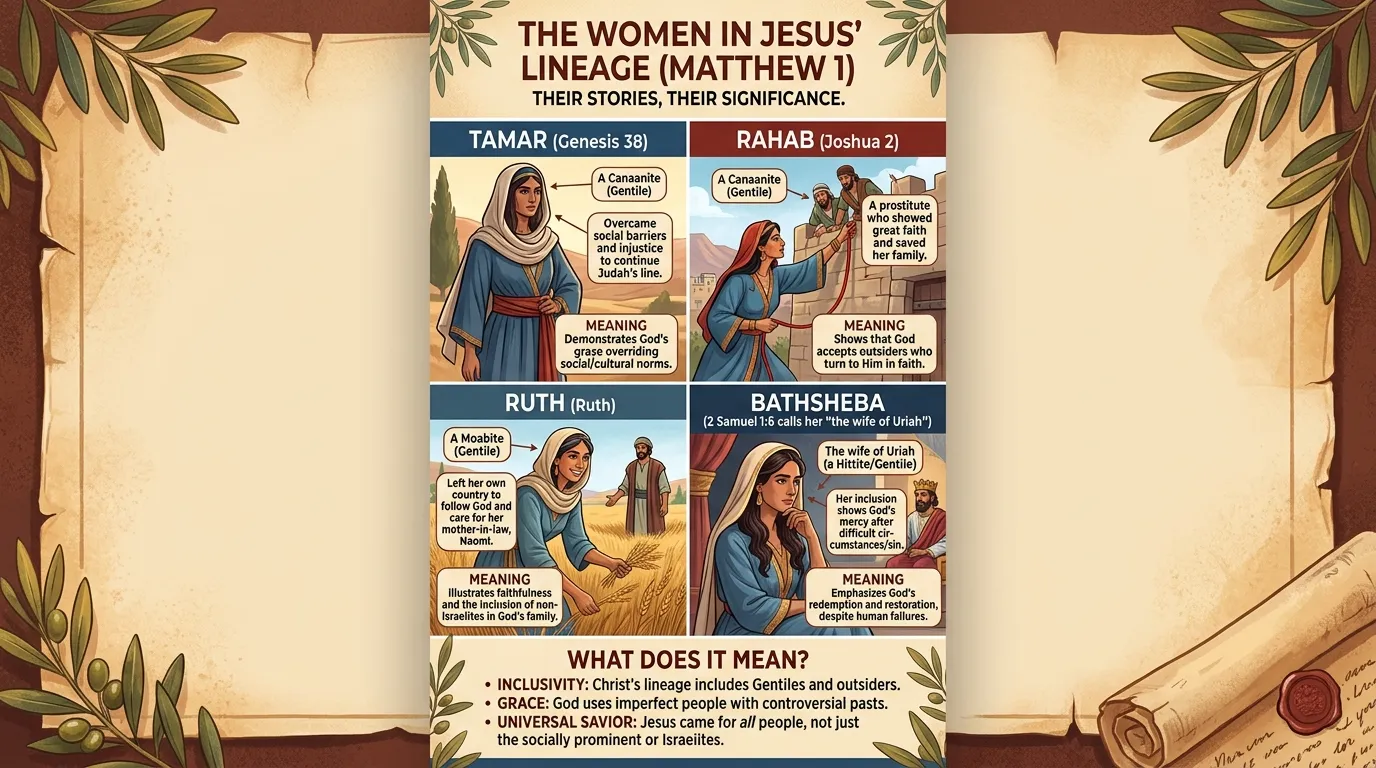
Matthew’s genealogy of Jesus contains a surprise that no ancient reader would have expected. In a list of fathers and sons, five women appear by name: Tamar, Rahab, Ruth, Bathsheba, and Mary. Ancient genealogies rarely mentioned women at all, and when they did, they chose the respectable ones. Matthew chose the opposite. He named a widow who was denied justice, a prostitute from a condemned city, a foreign widow from a despised nation, a woman whose story began with adultery and murder, and a young girl whose pregnancy could have ruined her. The women in Jesus’ lineage are not decorations. They are the proof that the genealogy is a story of grace.
Each of these women carries a story that would have been a scandal in her own day, and each of them is placed in the line of the Messiah without apology. Matthew does not explain them away. He does not soften their stories. He names them, and by naming them, he declares that God’s promise moves through people the world overlooks, despises, or condemns. To understand the women in Jesus’ lineage is to understand the gospel itself: that God saves through grace, not through pedigree.
Tamar: The Widow Who Demanded Justice
Tamar’s story is told in Genesis 38, one of the most uncomfortable chapters in the Bible. She was married to Er, the eldest son of Judah. Er died. Under the law of levirate marriage, Er’s brother Onan was to marry Tamar and raise up an heir for his brother. Onan refused, and he died as well. Judah promised his third son, Shelah, to Tamar, but he delayed, fearing that Shelah would die too. Tamar was left in limbo — a widow, childless, neither married nor free, with no future.
Tamar took matters into her own hands. She disguised herself as a prostitute, waited on the road where Judah would pass, and conceived twins by him. When Judah learned she was pregnant, he ordered her burned. Then she produced his seal, cord, and staff — the proof that he was the father — and Judah confessed, “She is more righteous than I.” The twins, Perez and Zerah, were born, and Perez became the ancestor of David and of Jesus.
Tamar’s inclusion in the genealogy is a statement about justice. She was a woman who had been denied what was owed to her, who took a desperate and morally ambiguous action to claim it, and who was vindicated by the very man who had condemned her. Her story is not a model of perfect behaviour. It is a picture of a God who works through flawed people and broken systems to preserve His promise. The line of the Messiah begins with a widow who refused to be forgotten.
Rahab: The Outsider Who Believed
Rahab was a Canaanite prostitute living in Jericho, the city that stood between Israel and the promised land. When Joshua sent two spies to scout the city, Rahab hid them on her roof, lied to the king’s men, and helped the spies escape through her window. In return, she asked for one thing: that when Israel destroyed Jericho, her family would be spared. The spies agreed, and when the walls fell, Rahab and her family were saved.
Rahab’s story is remarkable for two reasons. First, she was a Gentile, a Canaanite, a member of the very people Israel had been commanded to destroy. Her inclusion in the genealogy declares that the promise to Abraham — that all nations would be blessed through him — was already at work. Second, she was a prostitute, a woman whose profession placed her at the margins of respectable society. Her inclusion declares that grace reaches the margins. The writer of Hebrews lists Rahab among the heroes of faith, alongside Abraham, Moses, and David. James cites her as an example of faith demonstrated by works. The New Testament remembers her not for her past but for her faith.
Rahab married Salmon, a prince of Judah, and their son Boaz became the husband of Ruth. The Canaanite prostitute became the mother of the line that would produce the king. Her story is a preview of the gospel: that faith, not pedigree, is what makes a person part of God’s family, and that the outsider who believes is more truly a member of the family than the insider who does not.
Ruth: The Foreigner Who Clung to Naomi
Ruth was a Moabite, a member of a nation that Israel regarded with hostility. The Moabites were descendants of Lot’s incestuous union, and the law of Moses excluded them from the assembly of the Lord. Ruth was also a widow, childless, and poor. She had every reason to return to her own people when her husband died. Instead, she clung to her mother-in-law Naomi and said, “Where you go I will go, and where you stay I will stay. Your people will be my people and your God my God.” It is one of the most quoted speeches in Scripture, and it is spoken by a foreign widow with no status and no prospects.
Ruth’s loyalty was rewarded. She gleaned in the fields of Boaz, a wealthy relative of Naomi’s husband, and Boaz noticed her. He protected her, provided for her, and eventually married her as her kinsman-redeemer. Their son Obed became the grandfather of David. The book of Ruth ends with a genealogy, and its final word is David. The whole story is a picture of redemption: a foreigner brought into the covenant, a widow given a home, an empty family given a future.
Ruth’s inclusion in the genealogy is a statement about inclusion. The line of the Messiah already contained a Moabite, a member of a nation that the law had excluded. The gospel’s welcome to the Gentiles was not a new idea. It was the fulfilment of a pattern that had been present from the beginning. The promise to Abraham was always for all nations, and Ruth is the proof.
Bathsheba: The Woman Behind the Scandal
Matthew does not name Bathsheba directly. He calls her “the wife of Uriah,” a phrase that deliberately recalls the scandal. David saw Bathsheba bathing, took her, and when she became pregnant, arranged for her husband Uriah to be killed in battle. The child died. Nathan the prophet confronted David, and David repented. Bathsheba later became the mother of Solomon, the king who built the temple.
Matthew’s phrasing — “the wife of Uriah” — is a refusal to let the reader forget what happened. It is the only place in the genealogy where a woman is identified by her first husband rather than by her own name, and the effect is to keep the scandal visible. The genealogy does not airbrush David’s sin. It names the woman whose story is bound up with it, and it places her in the line of the Messiah. The inclusion of Bathsheba is a statement about grace: that God’s promise survived David’s worst sin, and that the woman who was sinned against became the mother of the king who built God’s house.
Bathsheba’s story is also a reminder that the women in the genealogy were not merely passive figures. Bathsheba acted to secure Solomon’s succession when David was old and Adonijah was plotting to take the throne. She intervened with David, reminded him of his promise, and ensured that the promise passed to Solomon. Her agency mattered. The genealogy remembers her not only as a victim but as a mother who shaped the future of the kingdom.
Mary: The Young Woman Who Said Yes
Mary is the final woman in the genealogy, and she is different from the others. The other four entered the line through marriage, through scandal, or through redemption. Mary entered it by giving birth. Matthew’s genealogy ends with a grammatical shift: where every other entry says “the father of,” the final entry says, “Joseph, the husband of Mary, and Mary was the mother of Jesus who is called the Messiah.” The chain of fathers breaks. The line passes through a woman.
Mary was a young woman from Nazareth, engaged to Joseph, when the angel Gabriel appeared and announced that she would conceive a child by the Holy Spirit. Her response — “I am the Lord’s servant. May your word to me be fulfilled” — is one of the great acts of faith in the Bible. She accepted a pregnancy that could have destroyed her reputation, her engagement, and her life. She carried the child, gave birth in Bethlehem, and watched Him grow, teach, die, and rise again. The genealogy that began with Tamar ends with Mary, and the pattern is complete: God works through women whom the world overlooks, and the greatest act of God in history came through a young woman’s yes.
The women in Jesus’ lineage, taken together, tell a single story: that God’s promise is carried by grace, not by respectability. Tamar, Rahab, Ruth, Bathsheba, and Mary were widows, foreigners, prostitutes, victims, and nobodies. They were the people the world would have passed over. God placed them in the family tree of His Son, and by doing so, He declared that His family is open to everyone. The women in the Bible include many more whose stories repay attention, but these five, named in the genealogy of Jesus, stand as the clearest proof that grace writes the family tree.